2026-06-09T16:12:52Z
https://oai.datacite.org/oai
doi:10.1594/pangaea.770425
2025-06-27T05:11:15Z
PANGAEA
PANGAEA.REPOSITORY
15
PANGAEA.REPOSITORY
10.1594/PANGAEA.770425
Wilhelms-Dick, Dorothee
Dorothee
Wilhelms-Dick
Westerhold, Thomas
Thomas
Westerhold
0000-0001-8151-4684
Röhl, Ursula
Ursula
Röhl
0000-0001-9469-7053
Vogt, Christoph
Christoph
Vogt
0000-0002-5376-9011
Hanebuth, Till J J
Till J J
Hanebuth
0000-0002-2833-3320
Römmermann, Helge
Helge
Römmermann
Kriews, Michael
Michael
Kriews
Kasten, Sabine
Sabine
Kasten
0000-0001-7453-5137
Quantitative LA-ICP-MS data obtained from sediment core GeoB12309-5 (0.4 mm resolution)
PANGAEA
2012
DEPTH, sediment/rock
Aluminium
Aluminium, standard deviation
Silicon
Silicon, standard deviation
Potassium
Potassium, standard deviation
Calcium
Calcium, standard deviation
Titanium
Titanium, standard deviation
Iron
Iron, standard deviation
Rubidium
Rubidium, standard deviation
Strontium
Strontium, standard deviation
Zirconium/Sodium ratio
Zirconium/Sodium, standard deviation
Lead
Lead, standard deviation
Gravity corer
Laser-ablation inductively coupled plasma quadrupole mass spectr. (LA-ICP-Q-MS)
M74/3
Meteor (1986)
2007-11-08T09:16:00
Dataset
10300 data points
text/tab-separated-values
Licensing unknown: Please contact principal investigator/authors to gain access and request licensing terms
Data access is restricted (moratorium, sensitive data, license constraints)
62.9978666666666
24.8716833333333
OMZ 950
doi:10.1594/pangaea.701728
2024-02-17T11:12:32Z
PANGAEA
PANGAEA.REPOSITORY
16
PANGAEA.REPOSITORY
10.1594/PANGAEA.701728
Dick, Dorothee
Dorothee
Dick
Kriews, Michael
Michael
Kriews
Rare earth elements determined in ice core EDML by laser-ablation inductively coupled plasma quadrupole mass spectrometry (La-ICP-Q-MS) in 269-270 m depth
PANGAEA
2008
DEPTH, ice/snow
Sodium ion
Sodium, standard deviation
Magnesium
Magnesium, standard deviation
Aluminium
Aluminium, standard deviation
Potassium
Potassium, standard deviation
Manganese
Manganese, standard deviation
Iron
Iron, standard deviation
Cobalt
Cobalt, standard deviation
Nickel
Nickel, standard deviation
Zinc
Zinc, standard deviation
Strontium
Strontium, standard deviation
Cadmium
Cadmium, standard deviation
Barium
Barium, standard deviation
Lanthanum
Lanthanum, standard deviation
Cerium
Cerium, standard deviation
Lead
Lead, standard deviation
Bismuth
Bismuth, standard deviation
EPICA drill
Laser-ablation inductively coupled plasma quadrupole mass spectr. (LA-ICP-Q-MS)
EPICA-Campaigns
Kohnen Station
European Project for Ice Coring in Antarctica (EPICA)
Alfred Wegener Institute, Helmholtz Centre for Polar and Marine Research, Bremerhaven
https://ror.org/032e6b942
2001-01-10T00:00:00/2006-01-17T00:00:00
Dataset
5052 data points
text/tab-separated-values
Licensing unknown: Please contact principal investigator/authors to gain access and request licensing terms
Data access is restricted (moratorium, sensitive data, license constraints)
Only values exceeding the DL and the lowest concentrated standard are shown.
0.0684
-75.0025
Fifth Framework Programme
https://doi.org/10.13039/100011104
EVK2-CT-2000-00077
European Project for Ice Coring in Antarctica
Fourth Framework Programme
https://doi.org/10.13039/100011105
ENV4980702
European Project for Ice Coring in Antarctica
doi:10.1594/pangaea.721796
2024-07-21T09:21:28Z
PANGAEA
PANGAEA.REPOSITORY
12
PANGAEA.REPOSITORY
10.1594/PANGAEA.721796
Bryant, C J
C J
Bryant
Arculus, Richard J
Richard J
Arculus
0000-0002-3432-392X
Eggins, Stephen M
Stephen M
Eggins
0000-0002-0007-5753
(Table DR1) Chemical element concentrations in sediments from DSDP Hole 60-459
PANGAEA
1999
DEPTH, sediment/rock
AGE
Sample code/label
Silicon dioxide
Niobium
Caesium
Europium
Ytterbium
Hafnium
Tantalum
Thorium
Uranium
Lanthanum
Cerium
Praseodymium
Neodymium
Samarium
Gadolinium
Dysprosium
Erbium
Drilling/drill rig
DSDP/ODP/IODP sample designation
Laser-ablation inductively coupled plasma quadrupole mass spectr. (LA-ICP-Q-MS)
Leg60
Glomar Challenger
Deep Sea Drilling Project (DSDP)
1978-04-25T00:00:00
Dataset
10.1594/PANGAEA.721798
10.1130/0091-7613(1999)027<1119:LAICPM>2.3.CO;2
120 data points
text/tab-separated-values
Creative Commons Attribution 3.0 Unported
147.3015
17.8625
North Pacific/SEDIMENT POND
doi:10.1594/pangaea.721797
2024-07-20T11:33:38Z
PANGAEA
PANGAEA.REPOSITORY
12
PANGAEA.REPOSITORY
10.1594/PANGAEA.721797
Bryant, C J
C J
Bryant
Arculus, Richard J
Richard J
Arculus
0000-0002-3432-392X
Eggins, Stephen M
Stephen M
Eggins
0000-0002-0007-5753
(Table DR2) Chemical element concentrations in sediments from DSDP Hole 60-458
PANGAEA
1999
DEPTH, sediment/rock
AGE
Sample code/label
Silicon dioxide
Potassium oxide
Lanthanum
Cerium
Praseodymium
Neodymium
Samarium
Europium
Gadolinium
Dysprosium
Erbium
Ytterbium
Drilling/drill rig
DSDP/ODP/IODP sample designation
Laser-ablation inductively coupled plasma quadrupole mass spectr. (LA-ICP-Q-MS)
Leg60
Glomar Challenger
Deep Sea Drilling Project (DSDP)
1978-04-18T00:00:00
Dataset
10.1594/PANGAEA.721798
10.1130/0091-7613(1999)027<1119:LAICPM>2.3.CO;2
286 data points
text/tab-separated-values
Creative Commons Attribution 3.0 Unported
146.9343
17.8642
North Pacific/TRENCH
doi:10.1594/pangaea.744949
2024-07-20T10:35:11Z
PANGAEA
PANGAEA.REPOSITORY
7
PANGAEA.REPOSITORY
10.1594/PANGAEA.744949
Bogdanov, Yury A
Yury A
Bogdanov
Lein, Alla Yu
Alla Yu
Lein
Maslennikov, Valery V
Valery V
Maslennikov
Li, Syaoli
Syaoli
Li
Ul'yanov, Alexander A
Alexander A
Ul'yanov
(Table 6) Chemical composition and zonal distribution of Cu minerals in a pipe from the Triple Chimney mound, Broken Spur hydrothermal field
PANGAEA
2008
Sample code/label
Sample type
Minerals
Copper
Zinc
Iron
Vanadium
Chromium
Manganese
Cobalt
Nickel
Arsenic
Selenium
Strontium
Molybdenum
Silver
Cadmium
Tin
Barium
Gold
Lead
Tellurium
MIR deep-sea manned submersible
Laser-ablation inductively coupled plasma quadrupole mass spectr. (LA-ICP-Q-MS)
AMK50
Akademik Mstislav Keldysh
Archive of Ocean Data (ARCOD)
Dataset
10.1594/PANGAEA.744985
10.1134/S000143700805007X
176 data points
text/tab-separated-values
Creative Commons Attribution 3.0 Unported
-43.17423
29.16758
Broken Srur Hydrothermal Field, Triple Chimney mound
doi:10.1594/pangaea.744972
2024-07-20T12:12:48Z
PANGAEA
PANGAEA.REPOSITORY
7
PANGAEA.REPOSITORY
10.1594/PANGAEA.744972
Bogdanov, Yury A
Yury A
Bogdanov
Lein, Alla Yu
Alla Yu
Lein
Maslennikov, Valery V
Valery V
Maslennikov
Li, Syaoli
Syaoli
Li
Ul'yanov, Alexander A
Alexander A
Ul'yanov
(Table 8) Chemical composition of main minerals in a fragment of a Zn-pyrite plate with zoned structure from the Saracen's Head mound, Broken Spur hydrothermal field
PANGAEA
2008
Sample type
Minerals
Copper
Zinc
Iron
Vanadium
Chromium
Manganese
Cobalt
Nickel
Arsenic
Selenium
Strontium
Molybdenum
Silver
Cadmium
Mercury
Barium
Gold
Lead
Uranium
MIR deep-sea manned submersible
Laser-ablation inductively coupled plasma quadrupole mass spectr. (LA-ICP-Q-MS)
AMK47
Akademik Mstislav Keldysh
Archive of Ocean Data (ARCOD)
Dataset
10.1594/PANGAEA.744985
10.1134/S000143700805007X
251 data points
text/tab-separated-values
Creative Commons Attribution 3.0 Unported
-43.17372
29.16707
Broken Srur Hydrothermal Field, Saracens Head mound
doi:10.4229/24theupvsec2009-2cv.5.47
2023-07-18T13:27:16Z
VLER
TIB.WIP
0
TIB.WIP
10.4229/24thEUPVSEC2009-2CV.5.47
Foss, S.E.
Scarborough, H.N.
Mangersnes, K.
Mayandi, J.
Optimisation of Laser Doped Emitters for Solar Cells
WIP-Munich
2009
Wafer-based Silicon Solar Cells and Materials Technology
Mono- and Multicrystalline Silicon Materials and Cells
2009-11-18
eng
Article
3-936338-25-6
3 pages
2093 kb
application/pdf
24th European Photovoltaic Solar Energy Conference, 21-25 September 2009, Hamburg, Germany; 1879-1881
Laser doped n+-emitters (phosphorus) were fabricated on high lifetime Cz Si-wafers with a resistivity
of 10 Ohm·cm using a 532 nm frequency doubled Nd:YVO4 Q-switched laser with ns pulse duration using a spin-on
dopant. Laser parameters, such as pulse repetition frequency and beam intensity, were varied, which resulted in sheet
resistivities between 10 and 35 Ohm/sq. The emitter saturation current densities, J0e, varied between 61 and 133
fA/cm2 measured by the photoconductance decay method after both sides were passivated. A J0e of 250 fA/cm2 was
obtained for a standard belt furnace diffused emitter with a sheet resistivity in the same range. The comparison shows
that the laser doped emitters are well suited for high efficiency solar cells.
doi:10.4229/24theupvsec2009-2dv.1.4
2023-07-18T13:24:56Z
VLER
TIB.WIP
0
TIB.WIP
10.4229/24thEUPVSEC2009-2DV.1.4
Mangersnes, K.
Foss, S.E.
Laser Ablation of PECVD Oxide for Structuring of Back-Junction Interdigitated Silicon Solar Cells
WIP-Munich
2009
Wafer-based Silicon Solar Cells and Materials Technology
Mono- and Multicrystalline Silicon Materials and Cells
2009-11-18
eng
Article
3-936338-25-6
3 pages
2583 kb
application/pdf
24th European Photovoltaic Solar Energy Conference, 21-25 September 2009, Hamburg, Germany; 2001-2003
We use a Q-switched Nd:YVO4 532 nm laser with a spot size of 20 μm and ns pulses to locally ablate a layer
of PECVD SiO2 to structure the rear of an n-type back-contacted back-junction solar cell with interdigitated fingers. The
PECVD SiO2 works as a barrier against diffusion from the spray-on dopants used in the solar cell fabrication process, as well
as a mask for an aqueous KOH solution that is used to remove the laser damage. The laser ablation energy threshold is found
to be 0.1mJ, which corresponds to a peak power density of 850 MW/cm2 with optimized laser parameters. We show that an
optimized KOH etch together with an appropriate set of laser parameters will increase the lifetime of the laser ablated areas
to the same level as the untreated areas of the samples. It is also shown that there is a strong correlation between the surface
roughness and the effective lifetime in the laser treated areas after the removal of the laser damage.
doi:10.4229/24theupvsec2009-3bv.4.6
2023-07-18T13:18:58Z
VLER
TIB.WIP
0
TIB.WIP
10.4229/24thEUPVSEC2009-3BV.4.6
Schillinger, H.
Pahl, H.-U.
Patel, R.
Bovatsek, J.
Desailly, R.
Bulgakova, N.M.
Bonse, J.
Endert, H.
High Speed Laser Scribe System for Large Area Thin Film Solar Cell Manufacturing
WIP-Munich
2009
Thin Films Solar Cells
Amorphous and Microcrystalline Silicon Solar Cells
2009-11-18
eng
Article
3-936338-25-6
3 pages
6027 kb
application/pdf
24th European Photovoltaic Solar Energy Conference, 21-25 September 2009, Hamburg, Germany; 2763-2765
Recent advances in laser sources and laser scribing process techniques are providing significant improvements
in manufacturing throughput, cell efficiencies and production yields for the industrial manufacture of thin film solar cells.
Widespread adoption of these improved technologies will contribute to accelerated reductions in manufacturing cost and
further enable market adoption of thin film photovoltaic solar cells.
We describe a novel new distributed laser scribe system design based on an air bearing linear motion stage which is
optimized for high throughput laser scribing of large area glass photovoltaic thin film panels. The design concept is shown in
the Fig. 1. This system provides six beam lines, each supplied by an individual compact ExplorerTM laser. Such system
enables multiple laser scribes to be “written” through the stationary glass from below at speeds up to 2 m/s yet with very
high accuracy (Fig. 2). This is a major improvement on existing designs that incorporate single laser beam split into 4 or 8
beam paths, scanners, mechanical bearings, or require fast movement of the glass substrates and thus are limited in their
speed and or accuracy, usable life time, and scalability to larger panel sizes.
This large area laser scribe platform is used to characterize the scribing processes in amorphous silicon process type thin film
samples, performed by using multi-kHz q-switched solid state lasers laser of ns pulse duration and for panel sizes up to
1.3m×1.1m. The scribe width along the scribe lines, their parallelism and their sensitivity to the ambient temperature
conditions were measured and characterized
doi:10.4229/25theupvsec2010-2co.5.3
2023-07-18T13:25:31Z
VLER
TIB.WIP
6
TIB.WIP
10.4229/25thEUPVSEC2010-2CO.5.3
Tjahjono, B.S.
Yang, M.J.
Lan, C.-Y.
Ting, J.
Sugianto, A.
Ho, H.
Kuepper, N.
Beilby, B.
Szpitalak, T.
Wenham, S.R.
18.9% Efficient Laser Doped Selective Emitter Solar Cell on Industrial Grade p-Type Czochralski Wafer
WIP-Munich
2010
Wafer-Based Silicon Solar Cells and Materials Technology
Mono- and Multicrystalline Silicon Materials and Cells
2010-10-28
eng
Article
3-936338-26-4
5 pages
6682 kb
application/pdf
25th European Photovoltaic Solar Energy Conference and Exhibition / 5th World Conference on Photovoltaic Energy Conversion, 6-10 September 2010, Valencia, Spain; 1396-1400
An effective way of achieving a selective emitter is by using laser doping to produce the heavily doped regions
beneath the metal contacts. Such technique allows simultaneous patterning of the dielectric and laser induced diffusion, while
only subjecting the substrate to localised heating. Laser Doped Selective Emitter (LDSE) solar cell technology has been
shown to achieve quite significant improvement over Screen-Printed (SP) Solar Cell due to better blue response and lower
metal shading losses among other benefits. In this paper, LDSE cells were fabricated in a screen-printed line in industrial
environment, with the exceptions of the two end processes: 1) laser doping and 2) metallisation via plating to replace front
silver contact. By using continuous wave (cw) green laser to do the laser doping, most of the surface damage normally caused
by nanosecond q-switched lasers can be avoided. A scan speed of 2 meter/second or higher was found to give good laser
doping profile. Such high speed is suitable for mass-production. Self-aligned nickel and copper plating were then done using
a novel contactless light induced plating (LIP) method. The laser doped regions are typically 10-15 μm wide, with metal lines
of only 35 μm wide after plating, leading to JSC as high as 37.7 mA/cm2. A cell efficiency approaching 19.0% on industrial
grade 6” 1.cm p-type Czochalski, with latest batch average of 18.7% was achieved. In this paper, some of the most critical
optimisation works done for these cells will be discussed and detailed analysis of the results will be presented.
doi:10.4229/25theupvsec2010-2cv.1.98
2023-07-21T15:46:35Z
VLER
TIB.WIP
7
TIB.WIP
10.4229/25THEUPVSEC2010-2CV.1.98
Vom Bauer, U.
U.
Vom Bauer
Müller, J.W.
J.W.
Müller
Patzlaff, T.
T.
Patzlaff
Binder, D.
D.
Binder
Geißler, S.
S.
Geißler
Spallek, M.
M.
Spallek
Kappe, P.
P.
Kappe
Brammer, B.
B.
Brammer
Felsch, D.
D.
Felsch
Laser Marking of Silicon Solar Cells in Mass Production
WIP-Munich
2010
Article
Wafer-Based Silicon Solar Cells and Materials Technology
Manufacturing Issues and Processing
2010-10-28
2010
en
3-936338-26-4
5 pages
6505 kb
application/pdf
25th European Photovoltaic Solar Energy Conference and Exhibition / 5th World Conference on Photovoltaic Energy Conversion, 6-10 September 2010, Spain; 1710-1714
25th European Photovoltaic Solar Energy Conference and Exhibition / 5th World Conference on Photovoltaic Energy Conversion, 6-10 September 2010, Valencia, Spain; 1710-1714
Solar Systems are capital intensive goods that will operate over a long period of time. In order to
positively impact lifetime quality requirements, intensified process- and quality control is desirable. Laser marking is
providing a meaningful contribution to these requirements. Applied to raw wafer at the beginning of the
manufacturing process, each solar cell becomes traceable along the entire value chain and over the whole lifetime –
since laser marking is a hard physical coding. As usual it takes transition work from patented innovation at laboratory
stage till mass production proof. At Q-Cells we have gained vast experience by marking great number of solar cells
under mass production conditions. The paper highlights some of the key factors to be considered for high yielding inline
laser marking of silicon solar cells, since interest of customers and suppliers is rising for this topic in the
industry.
doi:10.4229/25theupvsec2010-2cv.3.32
2023-07-18T13:21:01Z
VLER
TIB.WIP
6
TIB.WIP
10.4229/25thEUPVSEC2010-2CV.3.32
Paviet-Salomon, B.
Gall, S.
Manuel, S.
Monna, R.
Slaoui, A.
Laser Doped Emitter Silicon Solar Cells
WIP-Munich
2010
Wafer-Based Silicon Solar Cells and Materials Technology
Mono- and Multicrystalline Silicon Materials and Cells
2010-10-28
eng
Article
3-936338-26-4
4 pages
14489 kb
application/pdf
25th European Photovoltaic Solar Energy Conference and Exhibition / 5th World Conference on Photovoltaic Energy Conversion, 6-10 September 2010, Valencia, Spain; 2179-2182
A selective emitter patterning scheme featuring a single additional step compared to standard process
has been developed. Using a high-frequency Q-switched laser and the phosphosilicate glass layer (PSG) as a dopant
source, areas below front fingers were heavily doped while areas between them were kept lowly doped, thus realizing
a selective emitter. Applying this process to 125PSQ p-type FZ silicon wafers we were able to demonstrate an overall
gain in efficiency of +0.6 % absolute. This gain is due to improved short-circuit current density and open-circuit
voltage, the fill-factor being kept virtually constant.
doi:10.4229/25theupvsec2010-2cv.3.71
2023-07-21T15:44:59Z
VLER
TIB.WIP
7
TIB.WIP
10.4229/25THEUPVSEC2010-2CV.3.71
Otaegi, A.
A.
Otaegi
Jimeno, J.C.
J.C.
Jimeno
Salin, F.
F.
Salin
Saby, J.
J.
Saby
Evaluation of Different Wavelengths Fiber-Lasers for Isolation of the P-N Junction of Crystalline Silicon Solar-Cells
WIP-Munich
2010
Article
Wafer-Based Silicon Solar Cells and Materials Technology
Mono- and Multicrystalline Silicon Materials and Cells
2010-10-28
2010
en
3-936338-26-4
4 pages
6100 kb
application/pdf
25th European Photovoltaic Solar Energy Conference and Exhibition / 5th World Conference on Photovoltaic Energy Conversion, 6-10 September 2010, Spain; 2329-2332
25th European Photovoltaic Solar Energy Conference and Exhibition / 5th World Conference on Photovoltaic Energy Conversion, 6-10 September 2010, Valencia, Spain; 2329-2332
Preliminary work on edge isolations of crystalline solar cells, using a 10 nanosecond Q-switched fiber
laser working on the infrared and green spectrum. Acceptable values for shunt resistance are obtained by isolations
made by green laser ( = 515 nm) and infrared laser ( = 1030 nm), as long as fast velocities are used over a
threshold of peak energy. The damages introduced by the green and the infrared lasers are also analized and
compared, in terms of J02.
doi:10.4229/26theupvsec2011-3av.1.7
2023-07-21T15:41:55Z
VLER
TIB.WIP
7
TIB.WIP
10.4229/26THEUPVSEC2011-3AV.1.7
Chen, L.
L.
Chen
Ma, N.
N.
Ma
Ye, X.
X.
Ye
Zhang, M.
M.
Zhang
Chen, M.
M.
Chen
Lei, G.
G.
Lei
Wu, Y.
Y.
Wu
Laser Scribing of Flexible Amorphous Silicon Solar Cell on Polyimide
WIP
2011
Article
Thin Film Solar Cells
Amorphous and Microcrystalline Silicon Solar Cells
2011-10-10
2011
en
3-936338-27-2
4 pages
2326 kb
application/pdf
26th European Photovoltaic Solar Energy Conference and Exhibition; 2475-2478
26th European Photovoltaic Solar Energy Conference and Exhibition; 2475-2478
Flexible amorphous solar cell on polyimide allows to combine both roll-to-roll continuous fabrication,
and monolithic series connection, and they also offer specific advantages concerning handling (cleaning) and
application (weight, flexibility). Laser scribing and other processes are used to make monolithic module, but there are
few reports about laser scribing of flexible amorphous silicon solar cell on polyimide. This paper is focused on a
study of laser scribing of flexible amorphous silicon solar cell on polyimide. The optical characters about the
materials of Ag/ZnO, amorphous silicon, ITO are analysised. Multi-kHz Q-switched solid-state nanosecond lasers
with wavelengths of 1064nm and 532nm were used in this study. Detailed laser scribing parameters such as repetition
rate of the laser pulses, scanning speed of the sample and laser beam, individual pulse energy, laser wavelength are
examined. Characteristics of the scribing conditions are evaluated in terms of optical microscopy, confocal
microscopy, et al. The electrical validation is also implemented. The experiments show that the laser scribings meet
the requirements of flexible amorphous silicon solar cell on polyimide.
doi:10.2314/gbv:469881739
2025-10-23T03:03:53Z
WUUA
TIB.TIB
28
TIB.TIB
10.2314/GBV:469881739
Unknown
Technische Informationsbibliothek (TIB)
Technische Informationsbibliothek (TIB)
Schwenkenbecher, Klaus
Zimmermann, Hartmut
Miniaturisiertes modulares LIF-System für die begleitende Diagnostik bei der Krebstherapie von Kindern unter Einsatz eines diodengepumpten miniaturisierten UV-Lasers mit 4 verschiedenen Wellenlängen : MIMOLIS ; Teilvorhaben: Entwicklung eines miniaturisierten UV-Lasers mit 4-fach Wellenlängenumschaltung ; Abschlußbericht
Entwicklung eines miniaturisierten UV-Lasers mit 4-fach Wellenlängenumschaltung
Development of a miniaturized uv-laser with 4-fold wavelength switching
Crystal
2002
Chemistry
Physics
2002
de
Electronic Resource
GBV:469881739
01017654
16SV1090
16SV10909
469881739
TIBKAT:469881739
Online-Ressource (29 p. = 1,82 MB)
application/pdf
1.0
Open Access
(de)Frequency doubling, SHG, frequency tripling, THG, frequency quadrupling, FHG, UV-4-wavelength laser, uv-microchiplaser, 355 nm-laser, 532 nm-laser, 473 nm-laser, passive Q-switched laser, pulsed uv-laser
ill., graphs
doi:10.4121/uuid:57acdc8d-5c86-478a-9ada-8c075cc30b0a
2020-09-23T14:40:02Z
SCPR
DELFT.DATA4TU
20
DELFT.DATA4TU
10.4121/UUID:57ACDC8D-5C86-478A-9ADA-8C075CC30B0A
Westhoff, M.C.(Martijn)
0000-0002-8413-5572
High resolution temperature observations to identify different runoff processes
TU Delft
2011
DTS
stream water temperature
http://data.4tu.nl/repository/resource:study-all
http://resolver.tudelft.nl/uuid:17a5bbb4-44a1-45bb-9ce3-8836eb1422c7
10.1016/j.advwatres.2010.02.006
10.1029/2010WR009767
10.5194/hess-11-1469-2007
10.5194/hess-15-1945-2011
Headwater catchments are important contributors to streamflow. They are small, but all combined they influence river flow significantly. To be able to make proper runoff predictions under different climate conditions and changing land use, it is important to have detailed understanding of the discharge processes in the headwater catchments. In this rersearch the possibilities of fibre optic Distributed Temperature Sensing (DTS) are explored to obtain more insight in temporal and spatial discharge dynamics during stormflow. DTS is a technique capable of measuring temperature with high spatial and temporal resolution. The technique relies on short laser pulses that are sent through a fibre optic cable. Throughout the fibre optic cable small parts of the pulses are reflected by disturbances in the glass fibre, of which the exact position is obtained by measuring the travel time of the reflected light. All experiments were done in the Maisbich: a 565 m long, first order stream in Central Luxembourg.
Parent Study
All studies
Measuring instrument
Temperature sensor 1209363_Mai6A (T 414m inflow), Maisbich LUX
Temperature sensor,TidbiT v2 temp logger: Hobo USA.
Temperature of lateral inflow at 414 m downstream of V-notch weir Q4
Measuring instrument
Temperature sensor 1209365_Mai171 (T 350m inflow), Maisbich LUX
Temperature sensor,TidbiT v2 temp logger: Hobo USA.
Temperature of lateral inflow at 350 m downstream of V-notch weir Q4
Measuring instrument
Temperature sensor 1209368_Mai11 (T 178m inflow), Maisbich LUX
Temperature sensor,TidbiT v2 temp logger: Hobo USA.
Temperature of lateral inflow at 178 m downstream of V-notch weir Q4
Measuring instrument
Temperature sensor 1209369_SPOT (T 104m inflow), Maisbich LUX
Temperature sensor,TidbiT v2 temp logger: Hobo USA.
Temperature of lateral inflow at 104 m downstream of V-notch weir Q4
Measuring instrument
Temperature sensor 1209370_road, Maisbich (Luxemburg)
Temperature sensor,TidbiT v2 temp logger: Hobo USA.
Temperature of stream water at ca 280 m from V-notch weir Q3
Measuring instrument
Temperature sensor 1239545_SPOT_upstr (T 104m up), Maisbich LUX
Temperature sensor,TidbiT v2 temp logger: Hobo USA.
Temperature of stream water just upstream of lateral inflow at 104 m downstream of V-notch weir Q4
Measuring instrument
Temperature sensor 1239546_coolbox, Maisbich (Luxemburg)
Temperature sensor,TidbiT v2 temp logger: Hobo USA.
Temperature of water in a box. In the same box ca 30 m of DTS fiber optic cable measues temperature.
Measuring instrument
Temperature sensor 1239547_M11_upstr (T 178m up), Maisbich LUX
Temperature sensor,TidbiT v2 temp logger: Hobo USA.
Temperature of stream water just upstream of lateral inflow at 178 m downstream of V-notch weir Q4
Measuring instrument
Temperature sensor 1239550_SPOT_downstr (T 104m down), Maisbich LUX
Temperature sensor,TidbiT v2 temp logger: Hobo USA.
Temperature of stream water just downstream of lateral inflow at 104 m downstream of V-notch weir Q4
Measuring instrument
Temperature sensor 1239551_PM171_upstr (T 350m up), Maisbich LUX
Temperature sensor,TidbiT v2 temp logger: Hobo USA.
Temperature of stream water just upstream of lateral inflow at 350 m downstream of V-notch weir Q4
Measuring instrument
Temperature sensor 1239553_M11_downstr (T 178m down), Maisbich LUX
Temperature sensor,TidbiT v2 temp logger: Hobo USA.
Temperature of stream water just downstream of lateral inflow at 178 m downstream of V-notch weir Q4
Measuring instrument
Temperature sensor 1239554_M171_downstr (T 350m down), Maisbich LUX
Temperature sensor,TidbiT v2 temp logger: Hobo USA.
Temperature of stream water just downstream of lateral inflow at 350 m downstream of V-notch weir Q4
Measuring instrument
Fibre optic Distributed Temperature Sensor DTS, Maisbich, Luxemburg
The fibre optic Distributed Temperature Sensing (DTS) system measures the water temperature along the entire stream. It consists of a dedicated desktop computer with built-in data-acquisition and processing software, to which a fibre optic cable is attached. Short laser pulses (in the order of a few nanoseconds) are sent through the fibre optic cable. When light strikes matter a small portion of the light may be reflected. By measuring the time between the moment the laser pulse is sent through the cable and the moment a reflected photon comes back, the location of reflectance can be determined, since the speed of light in glass is known.
The system is from Halo, Sensornet, UK, and has a spatial resolution of 2 m and a temporal resolution of 3 min. This configuration results in a precision of ∼0.1◦C.
Measuring instrument
Maisbich basin: V-notch discharge meter Q3 (Qdown)
Type: Pressure Sensor Keller DCX-4.0, SN 1467
This instrument is based on differential pressure measurement of two
absolute sensors. The sensors measure pressure and temperature.
Height of V-notch above sensor: -0.0015m.
Datasets with correction contain the corrected discharge observed at the Vnotch.
The discharge is calculated as Q=Cd*h^2.5
After correcting the logger measurements with hand measured depths we interpolated the difference (dH)
Then we determined the factor Cd with discharge measurements which we also interpolated
The timing of hand measurements can be corrected to better represent the logged values
The last corrections (variable "clean_corr") were made for blocking of the V-notch weir as folows:
z1 represents the last good discharge value after which sedimentation slowly starts blocking the weir
z2 represents the moment when the blocking is max
z3 represents the moment just before cleaning of the weir
z4 represents the moment after cleaning of the weir
The max difference in discharge is Q(z3)-Q(z4)
Measuring instrument
Maisbich basin: V-notch discharge meter Q4 (Qup)
Type: Van Essen TD-Driver, SN 19613
This instrument measures pressure with one absolute sensor. It also measures temperature.
Height V-notch above sensor: 0.0018m.
Datasets with correction contain the corrected discharge observed at the Vnotch.
The discharge is calculated as Q=Cd*h^2.5
After correcting the logger measurements with hand measured depths we interpolated the difference (dH)
Then we determined the factor Cd with discharge measurements which we also interpolated
The timing of hand measurements can be corrected to better represent the logged values
The last corrections (variable "clean_corr") were made for blocking of the V-notch weir as folows:
z1 represents the last good discharge value after which sedimentation slowly starts blocking the weir
z2 represents the moment when the blocking is max
z3 represents the moment just before cleaning of the weir
z4 represents the moment after cleaning of the weir
The max difference in discharge is Q(z3)-Q(z4)
Measuring instrument
Maisbich basin: Tipping bucket rainfall meter
Type: Casella Tipping Bucket 100000 E
This instrument measures rainfall by counting the times a bucket tips over
due to filling with rainfall.
Aperture 400 cm3 (?)
Bucket size 0.2mm (?)
Measuring instrument
Maisbich basin: Weather station
Type HOBO Weather Station. Measures: rain, wind, gust speed, wind direction, temperature, relative humidity, solar radiation.
TU Delft, Faculty of Civil Engineering and Geosciences, Water Resources Section
Temperature sensor 1209363_Mai6A (T 414m inflow), Maisbich LUX
6.04509
49.88778
Temperature sensor 1209370_road, Maisbich (Luxemburg)
6.04748
49.88468
Fibre optic Distributed Temperature Sensor DTS, Maisbich, Luxemburg
6.044573
49.888592
Location 178 m downstream of V-notch weir Q4
6.04433
49.88947
Location 350 m downstream of V-notch weir Q4
6.04465
49.88828
Location 104 m downstream of V-notch weir Q4
6.04417
49.89005
House in Maisbich basin
6.04677
49.88386
Maisbich basin: V-notch discharge meter Q3 (Qdown)
6.04558
49.88698
Maisbich basin: V-notch discharge meter Q4 (Qup)
6.04372
49.89071
Maisbich basin: Tipping bucket rainfall meter
6.0388
49.8908
Maisbich basin: Weather station
6.0436
49.8916
Study
doi:10.2314/gbv:483008141
2025-10-23T01:55:50Z
WUUA
TIB.TIB
30
TIB.TIB
10.2314/GBV:483008141
Unknown
Technische Informationsbibliothek (TIB)
Technische Informationsbibliothek (TIB)
Schwenkenbecher, Klaus
Zimmermann, Hartmut
PAK II : Entwicklung eines PAK/BTEX-Sensors auf der Basis mikrosystemtechnischer Komponenten ; Teilvorhaben Crystal GmbH: Entwicklung eines miniaturisierten UV-Lasers bei 266 nm ; Abschlußbericht
Entwicklung eines miniaturisierten UV-Lasers bei 266 nm
Development of a miniaturited uv-laser at 266 nm
CRYSTAL
2003
Physics
2003
de
Electronic Resource
01017652
GBV:483008141
TIBKAT:483008141
483008141
16SV11112
16SV1111
Online-Ressource (36 S., 637 KB)
application/pdf
1.0
Open Access
Ill., graph. Darst
(de)Frequency doubling, SHG, THG, frequency quadrupling, FHG, miniaturised uv-laser, uv-microchiplaser, 266 nm-laser, 532 nm-laser, passive Q-switched laser, pulsed uv-laser
doi:10.6084/m9.figshare.18372
2024-03-24T07:28:54Z
OTJM
FIGSHARE.ARS
6
FIGSHARE.ARS
10.6084/M9.FIGSHARE.18372
Maria Lynn Spletter
Maria
Lynn Spletter
Jian Liu
Jian
Liu
Justin Liu
Justin
Liu
Helen Su
Helen
Su
Edward Giniger
Edward
Giniger
Takaki Komiyama
Takaki
Komiyama
Stephen Quake
Stephen
Quake
Liqun Luo
Liqun
Luo
Expression of isoforms in the brain
<p><b>Copyright information:</b></p><p>Taken from "Lola regulates olfactory projection neuron identity and targeting specificity"</p><p>http://www.neuraldevelopment.com/content/2/1/14</p><p>Neural Development 2007;2():14-14.</p><p>Published online 16 Jul 2007</p><p>PMCID:PMC1947980.</p><p></p> RNA analysis of isoforms. (a) An antisense probe generated against the common region of labels uniformly throughout the brain at 0 h APF. (a) A sense control to the same probe shows little specific staining. (a) A magnified view of the AL reveals expression in all PN cell bodies. PN cell bodies are marked by white arrows, while dotted while lines demark the rough area of the AL neuropil in each section that is not stained by DAPI. Midline to the left, lateral to the right. Isoform specific probes to isoform L (b), isoform Q (c) and isoform T (d) show different patterns of expression throughout the brain at 0 h APF, while sense control probes (b-d) show little specific labeling. Closer inspection of AL regions at a higher magnification (b-d) reveals that most isoforms appear to be expressed in PNs. Scale bars: 20 μm (a-d); 200 μm (a-d). DIG-labeled RNA probe in red, DAPI in blue, GFP in green. See Additional file for analysis of additional isoforms and additional labeling of section morphology. Quantitative RT-PCR of laser-captured PN enriched-samples verifies results that most isoforms are expressed in PNs. Additionally, different isoforms are expressed at different levels at 0 h APF, with about 100-fold difference between highest and lowest expression levels. Data are displayed by isoform on the X-axis and by relative abundance on a log scale on the Y-axis, where relative abundance has been determined against the level of expression. Error bars represent the standard deviation from four independent samples, and each sample was tested independently five times per device. Horizontal solid line represents a confidence limit of the average relative expression of samples near the detection limit based on CT values and reproducibility.
Neurosciences not elsewhere classified
figshare
2011
2011-12-30
2016-01-06
Figure
0 Bytes
CC BY 4.0
doi:10.3929/ethz-a-005461164
2025-08-06T03:02:10Z
STDP
ETHZ.E-COLL
724
ETHZ.E-COLL
10.3929/ETHZ-A-005461164
Romann, Albert
Pulsed and modulated photoacoustic and transmission spectroscopy on trace gases employing continuously tunable CO₂-and diode-lasers
ETH Zurich
2007
Dissertation
HALBLEITERLASER + LASERDIODEN (LASERTECHNIK)
PHOTOAKUSTISCHE SPEKTROSKOPIE
KOHLENDIOXIDLASER + KOHLENMONOXIDLASER (LASERTECHNIK)
CARBON-DIOXIDE LASERS + CARBON MONOXIDE LASERS (LASER ENGINEERING)
PHOTO-ACUSTIC SPECTROSCOPY
INFRARED SPECTROSCOPY
INFRAROTSPEKTROSKOPIE
SEMICONDUCTOR LASERS + LASER DIODES (LASER ENGINEERING)
info:eu-repo/classification/ddc/530
info:eu-repo/classification/ddc/540
Physics
Chemistry
Sigrist, Markus Werner
Keller, Ursula
2007
en
1 Band
application/pdf
http://rightsstatements.org/page/InC-NC/1.0/
info:eu-repo/semantics/openAccess
This thesis reports on laser-based spectroscopy for trace gas sensing in the mid- and near-infrared spectral region. The fundamental absorptionregion in the mid-infraredis accessed by a photoacousticspectrometer, which is based on a home-built,continuously tunable, high-pressure C02 laser employing periodically poled GaAs as non-linearmaterial in first-orderquasi-phase matching for second harmonic generation. Both, the fundamental 10 /xm- and the second harmonic 5 ^tm-radiations are used, either individually, or, as a novel approach to trace gas sensing, simultaneouslyto excite the same region of the sample (i.e. coaxial beams). The continuous tunability is a crucial feature for selective detection in multi-component mixtures and is not offered by the usual line tunable C02 lasers (10 ßm ränge) or CO lasers (5 ,um ränge). The characteristics of our source include wide tuning ranges and narrowlinewidths in both wavelength regions, i.e. the fundamental (9.2-10.7 ^m [1087-935cm-1], and 540MHz [0.018 cm"1]) and frequency-doubled (4.6-5.35^m [2174-1869cm-1], and 1050MHz [0.0315cm-1]), respectively. Fundamental pulse energies ränge from 10 to 80mJ, where as up to lmJ (typ. 0.04 to 0.4 mJ) can be achieved (external conversion efnciency up to 1.25%) in the frequency doubled regime (1 Hz repetition rate). The small photoacoustic cell (180 cm3 gas volume)features an 80-microphonearray and a built-in, battery-powered,low-noise preamplifier. The turbulence-free flow rate of up to 700 cm3/s allows real-time monitoring of samples at room temperatureand atmospheric pressures and below. Selected measurements, emphasizing on applications of the 5 fim wavelength extension of the C02 laser, are discussed. The nitric oxide 15NO/14NO isotope ratio was measured in good agreement with the literature in a mixture containingNO and traces of water vapor (H2O) as an impurity and interfering species. This demonstrates the high selectivity of the sensor. C02 was measured outside strong absorptionbands to show the good sensitivity. The detection limits (SNR=3) of these species are 42.2 ppmV for NO, 136 ppmV for H20, and 2.55% for C02. As a novelty, simultaneous detection of NO, H20, and C02 using both laser wavelengths has been investigated and found feasible,although signal normalizationissues remain. Overtone and combination bands in the near-infrared were investigated using spectrometersbased on a flber-coupled, continuous-wave, continuously tunable external cavity diode laser (ECDL) emitting in the telecommunication wavelength regionaround 1.6 //m. The source characteristics include a wide tuning ränge (1.54-1.66/zm, [6494-6024cm-1]) with a very narrow linewidth (<150kHz, [0.5xl0~6cm-1]) and 0.2-6.3mW average output power. Wavelengthmodulation (WM) with frequencies <10 kHz can causes a maximum carrier frequency shift of ±2 GHz. Detection schemes implemented include transmissionand resonant photoacoustic spectroscopy. Amplitudemodulation (AM) andWM are employed with both detection schemesusing a lock-in amplifier for demodulation. The transmissionspectrometer employs a White-type multipass cell (path length of 109 m at 80 passes and 4.31 sample volume)and home-madephotodetectors. Measurementsinclude the C02 concentrationin exhaled human breath, the 13C02/12C02 isotope ratio, and an exhaust sample from a motorcycle that demonstrates the analysis of a ulticomponentsample. Detected species include CO, C02, mediane (CH4), and acetylene (C2H2). Their detection limits (SNR^3) achieved with AM are 1112ppmV, 1390ppmV, 39ppmV, and 18ppmV, respectively. Using 1/ and 2/ WM techniques, the detection limits (SNR=3)improve by an average factor of 4.8 and 9.3, respectively. The absorption spectrometer is now used as a teaching device for laser-based spectroscopy of trace gases for undergraduate students at the physics department of the ETH Zürich. The resonant photoacoustic cell in Herriott-configuration (Q-factor of 70 at the resonance frequency of 1250 Hz, 2.31 sample volume, max. flow 1.51/min, flow mode time resolution of 5 min) employsa 16-microphonearray and has a total absorptionpath length in the photoacoustic part of 15m at 36 passes. An AM measurementof CH4 resulted in a detection limit of 11 ppmV (SNR-3).This can beimproved by employingWM techniquesfor which the optimal modulation depth is discussed. This thesis comprises four chapters. Chapter 1 gives a brief introduction to trace gas sensing. Chapter 2 summarizesthe theory relevant to the work presented. Chapter 3 reports on the frequency doubled C02 laser-based photoacoustic spectrometer and its applications. Finally, in chapter 4 discusses the ECDL-basedtransmission and photoacoustic spectrometers, as well as their Operationmodi and applications.
doi:10.4229/27theupvsec2012-3cv.1.49
2023-07-21T16:03:13Z
VLER
TIB.WIP
12
TIB.WIP
10.4229/27THEUPVSEC2012-3CV.1.49
Baird, B.
B.
Baird
Gerke, T.
T.
Gerke
Pulsewidth Dependence of Laser Scribing of Transparent Conductive Oxides in the Picosecond Regime
WIP
2012
Article
Thin Film Solar Cells
CdTe, CIS and Related Ternary and Quaternary Thin Film Solar Cells
2012-10-26
2012
en
3-936338-28-0
3 pages
4652 kb
application/pdf
27th European Photovoltaic Solar Energy Conference and Exhibition; 2356-2358
27th European Photovoltaic Solar Energy Conference and Exhibition; 2356-2358
Continuous improvement and innovation in laser processing methods and laser architectures are
needed to further improve device efficiencies and reduce overall device manufacturing costs. In particular, P1 and P3
laser scribes of transparent conductive oxide layers, such as F:SnO2 or Al:ZnO (AZO) employed in thin film solar
cell devices conventionally have been processed by Q-switched diode-pumped solid state lasers (DPSS) operating in
the nanosecond regime. The principal wavelength employed for F:SnO2 scribing has been in the near infrared at or
near 1064 nm while AZO has also been widely scribed at harmonic wavelengths, including in the near ultraviolet at
or near 355 nm. Scribes produced with these laser systems often display undesirable sidewall non-uniformities, heat
affected zones, film lift off, cracking, and excessive residual debris. Further, Q-switched DPSS laser architectures
face scaling challenges as improvements in beam positioning technology demand laser performance at pulse
repetition frequencies substantially higher than 200 KHz in order to keep pace with improvements in beam
positioning speed and overall system throughput requirements. In addition, the lifetime and reliability of Q-switched
ultraviolet DPSS lasers are well-known to be negatively impacted by the high photon energy in comparison to
comparable pulse energy infrared laser systems. Recently, substantial work has been performed to investigate the
effectiveness of sub-nanonsecond lasers on key laser scribing processes, including P1 molybdenum and P2 and P3
CdTe and a-Si scribes. In this work, we extend these investigations to evaluate the pulsewidth dependence of TCO
laser scribe process performance and quality produced by 1064 nm master oscillator fiber power amplifier (MOFPA)
laser systems in the picosecond regime.
doi:10.1594/ieda/100247
2024-01-10T15:02:18Z
XAQP
XAQP.JAMQZM
5
XAQP.JAMQZM
10.1594/IEDA/100247
Yu Huang
Yu
Huang
Fabio Mantovani
Fabio
Mantovani
William F. McDonough
William
McDonough
0000-0001-9154-3673
7005259221
Viacheslav Chubakov
Viacheslav
Chubakov
Roberta L. Rudnick
Roberta
Rudnick
7003986769
0000-0003-1559-7463
Peridotite composition, Appendix D data for "A reference Earth model for the heat producing elements and associated geoneutrino flux"
Interdisciplinary Earth Data Alliance (IEDA)
2013
Global
Global
Chemistry:Rock
Geochemistry
Solid Earth
garnet peridotite
massif peridotite
spinel peridotite
2013-02-05
2013-02-04
en
Collection
http://www.earthchem.org/library/browse/view?id=527
application/vnd.openxmlformats-officedocument.spreadsheetml.sheet
1.0
Creative Commons Attribution-NonCommercial-Share Alike 3.0 United States [CC BY-NC-SA 3.0]
This dataset is a compilation of chemical composition of global distributed spinel and garnet xenolithic peridotite and massif peridotite. The goal of this compilation is to estimate the average composition of sub-continental lithospheric mantle by xenolithic peridotites. Massif peridotite may provide information for the lithospheric mantle under oceanic crust.
Ackerman, L., E. Jelinek, G. Medaris, J. Jezek, W. Siebel, and L. Strnad (2009), Geochemistry of Fe-rich peridotites and associated pyroxenites from Horni Bory, Bohemian Massif: Insights into subduction-related melt-rock reactions, Chemical Geology, 259(3-4), 152-167, doi: 10.1016/j.chemgeo.2008.10.042.
Ackerman, L., N. Mahlen, E. Jelinek, G. Medaris, J. Ulrych, L. Strnad, and M. Mihaljevic (2007), Geochemistry and evolution of subcontinental lithospheric mantle in central Europe: Evidence from peridotite xenoliths of the Kozakov volcano, Czech Republic, Journal of Petrology, 48(12), 2235-2260.
Alard, O., W. L. Griffin, N. J. Pearson, J. P. Lorand, and S. Y. O'Reilly (2002), New insights into the Re-Os systematics of sub-continental lithospheric mantle from in situ analysis of sulphides, Earth and Planetary Science Letters, 203(2), 651-663.
Aoki, K.-I., and I. Shiba (1973), Pyroxenes from lherzolite inclusions of Itinome-gata, Japan, Lithos, 6(1), 41-51, doi: 10.1016/0024-4937(73)90078-9.
Beccaluva, L., C. Bonadiman, M. Coltorti, L. Salvini, and F. Siena (2001), Depletion events, nature of metasomatizing agent and timing of enrichment processes in lithospheric mantle xenoliths from the Veneto Volcanic Province, Journal of Petrology, 42(1), 173-187.
Becker, H. (1996), Geochemistry of garnet peridotite massifs from lower Austria and the composition of deep lithosphere beneath a Palaeozoic convergent plate margin, Chemical Geology, 134(1-3), 49-65.
Becker, H., S. B. Shirey, and R. W. Carlson (2001), Effects of melt percolation on the Re-Os systematics of peridotites from a Paleozoic convergent plate margin, Earth and Planetary Science Letters, 188(1-2), 107-121.
Bernstein, S., P. B. Kelemen, and C. K. Brooks (1998), Depleted spinel harzburgite xenoliths in tertiary dykes from east Greenland: Restites from high degree melting, Earth and Planetary Science Letters, 154(1-4), 221-235.
Beyer, E. E., W. L. Griffin, and S. Y. O'Reilly (2006), Transformation of archaean lithospheric mantle by refertilization: Evidence from exposed peridotites in the Western Gneiss Region, Norway, Journal of Petrology, 47(8), 1611-1636, doi: 10.1093/petrology/egl021.
Beyer, E. E., H. K. Brueckner, W. L. Griffin, S. Y. O'Reilly, and S. Graham (2004), Archean mantle fragments in proterozoic crust, western Gneiss Region, Norway, Geology, 32(7), 609-612, doi: 10.1130/g20366.1.
Bianchini, G., L. Beccaluva, C. Bonadiman, G. Nowell, G. Pearson, F. Siena, and M. Wilson (2007), Evidence of diverse depletion and metasomatic events in harzburgite-lherzolite mantle xenoliths from the Iberian plate (Olot, NE Spain): Implications for lithosphere accretionary processes, Lithos, 94(1-4), 25-45, doi: 10.1016/j.lithos.2006.06.008.
Bjerg, E. A., T. Ntaflos, M. Thoni, P. Aliani, and C. H. Labudia (2009), Heterogeneous Lithospheric Mantle beneath Northern Patagonia: Evidence from Prahuaniyeu Garnet- and Spinel-Peridotites, Journal of Petrology, 50(7), 1267-1298, doi: 10.1093/petrology/egp021.
Bodinier, J. L. (1988), GEOCHEMISTRY AND PETROGENESIS OF THE LANZO PERIDOTITE BODY, WESTERN ALPS, Tectonophysics, 149(1-2), 67-88.
Bodinier, J. L., C. Dupuy, and J. Dostal (1988), GEOCHEMISTRY AND PETROGENESIS OF EASTERN PYRENEAN PERIDOTITES, Geochimica Et Cosmochimica Acta, 52(12), 2893-2907.
Bodinier, J. L., M. A. Menzies, N. Shimizu, F. A. Frey, and E. McPherson (2004), Silicate, hydrous and carbonate metasomatism at Lherz, France: Contemporaneous derivatives of silicate melt-harzburgite reaction, Journal of Petrology, 45(2), 299-320.
Boyd, F. R., and S. A. Mertzman (1987), Composition and structure of the Kaapvaal lithosphere, in Magmatic Processes: Physiochemical Principles, edited by B. O. Mysen, pp. 13-24, Geochemical Society, Special Publication.
Boyd, F. R., D. G. Pearson, P. H. Nixon, and S. A. Mertzman (1993), LOW-CALCIUM GARNET HARZBURGITES FROM SOUTHERN AFRICA - THEIR RELATIONS TO CRATON STRUCTURE AND DIAMOND CRYSTALLIZATION, Contributions to Mineralogy and Petrology, 113(3), 352-366.
Boyd, F. R., N. P. Pokhilenko, D. G. Pearson, S. A. Mertzman, N. V. Sobolev, and L. W. Finger (1997), Composition of the Siberian cratonic mantle: evidence from Udachnaya peridotite xenoliths, Contributions to Mineralogy and Petrology, 128(2-3), 228-246.
Boyd, F. R., D. G. Pearson, K. O. Hoal, B. G. Hoal, P. H. Nixon, M. J. Kingston, and S. A. Mertzman (2004), Garnet lherzolites from Louwrensia, Namibia: bulk composition and P/T relations, Lithos, 77(1-4), 573-592, doi: 10.1016/j.lithos.2004.03.010.
Burwell, A. D. M. (1975), RB-SR ISOTOPE GEOCHEMISTRY OF LHERZOLITES AND THEIR CONSTITUENT MINERALS FROM VICTORIA, AUSTRALIA, Earth and Planetary Science Letters, 28(1), 69-78.
Canil, D., H. S. Oneill, D. G. Pearson, R. L. Rudnick, W. F. McDonough, and D. A. Carswell (1994), FERRIC IRON IN PERIDOTITES AND MANTLE OXIDATION-STATES, Earth and Planetary Science Letters, 123(1-4), 205-220.
Carlson, R. W., A. J. Irving, D. J. Schulze, and B. C. Hearn (2004), Timing of Precambrian melt depletion and Phanerozoic refertilization events in the lithospheric mantle of the Wyoming Craton and adjacent Central Plains Orogen, Lithos, 77(1-4), 453-472, doi: 10.1016/j.lithos.2004.03.030.
Carlson, R. W., A. L. N. Araujo, T. C. Junqueira-Brod, J. C. Gaspar, J. A. Brod, I. A. Petrinovic, M. Hollanda, M. M. Pimentel, and S. Sichel (2007), Chemical and isotopic relationships between peridotite xenoliths and mafic-ultrapotassic rocks from Southern Brazil, Chemical Geology, 242(3-4), 415-434, doi: 10.1016/j.chemgeo.2007.04.009.
Carswell, D. A., and J. B. Dawson (1970), Garnet peridotite xenoliths in South African kimberlite pipes and their petrogenesis, Contributions to Mineralogy and Petrology, 25(3), 163-184, doi: 10.1007/bf00371129.
Carswell, D. A., D. B. Clarke, and R. H. Mitchell (1979), The petrology and geochemistry of ultramafic nodules from pipe 200, northern Lesotho, in The mantle sample: inclusions in kimberlites and other volcanics, edited by F. R. Boyd and H. O. A. Meyer, pp. 127-144, American Geophysical Union.
Chauvel, C., and B. M. Jahn (1984), ND-SR ISOTOPE AND REE GEOCHEMISTRY OF ALKALI BASALTS FROM THE MASSIF-CENTRAL, FRANCE, Geochimica Et Cosmochimica Acta, 48(1), 93-110.
Chen, J. (1971), PETROLOGY AND CHEMISTRY OF GARNET LHERZOLITE NODULES IN KIMBERLITE FROM SOUTH-AFRICA, American Mineralogist, 56(11-12), 2098-2110.
Chen, C. Y., F. A. Frey, and Y. Song (1989), EVOLUTION OF THE UPPER MANTLE BENEATH SOUTHEAST AUSTRALIA - GEOCHEMICAL EVIDENCE FROM PERIDOTITE XENOLITHS IN MOUNT LEURA BASANITE, Earth and Planetary Science Letters, 93(2), 195-209.
Cominchiaramonti, P., G. Demarchi, V. A. V. Girardi, F. Princivalle, and S. Sinigoi (1986), EVIDENCE OF MANTLE METASOMATISM AND HETEROGENEITY FROM PERIDOTITE INCLUSIONS OF NORTHEASTERN BRAZIL AND PARAGUAY, Earth and Planetary Science Letters, 77(2), 203-217.
Conquere, F. (1978), Pétrologie des complexes ultramafiques de lherzolite á spinelle de l’Ariége (France) University of Paris.
Cox, K. G., J. J. Gurney, and B. Harte (1973), Xenoliths from the Matsoku pipe, in Lesotho Kimberlites, edited by P. H. Nixon, pp. 76-100, Lesotho National Development Corp, Maseru, Lesotho.
Cox, K. G., M. R. Smith, and S. Beswetherick (1987), Textural studies of garnet lherzolites: evidence of exsolution origin from high-temperature harzburgite., in Mantle Xenoliths, edited by P. H. Nixon, pp. 537-550, John Wiley, Chichester.
Cvetkovic, V., H. Downes, D. Prelevic, M. Lazarov, and K. Resimic-Saric (2007), Geodynamic significance of ultramafic xenoliths from Eastern Serbia: Relics of sub-arc oceanic mantle?, Journal of Geodynamics, 43(4-5), 504-527, doi: 10.1016/j.jog.2006.11.003.
Danchin, R. V. (1979), Mineral and bulk chemistry of garnet lherzolite and garnet harzburgite xenoliths from the Premier Mine, South Africa, in The mantle sample: inclusions in kimberlites and other volcanics, edited by F. R. Boyd and H. O. A. Meyer, pp. 104-126, American Geophysical Union.
Dautria, J. M., C. Dupuy, D. Takherist, and J. Dostal (1992), CARBONATE METASOMATISM IN THE LITHOSPHERIC MANTLE - PERIDOTITIC XENOLITHS FROM A MELILITITIC DISTRICT OF THE SAHARA BASIN, Contributions to Mineralogy and Petrology, 111(1), 37-52.
Dawson, J. B. (1987), Metasomatized harzburgites in kimberlite and alkaline magmas: Enriched restites and “flushed” lherzolites, in Mantle Metasomatism, edited by M. A. Menzies and C. J. Hawkesworth, pp. 125-144, Academic Press, London.
Dawson, J. B., D. G. Powell, and A. M. Reid (1970), ULTRABASIC XENOLITHS AND LAVA FROM LASHAINE-VOLCANO, NORTHERN TANZANIA, Journal of Petrology, 11(3), 519-548.
Dodge, F. C. W., J. P. Lockwood, and L. C. Calk (1988), FRAGMENTS OF THE MANTLE AND CRUST FROM BENEATH THE SIERRA-NEVADA BATHOLITH - XENOLITHS IN A VOLCANIC PIPE NEAR BIG-CREEK, CALIFORNIA, Geological Society of America Bulletin, 100(6), 938-947.
Downes, H., and C. Dupuy (1987), TEXTURAL, ISOTOPIC AND REE VARIATIONS IN SPINEL PERIDOTITE XENOLITHS, MASSIF-CENTRAL, FRANCE, Earth and Planetary Science Letters, 82(1-2), 121-135.
Downes, H., A. Embeyisztin, and M. F. Thirlwall (1992), PETROLOGY AND GEOCHEMISTRY OF SPINEL PERIDOTITE XENOLITHS FROM THE WESTERN PANNONIAN BASIN (HUNGARY) - EVIDENCE FOR AN ASSOCIATION BETWEEN ENRICHMENT AND TEXTURE IN THE UPPER MANTLE, Contributions to Mineralogy and Petrology, 109(3), 340-354.
Downes, H., M. K. Reichow, P. R. D. Mason, A. D. Beard, and M. F. Thirlwall (2003), Mantle domains in the lithosphere beneath the French Massif Central: trace element and isotopic evidence from mantle clinopyroxenes, Chemical Geology, 200(1-2), 71-87, doi: 10.1016/s0009-2541(03)00126-8.
Downes, H., T. Kostoula, A. P. Jones, A. D. Beard, M. F. Thirlwall, and J. L. Bodinier (2002), Geochemistry and Sr-Nd isotopic compositions of mantle xenoliths from the Monte Vulture carbonatite-melilitite volcano, central southern Italy, Contributions to Mineralogy and Petrology, 144(1), 78-92, doi: 10.1007/s00410-002-0383-4.
Downes, H., R. MacDonald, B. G. J. Upton, K. G. Cox, J. L. Bodinier, P. R. D. Mason, D. James, P. G. Hill, and B. C. Hearn (2004), Ultramafic xenoliths from the Bearpaw Mountains, Montana, USA: Evidence for multiple metasomatic events in the lithospheric mantle beneath the Wyoming craton, Journal of Petrology, 45(8), 1631-1662, doi: 10.1093/petrology/egh027.
Dupuy, C., J. Dostal, and J. L. Bodinier (1987), GEOCHEMISTRY OF SPINEL PERIDOTITE INCLUSIONS IN BASALTS FROM SARDINIA, Mineralogical Magazine, 51(362), 561-568.
Dupuy, C., J. Dostal, J. M. Dautria, and M. Girod (1986), Geochemistry of spinel peridotite inclusions in basalts from Hoggar, Algeria, Journal of African Earth Sciences (1983), 5(3), 209-215, doi: 10.1016/0899-5362(86)90012-6.
Eggins, S. M., R. L. Rudnick, and W. F. McDonough (1998), The composition of peridotites and their minerals: A laser-ablation ICP-MS study, Earth and Planetary Science Letters, 154(1-4), 53-71.
Eggler, D. H., M. E. McCallum, and M. B. Kirkley (1987), Kimberlite-transported Nodules from Colorado-Wyoming: A Record of Enrichment of Shallow Portions of an Infertile Lithosphere., Geological Society of America, Special Paper, 215, 77-90.
Ehrenberg, S. N. (1982), PETROGENESIS OF GARNET LHERZOLITE AND MEGACRYSTALLINE NODULES FROM THE THUMB, NAVAJO VOLCANIC FIELD, Journal of Petrology, 23(4), 507-547.
Ehrenberg, S. N. (1982), RARE-EARTH ELEMENT GEOCHEMISTRY OF GARNET LHERZOLITE AND MEGACRYSTALLINE NODULES FROM MINETTE OF THE COLORADO PLATEAU PROVINCE, Earth and Planetary Science Letters, 57(1), 191-210.
Erland, A. J., F. G. Waters, C. J. Hawkesworth, S. E. Haggerty, H. L. Allsopp, R. S. Richard, and M. A. Menzies (1987), Evidence for mantle metasomatism in peridotite nodules from the Kimberley pipes, South Africa., in Mantle Metasomatism, edited by M. A. Menzies and C. J. Hawkesworth, pp. 221-312, Academic Press, London.
Ernst, W. G. (1978), PETROCHEMICAL STUDY OF LHERZOLITIC ROCKS FROM WESTERN ALPS, Journal of Petrology, 19(3), 341-392.
Feigenson, M. D. (1986), CONTINENTAL ALKALI BASALTS AS MIXTURES OF KIMBERLITE AND DEPLETED MANTLE - EVIDENCE FROM KILBOURNE HOLE MAAR, NEW-MEXICO, Geophysical Research Letters, 13(9), 965-968.
Femenias, O., N. Coussaert, B. Bingen, M. Whitehouse, J. C. Mercier, and D. Demaiffe (2003), A Permian underplating event in late- to post-orogenic tectonic setting. Evidence from the mafic-ultramafic layered xenoliths from Beaunit (French Massif Central), Chemical Geology, 199(3-4), 293-315, doi: 10.1016/s0009-2541(03)00124-4.
Francis, D. (1987), MANTLE MELT INTERACTION RECORDED IN SPINEL LHERZOLITE XENOLITHS FROM THE ALLIGATOR LAKE VOLCANIC COMPLEX, YUKON, CANADA, Journal of Petrology, 28(3), 569-597.
Frey, F. A., and D. H. Green (1974), MINERALOGY, GEOCHEMISTRY AND ORIGIN OF ILHERZOLITE INCLUSIONS IN VICTORIAN BASANITES, Geochimica Et Cosmochimica Acta, 38(7), 1023-1059.
Frey, F. A., and M. Prinz (1978), ULTRAMAFIC INCLUSIONS FROM SAN-CARLOS, ARIZONA - PETROLOGIC AND GEOCHEMICAL DATA BEARING ON THEIR PETROGENESIS, Earth and Planetary Science Letters, 38(1), 129-176.
Frey, F. A., C. J. Suen, and H. W. Stockman (1985), THE RONDA HIGH-TEMPERATURE PERIDOTITE - GEOCHEMISTRY AND PETROGENESIS, Geochimica Et Cosmochimica Acta, 49(11), 2469-2491.
Frey, F. A., N. Shimizu, A. Leinbach, M. Obata, and E. Takazawa (1991), Compositional Variations within the Lower Layered Zone of the Horoman Peridotite, Hokkaido, Japan: Constraints on Models for Melt-Solid Segregation, Journal of Petrology, 211-227.
Green, D. H. (1964), THE PETROGENESIS OF THE HIGH-TEMPERATURE PERIDOTITE INTRUSION IN THE LIZARD AREA, CORNWALL, Journal of Petrology, 5(1), 134-188.
Gregoire, M., D. R. Bell, and A. P. Le Roex (2003), Garnet lherzolites from the Kaapvaal craton (South Africa): Trace element evidence for a metasomatic history, Journal of Petrology, 44(4), 629-657.
Gregoire, M., C. Tinguely, D. R. Bell, and A. P. le Roex (2005), Spinel lherzolite xenoliths from the Premier kimberlite (Kaapvaal craton, South Africa): Nature and evolution of the shallow upper mantle beneath the Bushveld complex, Lithos, 84(3-4), 185-205, doi: 10.1016/j.lithos.2005.02.004.
Griffin, W. L. (1973), LHERZOLITE NODULES FROM FEN ALKALINE COMPLEX, NORWAY, Contributions to Mineralogy and Petrology, 38(2), 135-146.
Griffin, W. L., F. L. Sutherland, and J. D. Hollis (1987), GEOTHERMAL PROFILE AND CRUST MANTLE TRANSITION BENEATH EAST-CENTRAL QUEENSLAND - VOLCANOLOGY, XENOLITH PETROLOGY AND SEISMIC DATA, Journal of Volcanology and Geothermal Research, 31(3-4), 177-203.
Griffin, W. L., S. Graham, S. Y. O'Reilly, and N. J. Pearson (2004), Lithosphere evolution beneath the Kaapvaal Craton: Re-Os systematics of sulfides in mantle-derived peridotites, Chemical Geology, 208(1-4), 89-118, doi: 10.1016/j.chemgeo.2004.04.007.
Handler, M. R., V. C. Bennett, and T. M. Esat (1997), The persistence of off-cratonic lithospheric mantle: Os isotopic systematics of variably metasomatised southeast Australian xenoliths, Earth and Planetary Science Letters, 151(1-2), 61-75.
Handler, M. R., V. C. Bennett, and R. W. Carlson (2005), Nd, Sr and Os isotope systematics in young, fertile spinel peridotite xenoliths from northern Queensland, Australia: A unique view of depleted MORB mantle?, Geochimica Et Cosmochimica Acta, 69(24), 5747-5763, doi: 10.1016/j.gca.2005.08.003.
Harte, B., A. Winterburn, and J. J. Gurney (1987), Metasomatic and enrichment phenomena in garnet peridotite facies mantle xenoliths from the Matsoku kimberlite pipe, Lesotho., in Mantle Metasomatism, edited by M. A. Menzies and C. J. Hawkesworth, pp. 145-220, Academic Press, London.
Harvey, J., A. Gannoun, K. W. Burton, P. Schiano, N. W. Rogers, and O. Alard (2010), Unravelling the effects of melt depletion and secondary infiltration on mantle Re-Os isotopes beneath the French Massif Central, Geochimica Et Cosmochimica Acta, 74(1), 293-320, doi: 10.1016/j.gca.2009.09.031.
Heinrich, W., and T. Besch (1992), THERMAL HISTORY OF THE UPPER MANTLE BENEATH A YOUNG BACK-ARC EXTENSIONAL ZONE - ULTRAMAFIC XENOLITHS FROM SAN-LUIS-POTOSI, CENTRAL MEXICO, Contributions to Mineralogy and Petrology, 111(1), 126-142.
Ionov, D. A. (2007), Compositional variations and heterogeneity in fertile lithospheric mantle: peridotite xenoliths in basalts from Tariat, Mongolia, Contributions to Mineralogy and Petrology, 154(4), 455-477, doi: 10.1007/s00410-007-0203-y.
Ionov, D. A. (2010), Petrology of Mantle Wedge Lithosphere: New Data on Supra-Subduction Zone Peridotite Xenoliths from the Andesitic Avacha Volcano, Kamchatka, Journal of Petrology, 51(1-2), 327-361, doi: 10.1093/petrology/egp090.
Ionov, D. A., and A. W. Hofmann (1995), NB-TA-RICH MANTLE AMPHIBOLES AND MICAS - IMPLICATIONS FOR SUBDUCTION-RELATED METASOMATIC TRACE-ELEMENT FRACTIONATIONS, Earth and Planetary Science Letters, 131(3-4), 341-356.
Ionov, D. A., and A. W. Hofmann (2007), Depth of formation of subcontinental off-craton peridotites, Earth and Planetary Science Letters, 261(3-4), 620-634, doi: 10.1016/j.epsl.2007.07.036.
Ionov, D. A., U. Kramm, and H. G. Stosch (1992), EVOLUTION OF THE UPPER MANTLE BENEATH THE SOUTHERN BAIKAL RIFT-ZONE - AN SR-ND ISOTOPE STUDY OF XENOLITHS FROM THE BARTOY VOLCANOS, Contributions to Mineralogy and Petrology, 111(2), 235-247.
Ionov, D. A., A. W. Hofmann, and N. Shimizu (1994), METASOMATISM-INDUCED MELTING IN MANTLE XENOLITHS FROM MONGOLIA, Journal of Petrology, 35(3), 753-785.
Ionov, D. A., S. Y. Oreilly, and I. V. Ashchepkov (1995), FELDSPAR-BEARING IHERZOLITE XENOLITHS IN ALKALI BASALTS FROM HAMAR-DABAN, SOUTHERN BAIKAL REGION, RUSSIA, Contributions to Mineralogy and Petrology, 122(1-2), 174-190.
Ionov, D. A., V. S. Prikhodko, and S. Y. Oreilly (1995), PERIDOTITE XENOLITHS IN ALKALI BASALTS FROM THE SIKHOTE-ALIN, SOUTHEASTERN SIBERIA, RUSSIA - TRACE-ELEMENT SIGNATURES OF MANTLE BENEATH A CONVERGENT CONTINENTAL-MARGIN, Chemical Geology, 120(3-4), 275-294.
Ionov, D. A., I. Chanefo, and J. L. Bodinier (2005), Origin of Fe-rich lherzolites and wehrlites from Tok, SE Siberia by reactive melt percolation in refractory mantle peridotites, Contributions to Mineralogy and Petrology, 150(3), 335-353, doi: 10.1007/s00410-005-0026-7.
Ionov, D. A., I. Ashchepkov, and E. Jagoutz (2005), The provenance of fertile off-craton lithospheric mantle: Sr-Nd isotope and chemical composition of garnet and spinel peridotite xenoliths from Vitim, Siberia, Chemical Geology, 217(1-2), 41-75, doi: 10.1016/j.chemgeo.2004.12.001.
Ionov, D. A., J. Hoefs, K. H. Wedepohl, and U. Wiechert (1993), CONTENT OF SULFUR IN DIFFERENT MANTLE RESERVOIRS - REPLY TO COMMENT ON THE PAPER CONTENT AND ISOTOPIC COMPOSITION OF SULFUR IN ULTRAMAFIC XENOLITHS FROM CENTRAL-ASIA, Earth and Planetary Science Letters, 119(4), 635-640.
Ionov, D. A., S. Y. O'Reilly, Y. S. Genshaft, and M. G. Kopylova (1996), Carbonate-bearing mantle peridotite xenoliths from Spitsbergen: Phase relationships, mineral compositions and trace-element residence, Contributions to Mineralogy and Petrology, 125(4), 375-392.
Ionov, D. A., J. L. Bodinier, S. B. Mukasa, and A. Zanetti (2002), Mechanisms and sources of mantle metasomatism: Major and trace element compositions of peridotite xenoliths from Spitsbergen in the context of numerical modelling, Journal of Petrology, 43(12), 2219-2259.
Ionov, D. A., S. B. Shirey, D. Weis, and G. Brugmann (2006), Os-Hf-Sr-Nd isotope and PGE systematics of spinel peridotite xenoliths from Tok, SE Siberian craton: Effects of pervasive metasomatism in shallow refractory mantle, Earth and Planetary Science Letters, 241(1-2), 47-64, doi: 10.1016/j.epsl.2005.10.038.
Ionov, D. A., I. V. Ashchepkov, H. G. Stosch, G. Witteickschen, and H. A. Seck (1993), GARNET PERIDOTITE XENOLITHS FROM THE VITIM VOLCANIC FIELD, BAIKAL REGION - THE NATURE OF THE GARNET SPINEL PERIDOTITE TRANSITION ZONE IN THE CONTINENTAL MANTLE, Journal of Petrology, 34(6), 1141-1175.
Ionov, D. A., V. S. Prikhodko, J. L. Bodinier, A. V. Sobolev, and D. Weis (2005), Lithospheric mantle beneath the south-eastern Siberian craton: petrology of peridotite xenoliths in basalts from the Tokinsky Stanovik, Contributions to Mineralogy and Petrology, 149(6), 647-665, doi: 10.1007/s00410-005-0672-9.
Ionov, D. A., G. Chazot, C. Chauvel, C. Merlet, and J. L. Bodinier (2006), Trace element distribution in peridotite xenoliths from Tok, SE Siberian craton: A record of pervasive, multi-stage metasomatism in shallow refractory mantle, Geochimica Et Cosmochimica Acta, 70(5), 1231-1260, doi: 10.1016/j.gca.2005.11.010.
Irvine, G. J., D. G. Pearson, B. A. Kjarsgaard, R. W. Carlson, M. G. Kopylova, and G. Dreibus (2003), A Re-Os isotope and PGE study of kimberlite-derived peridotite xenoliths from Somerset Island and a comparison to the Slave and Kaapvaal cratons, Lithos, 71(2-4), 461-488, doi: 10.1016/s0024-4937(03)00126-9.
Irving, A. J. (1980), PETROLOGY AND GEOCHEMISTRY OF COMPOSITE ULTRAMAFIC XENOLITHS IN ALKALIC BASALTS AND IMPLICATIONS FOR MAGMATIC PROCESSES WITHIN THE MANTLE, American Journal of Science, 280A, 389-426.
Jagouta, E., H. Palme, H. Baddenhausen, K. Blum, M. Cendales, G. Dreibus, B. Spettel, V. Lorenz, and H. Wanke (1979), The abundances of major, minor and trace elements in the earth's mantle as derived from primitive ultramafic nodules, Proceedings, Lunar and Planetary Science Conference, 10th, 2, 2031-2050.
Kogarko, L. N., V. A. Turkov, I. D. Riabchikov, G. M. Kolesov, N. A. Shubina, V. A. Karpushina, and V. I. Kovalenko (1986), THE COMPOSITION OF THE EARTH PRIMARY MANTLE BASED ON DATA OF THE NODULE INVESTIGATION, Doklady Akademii Nauk Sssr, 290(1), 199-203.
Kopylova, M. G., and G. Caro (2004), Mantle xenoliths from the Southeastern Slave craton: Evidence for chemical zonation in a thick, cold lithosphere, Journal of Petrology, 45(5), 1045-1067, doi: 10.1093/petrology/egh003.
Kornprob.J (1970), PERIDOTITES AND PYROXENITES FROM BENI BOUCHERA (MOROCCO) - EXPERIMENTAL INVESTIGATION BETWEEN 1100 AND 1550 DEGREES C FROM 15 TO 30 KILOBARS DRY PRESSURE, Contributions to Mineralogy and Petrology, 29(4), 290-309.
Kurat, G., H. Palme, B. Spettel, H. Baddenhausen, H. Hofmeister, C. Palme, and H. Wanke (1980), GEOCHEMISTRY OF ULTRAMAFIC XENOLITHS FROM KAPFENSTEIN, AUSTRIA - EVIDENCE FOR A VARIETY OF UPPER MANTLE PROCESSES, Geochimica Et Cosmochimica Acta, 44(1), 45-&.
Kuskov, O. L., V. A. Kronrod, and H. Annersten (2006), Inferring upper-mantle temperatures from seismic and geochemical constraints: Implications for Kaapvaal craton, Earth and Planetary Science Letters, 244(1-2), 133-154, doi: 10.1016/j.epsl.2006.02.016.
Le Roux, V., J. L. Bodinier, A. Tommasi, O. Alard, J. M. Dautria, A. Vauchez, and A. J. V. Riches (2007), The Lherz spinel lherzolite: Refertilized rather than pristine mantle, Earth and Planetary Science Letters, 259(3-4), 599-612, doi: 10.1016/j.epsl.2007.05.026.
Lucassen, F., G. Franz, J. Viramonte, R. L. Romer, P. Dulski, and A. Lang (2005), The late Cretaceous lithospheric mantle beneath the Central Andes: Evidence from phase equilibria and composition of mantle xenoliths, Lithos, 82(3-4), 379-406, doi: 10.1016/j.lithos.2004.08.002.
Lugovic, B., R. Altherr, I. Raczek, A. W. Hofmann, and V. Majer (1991), GEOCHEMISTRY OF PERIDOTITES AND MAFIC IGNEOUS ROCKS FROM THE CENTRAL DINARIC OPHIOLITE BELT, YUGOSLAVIA, Contributions to Mineralogy and Petrology, 106(2), 201-216.
Maury, R. C., M. J. Defant, and J. L. Joron (1992), METASOMATISM OF THE SUB-ARC MANTLE INFERRED FROM TRACE-ELEMENTS IN PHILIPPINE XENOLITHS, Nature, 360(6405), 661-663.
Mazzucchelli, M., G. Rivalenti, D. Brunelli, A. Zanetti, and E. Boari (2009), Formation of Highly Refractory Dunite by Focused Percolation of Pyroxenite-Derived Melt in the Balmuccia Peridotite Massif (Italy), Journal of Petrology, 50(7), 1205-1233, doi: 10.1093/petrology/egn053.
Medaris, G., H. Wang, E. Jelinek, M. Mihaljevic, and P. Jakes (2005), Characteristics and origins of diverse Variscan peridotites in the Gfohl Nappe, Bohemian Massif, Czech Republic, Lithos, 82(1-2), 1-23, doi: 10.1016/j.lithos.2004.12.004.
Meisel, T., R. J. Walker, A. J. Irving, and J. P. Lorand (2001), Osmium isotopic compositions of mantle xenoliths: A global perspective, Geochimica Et Cosmochimica Acta, 65(8), 1311-1323.
Meisel, T., F. Melcher, P. Tomascak, C. Dingeldey, and F. Koller (1997), Re-Os isotopes in orogenic peridotite massifs in the Eastern Alps, Austria, Chemical Geology, 143(3-4), 217-229.
Menzies, M. A., and C. J. Hawkeworth (1987), Mantle metasomatism, Academic Press.
Menzies, M. A., N. Rogers, A. Tindle, and C. J. Hawkesworth (1987), Metasomatic and enrichment processes in lithospheric peridotites, an effect of asthenosphere-lithosphere interaction., in Mantle Metasomatism, edited by M. A. Menzies and C. J. Hawkesworth, pp. 313-361, Academic Press, London.
Milliard, Y. (1959), Les massifs metamorphiques et ultrabasiques de la zone paleozoique interne du Rif., Notes Serv. Geol. Maroc, 18, 125-160.
Muntener, O. (1997), The Malenco peridotites (Alps): Petrology and geochemistry of subcontinental mantle and Jurassic exhumation during rifting, 205 pp.
Nehru, C. E., and A. K. Reddy (1989), Ultramafic xenoliths from Vajrakarur Kimberlites, India, in Kimberlites and related rocks: proceedings of the Fourth International Kimberlite Conference, Perth, 1986, edited by J. Ross, pp. 745-758, Blackwell.
Nickel, K. G., and D. H. Green (1984), The nature of the upper-most mantle beneath Victoria, Australia as deduced from ultramafic xenoliths, in Kimberlites, II. The Mantle and Crust-Mantle Relationships., edited by J. Kornprobst, pp. 161-178, Elsevier, Amsterdam.
Nixon, P. H. (1987), Mantle Xenoliths, Johns Wiley & Sons Lid.
Nixon, P. H. (1987), Kimberlitic xenoliths and their cratonic setting., in Mantle Xenoliths, edited by P. H. Nixon, pp. 215-239, John Wiley & Sons Inc.
Nixon, P. H., and F. R. Boyd (1973), Petrogenesis of the granular and sheared ultrabasic nodule suite in kimberlites, in Lesotho Kimberlites, edited by P. H. Nixon, pp. 48-56, Lesotho National Development Corp, Maseru, Lesotho.
Nixon, P. H., J. M. Rooke, and O. V. Knorring (1963), KIMERLITES AND ASSOCIATED INCLUSIONS OF BASUTOLAND - A MINERALOGICAL AND GEOCHEMICAL STUDY, American Mineralogist, 48(9-10), 1090-1132.
Nixon, P. H., N. W. Rogers, I. L. Gibson, and A. Grey (1981), DEPLETED AND FERTILE MANTLE XENOLITHS FROM SOUTHERN AFRICAN KIMBERLITES, Annual Review of Earth and Planetary Sciences, 9, 285-309.
Nixon, P. H., P. W. C. van Calsteren, F. R. Boyd, and C. J. Hawkesworth (1987), Harzburgites with garnets of diamond facies from southern African kimberlites., in Mantle Xenolith, edited by P. H. Nixon, pp. 523-533, John Wiley & Sons Inc.
Norman, M. D. (1998), Melting and metasomatism in the continental lithosphere: laser ablation ICPMS analysis of minerals in spinel lherzolites from eastern Australia, Contributions to Mineralogy and Petrology, 130(3-4), 240-255.
Ntaflos, T., E. A. Bjerg, C. H. Labudia, and G. Kurat (2007), Depleted lithosphere from the mantle wedge beneath Tres Lagos, southern Patagonia, Argentina, Lithos, 94(1-4), 46-65, doi: 10.1016/j.lithos.2006.06.011.
Oreilly, S. Y., and W. L. Griffin (1988), MANTLE METASOMATISM BENEATH WESTERN VICTORIA, AUSTRALIA .1. METASOMATIC PROCESSES IN CR-DIOPSIDE LHERZOLITES, Geochimica Et Cosmochimica Acta, 52(2), 433-447.
Ottonello, G. (1980), RARE-EARTH ABUNDANCES AND DISTRIBUTION IN SOME SPINEL PERIDOTITE XENOLITHS FROM ASSAB (ETHIOPIA), Geochimica Et Cosmochimica Acta, 44(11), 1885-1901.
Ottonello, G., W. G. Ernst, and J. L. Joron (1984), RARE-EARTH AND 3D TRANSITION ELEMENT GEOCHEMISTRY OF PERIDOTITIC ROCKS .1. PERIDOTITES FROM THE WESTERN ALPS, Journal of Petrology, 25(2), 343-372.
Ottonello, G., G. Piccardo, J. Joron, and M. Treuil (1978), Evolution of the upper mantle under the Assab Region (Ethiopia): Suggestions from petrology and geochemistry of tectonitic ultramafic xenoliths and host basaltic lavas, Geologische Rundschau, 67(2), 547-575, doi: 10.1007/bf01802804.
Paul, D. K. (1971), STRONTIUM ISOTOPE STUDIES ON ULTRAMAFIC INCLUSIONS FROM DREISER WEIHER, EIFEL, GERMANY, Contributions to Mineralogy and Petrology, 34(1), 22-&.
Pearson, D. G., R. W. Carlson, S. B. Shirey, F. R. Boyd, and P. H. Nixon (1995), STABILIZATION OF ARCHEAN LITHOSPHERIC MANTLE - A RE-OS ISOTOPE STUDY OF PERIDOTITE XENOLITHS FROM THE KAAPVAAL CRATON, Earth and Planetary Science Letters, 134(3-4), 341-357.
Pearson, D. G., S. B. Shirey, R. W. Carlson, F. R. Boyd, N. P. Pokhilenko, and N. Shimizu (1995), RE-OS, SM-ND, AND RB-SR ISOTOPE EVIDENCE FOR THICK ARCHEAN LITHOSPHERIC MANTLE BENEATH THE SIBERIAN CRATON MODIFIED BY MULTISTAGE METASOMATISM, Geochimica Et Cosmochimica Acta, 59(5), 959-977.
Peslier, A. H., D. Francis, and J. Ludden (2002), The lithospheric mantle beneath continental margins: Melting and melt-rock reaction in Canadian Cordillera xenoliths, Journal of Petrology, 43(11), 2013-2047.
Peslier, A. H., L. Reisberg, J. Ludden, and D. Francis (2000), Os isotopic systematics in mantle xenoliths; age constraints on the Canadian Cordillera lithosphere, Chemical Geology, 166(1-2), 85-101.
Piccardo, G. B., A. Zanetti, and O. Muntener (2007), Melt/peridotite interaction in the Southern Lanzo peridotite: Field, textural and geochemical evidence, Lithos, 94(1-4), 181-209, doi: 10.1016/j.lithos.2006.07.002.
Press, S., G. Witt, H. A. Seck, D. Eonov, and V. I. Kovalenko (1986), SPINEL PERIDOTITE XENOLITHS FROM THE TARIAT DEPRESSION, MONGOLIA .1. MAJOR ELEMENT CHEMISTRY AND MINERALOGY OF A PRIMITIVE MANTLE XENOLITH SUITE, Geochimica Et Cosmochimica Acta, 50(12), 2587-2599.
Project, B. V. S. (1981), Basaltic Volcanism on the Terrestrial Planets, Pergamon Press, Inc., New York.
Qi, Q., L. A. Taylor, and X. M. Zhou (1995), PETROLOGY AND GEOCHEMISTRY OF MANTLE PERIDOTITE XENOLITHS FROM SE CHINA, Journal of Petrology, 36(1), 55-79.
Rampone, E., A. W. Hofmann, G. B. Piccardo, R. Vannucci, P. Bottazzi, and L. Ottolini (1995), PETROLOGY, MINERAL AND ISOTOPE GEOCHEMISTRY OF THE EXTERNAL LIGURIDE PERIDOTITES (NORTHERN APENNINES, ITALY), Journal of Petrology, 36(1), 81-105.
Rehkamper, M., A. N. Halliday, D. Barfod, and J. G. Fitton (1997), Platinum-group element abundance patterns in different mantle environments, Science, 278(5343), 1595-1598.
Reisberg, L., J. P. Lorand, and R. M. Bedini (2004), Reliability of Os model ages in pervasively metasomatized continental mantle lithosphere: a case study of Sidamo spinel peridotite xenoliths (East African Rift, Ethiopia), Chemical Geology, 208(1-4), 119-140, doi: 10.1016/j.chemgeo.2004.04.008.
Rhodes, J. M., and J. B. Dawson (1975), Major and trace element chemistry of peridotite inclusions from the Lashaine volcano, Tanzania, Physics and Chemistry of The Earth, 9, 545-557, doi: 10.1016/0079-1946(75)90038-5.
Rivalenti, G., A. Zanetti, V. A. V. Girardi, M. Mazzucchelli, C. C. G. Tassinari, and G. W. Bertotto (2007), The effect of the Fernando de Noronha plume on the mantle lithosphere in north-eastern Brazil, Lithos, 94(1-4), 111-131, doi: 10.1016/j.lithos.2006.06.012.
Roden, M. F., A. J. Irving, and V. R. Murthy (1988), ISOTOPIC AND TRACE-ELEMENT COMPOSITION OF THE UPPER MANTLE BENEATH A YOUNG CONTINENTAL RIFT - RESULTS FROM KILBOURNE-HOLE, NEW-MEXICO, Geochimica Et Cosmochimica Acta, 52(2), 461-473.
Rudnick, R. L., W. F. McDonough, and B. W. Chappell (1993), CARBONATITE METASOMATISM IN THE NORTHERN TANZANIAN MANTLE - PETROGRAPHIC AND GEOCHEMICAL CHARACTERISTICS, Earth and Planetary Science Letters, 114(4), 463-475.
Schilling, M., R. V. Conceicao, G. Mallmann, E. Koester, K. Kawashita, F. Herve, D. Morata, and A. Motoki (2005), Spinel-facies mantle xenoliths from Cerro Redondo, Argentine Patagonia: Petrographic, geochemical, and isotopic evidence of interaction between xenoliths and host basalt, Lithos, 82(3-4), 485-502, doi: 10.1016/j.lithos.2004.09.028.
Schmidberger, S. S., and D. Francis (1999), Nature of the mantle roots beneath the North American craton: mantle xenolith evidence from Somerset Island kimberlites, Lithos, 48(1-4), 195-216.
Schmidberger, S. S., A. Simonetti, and D. Francis (2001), Sr-Nd-Pb isotope systematics of mantle xenoliths from Somerset Island kimberlites: Evidence for lithosphere stratification beneath Arctic Canada, Geochimica Et Cosmochimica Acta, 65(22), 4243-4255.
Seyler, M., and P. H. Mattson (1989), PETROLOGY AND THERMAL EVOLUTION OF THE TINAQUILLO PERIDOTITE (VENEZUELA), Journal of Geophysical Research-Solid Earth and Planets, 94(B6), 7629-7660.
Simon, N. S. C., R. W. Carlson, D. G. Pearson, and G. R. Davies (2007), The origin and evolution of the Kaapvaal cratonic lithospheric mantle, Journal of Petrology, 48(3), 589-625, doi: 10.1093/petrology/egl074.
Simon, N. S. C., G. J. Irvine, G. R. Davies, D. G. Pearson, and R. W. Carlson (2003), The origin of garnet and clinopyroxene in "depleted" Kaapvaal peridotites, Lithos, 71(2-4), 289-322, doi: 10.1016/s0024-4937(03)00118-x.
Song, Y., and F. A. Frey (1989), GEOCHEMISTRY OF PERIDOTITE XENOLITHS IN BASALT FROM HANNUOBA, EASTERN CHINA - IMPLICATIONS FOR SUBCONTINENTAL MANTLE HETEROGENEITY, Geochimica Et Cosmochimica Acta, 53(1), 97-113.
Soustelle, V., A. Tommasi, J. L. Bodinier, C. J. Garrido, and A. Vauchez (2009), Deformation and Reactive Melt Transport in the Mantle Lithosphere above a Large-scale Partial Melting Domain: the Ronda Peridotite Massif, Southern Spain, Journal of Petrology, 50(7), 1235-1266, doi: 10.1093/petrology/egp032.
Stern, C. R., S. L. Saul, M. A. Skewes, and K. Futa (1989), Garnet peridotite xenoliths from Pali-Aike basalts of southernmost South America, in Kimberlites and related rocks: proceedings of the Fourth International Kimberlite Conference, Perth, 1986, edited by J. Ross, pp. 735-744, Blackwell.
Stern, C. R., R. Kilian, B. Olker, E. H. Hauri, and T. K. Kyser (1999), Evidence from mantle xenoliths for relatively thin (< 100 km) continental lithosphere below the Phanerozoic crust of southernmost South America, Lithos, 48(1-4), 217-235.
Stolz, A. J., and G. R. Davies (1988), Chemical and Isotopic Evidence from Spinel Lherzolite Xenoliths for Episodic Metasomatism of the Upper Mantle beneath Southeast Australia, Journal of Petrology, Special_Volume(1), 303-330, doi: 10.1093/petrology/Special_Volume.1.303.
Stosch, H. G., and H. A. Seck (1980), GEOCHEMISTRY AND MINERALOGY OF 2 SPINEL PERIDOTITE SUITES FROM DREISER-WEIHER, WEST-GERMANY, Geochimica Et Cosmochimica Acta, 44(3), 457-470.
Suwa, K., Y. Yusa, and N. Kishida (1975), Petrology of peridotite nodules from Ndonyuo Olnchoro, samburu district, central Kenya, Physics and Chemistry of The Earth, 9, 273-286, doi: 10.1016/0079-1946(75)90022-1.
Tessalina, S. G., B. Bourdon, A. Gannoun, F. Capmas, J. L. Birck, and C. J. Allegre (2007), Complex proterozoic to paleozoic history of the upper mantle recorded in the Urals lherzolite malssifs by Re-Os and Sm-Nd systematics, Chemical Geology, 240(1-2), 61-84, doi: 10.1016/j.chemgeo.2007.02.006.
van Acken, D., H. Becker, and R. J. Walker (2008), Refertilization of Jurassic oceanic peridotites from the Tethys Ocean - Implications for the Re-Os systematics of the upper mantle, Earth and Planetary Science Letters, 268(1-2), 171-181, doi: 10.1016/j.epsl.2008.01.002.
Walter, M. J. (1998), Melting of garnet peridotite and the origin of komatiite and depleted lithosphere, Journal of Petrology, 39(1), 29-60.
Wilshire, H. G., A. V. McGuire, J. S. Noller, and B. D. Turrin (1991), PETROLOGY OF LOWER CRUSTAL AND UPPER MANTLE XENOLITHS FROM THE CIMA VOLCANIC FIELD, CALIFORNIA, Journal of Petrology, 32(1), 169-200.
Winterburn, P. A., B. Harte, and J. J. Gurney (1990), PERIDOTITE XENOLITHS FROM THE JAGERSFONTEIN KIMBERLITE PIPE .1. PRIMARY AND PRIMARY-METASOMATIC MINERALOGY, Geochimica Et Cosmochimica Acta, 54(2), 329-341.
Wittig, N., D. G. Pearson, J. A. Baker, S. Duggen, and K. Hoernle (2010), A major element, PGE and Re-Os isotope study of Middle Atlas (Morocco) peridotite xenoliths: Evidence for coupled introduction of metasomatic sulphides and clinopyroxene, Lithos, 115(1-4), 15-26, doi: 10.1016/j.lithos.2009.11.003.
Yaxley, G. M., A. J. Crawford, and D. H. Green (1991), EVIDENCE FOR CARBONATITE METASOMATISM IN SPINEL PERIDOTITE XENOLITHS FROM WESTERN VICTORIA, AUSTRALIA, Earth and Planetary Science Letters, 107(2), 305-317.
Zangana, N. A., H. Downes, M. F. Thirlwall, G. F. Marriner, and F. Bea (1999), Geochemical variation in peridotite xenoliths and their constituent clinopyroxenes from Ray Pic (French Massif Central): implications for the composition of the shallow lithospheric mantle, Chemical Geology, 153(1-4), 11-35.
Zhuravlev, A. Z., E. E. Lazko, and A. I. Ponomarenko (1991), RADIOGENIC ISOTOPES AND RARE-EARTH ELEMENTS IN THE MINERALS OF GARNET PERIDOTITE XENOLITHS FROM MIR KIMBERLITE PIPE (YAKUTIA), Geokhimiya(7), 982-994.
1067983
National Science Foundation
1068097
National Science Foundation
doi:10.5075/epfl-thesis-2349
2026-02-28T02:00:26Z
AMIV
ETHZ.EPFL
56
ETHZ.EPFL
10.5075/EPFL-THESIS-2349
Favre, Sébastian
Génération de deuxième et troisième harmonique avec un laser Nd:YAG en régime pulsé libre
Lausanne, EPFL
2001
[SLAB]
2001
fr
doctoral thesis
https://infoscience.epfl.ch/handle/20.500.14299/211192
restricted
Industrial laser precision machining is predominately based on pulsed Nd:YAG lasers operated at a wavelength of 1.06 µm in a free running pulse regime. The objective of this thesis work has been to investigate second and third harmonic generation for such "long pulse" Nd:YAG lasers. Visible and UV radiation can be better focused. The absorption coefficient at these wavelengths is higher in most materials. Processing at the doubled or tripled frequency increases machining precision and allows processing of new classes of materials such as, e.g., high reflective metals or ceramics. Frequency doubling and tripling of Q-switched, modelocked, or CW operated Nd:YAG lasers has been the subject of numerous publications. However, the particular problems associated with the free running pulse regime have not yet been addressed. The generation of harmonics requires a laser source that can deliver radiation with high brightness. A system based on a slab crystal with a beam quality factor of M2 ≈ 1.6 and a power of up to 1.5 kW has been used in the experiments. An external electro-optical switch has been implemented in order to precisely control the laser pulse shape and duration. The non-linear coefficient and the angular acceptance have been the main criteria for selecting LBO (LiB3O5), KTP (KTiOPO4), and MgO:LiNbO3 for the frequency conversion experiments. The conversion efficiency has been measured for these crystals as a function of the intensity at the fundamental wavelength. In contrast to simple model predictions, the efficiency does not increase linearly with intensity under long pulse conditions. An intensity dependant phase mismatch is at the origin of the deviations. A heuristic model for the efficiency prediction has been developed. It is based on a linear increase of phase mismatch with intensity and it allows describing the experimental findings with sufficient accuracy. The conversion efficiency for frequency doubling is limited to about 20% at pulse durations of 100 µsec. It decreases with increasing pulse duration. Catastrophic thermal damage is at the origin of the limitation in this pulse regime. Our experiments indicate that the damage is initiated by the frequency doubled light. Temporary color centers are created in the presence of the second harmonic light. The dynamic of the creation and annihilation of these centers has been investigated. It could be shown that finally the absorption of the fundamental harmonic (infrared) radiation at these centers results in irreversible thermal damages. A power of 140 W in the second harmonic (178 MW/cm2 on a waist of 5 µm) and 12 W in the third harmonic (61 MW/cm2 in a waist of 2.5 µm) was obtained with pulses of 200 µs. This allowed to demonstrate the feasibility of material processing with very high reproducibility and definition, which for instance allowed the design and the manufacturing of micro-grippers and several other prototypes in the field of robotics and micro-engineering.
doi:10.5075/epfl-thesis-4784
2026-03-12T02:00:33Z
AMIV
ETHZ.EPFL
73
ETHZ.EPFL
10.5075/EPFL-THESIS-4784
Yoder, Bruce
Steric Effects in the Chemisorption of Vibrationally Excited Methane on Nickel
Lausanne, EPFL
2010
methane
chemisorption
Ni(100)
Ni(110)
stereodynamics
quantum state-resolved reactivity
surface science
méthane
chimisorption
effets stériques
réactivité résolue en états quantiques
science de la surface
2010
en
doctoral thesis
https://infoscience.epfl.ch/handle/20.500.14299/50892
restricted
In this thesis, steric effects in the dissociative chemisorption of quantum state-prepared methane on single crystal surfaces of nickel (Ni(100) and Ni(110)) are detected and quantified for the first time. Exploiting a new, continuous-wave, high-power, single-mode infrared optical parametric oscillator, I produced an intense, quantum state-prepared molecular beam by rapid adiabatic passage. During the infrared excitation of the antisymmetric (ν3) stretch of CH4 or the C-H (ν1) stretch of CD3H by linearly polarized radiation, the angular momentum and vibrational transition dipole moment of methane is aligned in the laboratory frame. The excited, aligned molecular beam is used to probe the stereodynamics of the chemisorption reaction of vibrationally excited methane. For the reaction on Ni(100), an increase in state-prepared methane reactivity of nearly 60% is observed when the laser polarization direction is changed from normal to parallel to the surface. The dependence of the alignment effect on the rotational branch used for excitation (P-, Q-, or R-branch) indicates that alignment of the vibrational dipole moment rather than the angular momentum is responsible for the alignment dependent reactivity. Dephasing of the initially prepared alignment due to hyperfine coupling is observed to be on the timescale of 5-15 microseconds which does not preclude the study of alignment dependent reactivity in our experimental setup. Reactivity decreased monotonically from parallel to perpendicular alignment for both methane isotopologues studied. The alignment effect is shown to be independent of incident velocity for CH4(ν3) and decreases with increasing velocity of CD3H(ν1). For the Ni(110) surface, which consists of parallel rows of closely spaced Ni atoms separated by one-layer deep troughs, I probed if the reactivity depends on the methane alignment relative to the direction of the surface rows. The CH4(ν3) reactivity increases a factor of two when the laser polarization direction is changed from normal to parallel to the surface. Alignment of the vibration perpendicular to the surface rows produced a ∼10% higher reactivity than alignment parallel to the surface rows. Steric effects in a chemical reaction reveal detailed information about the reactive potential energy surface, which makes experimental studies of stereochemistry a powerful probe of microscopic chemical dynamics. The results in this thesis demonstrate and quantify specific steric requirements for this benchmark gas-surface reaction and will serve as a stringent test of multi-dimensional dynamics calculations.
doi:10.5075/epfl-thesis-4489
2026-06-05T02:00:35Z
AMIV
ETHZ.EPFL
75
ETHZ.EPFL
10.5075/EPFL-THESIS-4489
Conde, Janine
High coupling materials for thin film bulk acoustic wave resonators
Lausanne, EPFL
2009
ferroelectric
thin film bulk acoustic wave resonator
TFBAR
PZT
RF-MEMS
2009
2009-07-30T09:20:19
en
doctoral thesis
https://infoscience.epfl.ch/handle/20.500.14299/41855
N/A
openaccess
Radio frequency (RF) filters based on bulk acoustic wave resonances in piezoelectric thin films have become indispensable components in mobile communications. The currently used material, AlN, exhibits many excellent properties for this purpose. However, its bandwidth is often a limiting factor. In addition, no tuning is possible with AlN. Ferroelectrics would offer both larger coupling to achieve larger bandwidths, and tunability. However, their acoustic properties are not well known, especially in the thin film case. The goal of this thesis is to investigate the potential and identify the limitations of ferroelectric thin films for thickness mode resonators in the 0.5 - 2 GHz range. The Pb(Zrx,Ti1-x)O3 (PZT) solid solution system is the main candidate, since it is known for its large piezoelectric constants and its growth is already well studied. As a main test vehicle, free standing thin film bulk acoustic resonator (TFBAR) structures with Pt/PZT/Pt/SiO2 membranes were successfully fabricated using silicon micro-machining techniques. The main drawback of ferroelectrics is the damping of acoustic waves by domain wall motion both in the RF electric field and in the pressure wave. For this reason films with varying orientations and compositions were investigated. From the device structures the electro-mechanical coupling constants kt2, the quality factors (Q-factors) and several materials parameters have been obtained. High coupling constants have been found for sol-gel Pb(Zr0.53,Ti0.47)O3 films with a {100} texture, kt2 is found to be 0.4 for a 1 µm thick film and 0.8 for a 3.8 µm thick film. However, the Q-factors of these films are low, 18 for the first film and 3 for the second film. The increase of kt2 and the decrease of the Q-factor with frequency indicates that the domains present in these films contribute to these characteristic parameters. It was generally observed that high coupling constant are associated to low Q-factors. This became evident when comparing films with 53/47 composition, where both tetragonal and rhombohedral phases are present, to tetragonal films as well as when comparing {100} textures with (111) textures. Both for the 53/47 composition and for the {100} texture, ferroelastic domain walls are thought to play a bigger role than for tetragonal compositions and (111) textures. The highest figure of merit (FOM) of about 15 was found when combining the composition leading to a high coupling constant (53/47) and the orientation leading to lower losses (111). However the losses even in this film are too high for RF-filter applications. On the other hand, films with low Q-factors but high coupling could prove very useful as transducers for ultrasonic imaging applications, where low Q-factors are desired. The stiffness coefficients of the studied PZT films were shown to be higher than expected from ceramics data. Most likely the stiffness of ceramics always contains domain contributions leading to softening. In contrast, in textured films the variety of domain orientation is very much reduced. In order to reduce losses due the presence of ferroelastic domains three different potential solutions were explored. The first idea was to manipulate the domain populations of the films deposited on silicon by using heat and vacuum treatments. Silicon substrates are known from previous works to be unfavourable for high c-domain fractions. It was discovered that an anneal in vacuum at 550 °C lead to a significant reduction of c-domains in tetragonal 30/70 PZT ({100}). On the contrary, if the sample was subjected to a compressive stress during cooling, the c-domain fraction could be increased. Analysis of the film stress versus temperature curves revealed a trend consistent with theoretical predictions, i.e. a phase boundary between the c/a/c/a and the a1/a2/a1/a2 domain patterns between room temperature and the Curie temperature θC. However, even though this method reveals interesting results, it can not be exploited as a method to achieve a sufficient c-domain population. The second idea explored was the implementation of a high thermal expansion material as a substrate. PZT films deposited on MgO are known to be compressive due to the difference in thermal expansion of the two materials. The compressive stress leads to highly c-axis oriented PZT films. Devices using MgO substrates were fabricated, however difficulties in the micro-machining of the MgO substrate inhibited a complete liberation of the membrane. Nevertheless, preliminary measurements indicate these devices could lead to both high coupling and high Q-factors, suggesting that further detailed study of this method is worthwhile. As a third method for avoiding ferroelastic domains, the uniaxial ferroelectric potassium lithium niobate (KLN) was explored. The unique ferroelectric axis in this material means that only 180° domain walls are present, which can theoretically be removed by poling. This material has been deposited in thin film form using pulsed laser deposition (PLD). KLN thin films with a {001} texture were deposited successfully on Pt/Si substrates. The films were piezoelectric with a d33,f value of around 10 pm/V and a dielectric constant of 250. This is the first time that piezoelectric properties were measured on KLN thin films. A columnar structure has been observed, however the small grain size and the rough surface currently make it difficult to apply this material to TFBAR's.
doi:10.5075/epfl-thesis-4501
2026-01-11T02:00:43Z
AMIV
ETHZ.EPFL
67
ETHZ.EPFL
10.5075/EPFL-THESIS-4501
Dinoev, Todor
Automated Raman Lidar for Day and Night Operational Observation of Tropospheric Water Vapor for Meteorological Applications
Lausanne, EPFL
2009
Lidar
Raman
water vapor mixing ratio
humidity
meteorology
grating polychromator
Lidar
Raman
vapeur d’eau
humidité
météo
opération diurne
polychromateur
2009
en
doctoral thesis
https://infoscience.epfl.ch/handle/20.500.14299/42240
restricted
Water vapor is a fundamental constituent of the atmosphere and is the most abundant green house gas thus having an important influence on climate. It is as well a key prognostic variable for numerical weather prediction models (NWP). Currently, the vertical profiles of tropospheric water vapor are provided by twice a day radiosondes. The routine observations have rather low temporal resolution that is insufficient to resolve fast-running meteorological phenomena. The aim of the thesis work was to design and build a Raman lidar instrument capable of continuous vertical profiling of tropospheric water vapor field with high temporal and vertical resolution. The provided observations will improve the database available for direct meteorological applications and could increase the accuracy of numerical weather prediction. RALMO – RAman Lidar for Meteorological Observations is developed as fully automated, eye-safe instrument for operational use by the Swiss meteorological service – MeteoSwiss. The lidar is able to provide vertical profiles of water vapor mixing ratio with time resolution from 5 to 30 min and vertical resolution from 15 m in boundary layer and 75 – 500 m in free troposphere. The daytime vertical operational range of the lidar extends from about 50 m to mid-troposphere and the detection limit is 0.5 g/kg. In night-time conditions the vertical operational range extends up to the tropopause with 0.01 g/kg detection limit. To allow daytime operation with extended vertical range and required detection limit the lidar is designed with narrow field-of-view receiver, narrow band detection, and it uses high pulse power laser with wavelength in the UV but out of solar blind region. The lidar transmitter uses flash-lamps pumped frequency tripled Nd: YAG laser generating 8 ns pulses with 0.3 J energy and 355 nm wavelength. To reduce the beam irradiance, required for eye-safe operation, and to reduce the divergence required for narrow field of view receiver, the laser beam is expanded by 15x refractive type expander. The backscattered laser light is collected by four 30 cm in diameter telescopes with focal length of 1 m. For better long term alignment stability the telescopes are tightly arranged around the beam expander in compact assembly. The field-of-view of the telescopes is reduced to 0.2 mrad to decrease the collected sky-scattered sunlight thus allowing daytime measurements up to mid troposphere. Fibers transmit the light collected by the telescopes to the lidar polychromator. Fiber coupling was preferred against free space connection because it separates the units mechanically and increases the overall lidar stability. In addition the fibers perform aperture scrambling which prevents range dependence of the receiver parameters. An additional "near range" fiber is installed in one of the telescopes to enhance the near range signal and to allow daytime measurements starting from approximately 50 m above the lidar. A high throughput diffraction grating polychromator is designed for narrow band isolation of water vapor, nitrogen, and oxygen Q branches of ro-vibrational Raman spectra. Water vapor mixing ratio is derived from the ratio of water vapor to nitrogen Raman signals and the oxygen signal is used to correct for aerosol differential extinction at water and nitrogen wavelengths. The water vapor detection channel passband is 0.3 nm. The narrow band detection increases the lidar sensitivity and operational range in daytime conditions. For maximum throughput of the polychromator, the exit and entrance slits are matched and the polychromator entrance accepts the divergent beam from the fibers without losses. Photomultipliers at the exit of the polychromator detect the Raman lidar signals, which are then acquired by transient recorders (Licel). The signals are simultaneously recorded in analog and photon-counting modes. The analog signals are used in daytime conditions with sky background signal that saturates completely the photon counter, whereas in night-time conditions, photon counting signals are used. Two computers provide for the automated operation of the lidar instrument. The first one controls all lidar units relevant to the lidar operation, including the laser and the data acquisition. For this purpose, Lidar Automat software has been developed under LabView and requires only activation by an operator. Automated data treatment software, developed under Matlab, is run on the second lidar computer. It reads the initial lidar data, treats them, and stores the final result in files ready for upload to the meteorological service. The files contain vertical profiles of water vapor mixing ratio and relative error. The lidar was completed in July 2007 and installed at the aerological station of MeteoSwiss in Payerne. Since October 2007 the lidar has been in experimental operation and the software for automated data treatment was completed. Since September 2008 the instrument has been fully operational, providing continuous vertical water vapor mixing ratio profiles uploaded to MeteoSwiss every 30 min. Regular comparisons with Vaisala RS-92 and Snow White® radiosondes were performed during the experimental lidar operation at Payerne. Long-term stability study of the calibration coefficient was performed as well.
doi:10.5075/epfl-thesis-4359
2026-06-01T02:00:47Z
AMIV
ETHZ.EPFL
73
ETHZ.EPFL
10.5075/EPFL-THESIS-4359
Atlasov, Kirill
Light control and microcavity lasers based on quantum wires integrated in photonic-crystal cavities
Lausanne, EPFL
2009
semiconductors
photonics
nanotechnology
nanoscale
quantum nanostructures
photonic crystals
light-matter interaction
spontaneous emission control
stimulated emission
microcavity laser
optical coupling
frequency splitting
supermodes
energy transfer
1D system
photonic band
waveguide
quantum wire
quantum dot
epitaxy
MOVPE
micro-processing
nanolithography
ICP reactive ion etching
PhC membranes
GaAs
optical properties
photoluminescence
internal light source
transient spectroscopy
semi-conducteurs
photonique
nanotechnologie
échelle nanométrique
nanostructures quantiques
cristaux photoniques
interaction lumière-matière
contrôle de l'émission spontanée
émission stimulée
laser à microcavité
couplage optique
séparation des fréquences
supermodes
transfert d'énergie
système unidimensionnel
bande photonique
guide d'ondes
fils quantique
boîtes quantiques
épitaxie
MOVPE
micro-processing
nanolithographie
plasma à couplage inductif
membrane à PhC
GaAs
propriétés optiques
photoluminescence
source de la lumière interne
spectroscopie transitoire
2009
2009-02-05T08:50:49
en
doctoral thesis
https://infoscience.epfl.ch/handle/20.500.14299/34764
N/A
openaccess
Novel light-emitting devices and micro-optical-circuit elements will rely upon understanding and control of light-matter interaction at the nanoscale. Recent advances in nanofabrication and micro-processing make it possible to develop integrable solid-state structures where the optical- and quantum-confinement effects determine the density and distribution of the energy states, allowing for mastering the output characteristics. In semiconductor nanostructures, such as quantum wires or quantum dots (sometimes referred even to as "artificial atoms") produced by epitaxy, with characteristic dimensions of 10÷20 nm, the quantization determines light absorbtion and emission spectra. Unlike the bulk matter, these important properties depend on the size and shape of the object, which is designed by nanotechnology. In photonic crystals and photonic-crystal micro-resonators, on the other hand, due to pronounced bandgap effects acting on light, unprecedented control over reflectivity, transmission and such a fundamental quantum-mechanical property as the density of electromagnetic vacuum-field fluctuations is achieved, the latter defining the rates of spontaneous emission of an embedded source. Based on these ideas, a number of passive and active optical and optoelectronic devices is anticipated practically, in particular, semiconductor microlasers with extremely low threshold pump-powers and ultimate conversion efficiency. Within the framework of this thesis we successfully integrated site-controlled quantum wires (QWRs) in 2D photonic-crystal (PhC) microcavities, examined the basic spectral and dynamics properties of the system, implemented the QWRs as a testing light source and probed interesting cavity configurations, and finally achieved stimulated emission and lasing. Starting from the previous studies of the QWR nanostructures, we, first, designed the geometry patterns adapted for implementation in the PhC-cavity system. Crystal growth (by metal-organic vapor-phase epitaxy) of InGaAs/GaAs QWRs on such patterns was verified; single and triple vertically stacked identical wires were obtained integrated within a 260-nm thin GaAs membrane. The basic properties of such QWRs were checked by photoluminescence spectroscopy. Spectra, power-dependent blueshift and temperature dependence consistent with previous studies were evidenced. Relatively long radiative lifetimes were found (at low – 20K – temperature) in transient spectroscopy, suggesting exciton localization effects and the effective dimensionality in between 0D and 1D. Identified as the most practically feasible way of exploiting the PhC bandgap effects for achieving high-Q truly single-mode resonators, the membrane approach in 2D photonic crystals was then implemented. In our nanofabrication effort we succeeded in incorporating the QWRs into such PhC cavities with very good site-control. The site control is apparently crucial, as light-matter coupling in an optical cavity and the spontaneous-emission properties are determined by the spatial and spectral matching. Cavity Q-factors of ∼ 5000÷6000 were reached. Our technology can be readily extended to schemes involving multiple site-controlled nanostructures in single or multiple (e.g. coupled) cavities that are currently of interest for various experiments in quantum physics. We then examined several interesting cavity configurations including coupled and 1D-like PhC cavities, exploiting QWRs as an embedded local light source. Such cavity geometries are relevant to on-chip photon-transfer lines, single-photon sources, coupled-cavity lasers and quantum-optics experiments. While with 1D-like cavities we were able to track the 0D-1D transition of the photonic states and observe important implications due to distributed disorder, we also found out experimentally and analyzed numerically that in the formation of the coupled states an important feature of loss splitting appears having implications on the energy transfer. On a more fundamental level, we examined PhC-cavity and bandgap effects on the QWR spontaneous emission. It was found experimentally that, at low temperature, the QWR spontaneous emission resonantly coupled to the cavity mode can be enhanced by factors of ∼ 2 ÷ 2.5. In addition, the off-resonance part is inhibited by a factor of ∼ 3. Such measured factors suggest that the output stems from an ensemble of emitters, which is consistent with a regular QWR inhomogeneous broadening and exciton localization picture. Nevertheless, the enhancement of the spontaneous emission into the cavity mode with respect to any other available modes is then a factor of ∼ 6, which is important for microcavity laser concept based on the spontaneous-emission control. Finally, multi- and single-mode lasing is experimentally demonstrated (for the first time). In order to verify the observation of the stimulated emission and lasing, complex analysis of spectral and photon-dynamics characteristics was undertaken and compared to a rate-equation model. Significantly low threshold values of ≲ 1 μW (incident power) were achieved, with relatively high spontaneous-emission coupling factors of ∼ 0.3.
doi:10.5167/uzh-40383
2026-04-02T11:54:33Z
KADQ
ETHZ.ZORA
32
ETHZ.ZORA
10.5167/UZH-40383
Kim, I S
I S
Kim
Cho, T H
T H
Cho
Kim, K
K
Kim
Weber, Franz E
Franz E
Weber
https://orcid.org/0000-0003-1670-2296
Hwang, S J
S J
Hwang
High power-pulsed Nd:YAG laser as a new stimulus to induce BMP-2 expression in MC3T3-E1 osteoblasts
Wiley-Blackwell
2010
610 Medicine & health
University of Zurich
University of Zurich
2011-01-05
2011-01-05
2010
eng
0196-8092
10.1002/lsm.20870
2-s2.0-77955611552
000281009400009
https://www.zora.uzh.ch/handle/20.500.14742/55762
BACKGROUND AND OBJECTIVE: High-power laser has recently become a physical stimulus for bone regeneration. Little is known about how high-power laser irradiation affects osteoblast differentiation. This study investigated osteoblast responses to high-power laser and combined irradiation with BMP-2 treatment. STUDY DESIGN/MATERIALS AND METHODS: MC3T3-E1 pre-osteoblasts were exposed to laser irradiation, 100 ng/ml BMP-2 or both. Cells were irradiated with a Q-switched, pulsed neodymium-doped yttrium aluminum garnet (Nd:YAG) laser, with a 1,064 nm wavelength and 0.75 W output power under 1.5, 3, or 5 J/cm(2) energy densities. Cell proliferation was evaluated using tetrazolium salt, WST-8. To determine the effect of these treatments on in vitro osteogenesis, we examined alkaline phosphatase (ALP) activity, mineral deposition, and expression of genes associated with osteogenesis. Quantitative real time PCR or ELISA was used to examine cytokine expression. In each experiment, either non-irradiated or BMP-2 (100 ng/ml)-treated cells were used as controls. RESULTS: High-power, low-level, Nd:YAG laser irradiation significantly increased ALP activity, when combined with BMP-2 or not. Cell proliferation declined in the irradiation and combined irradiation/BMP-2 groups. Interestingly, Nd:YAG laser stimulation resulted in significant induction of endogenous BMP-2 protein and gene expression. The increased expression of upstream regulators cbfa1 by Nd:YAG laser alone was comparable to exogenous BMP-2 treatment (100 ng/ml). Combined laser/BMP-2 treatment was synergistic in the expression of some genes (IGF-1, cbfa1) and ALP activity, compared to both BMP-2 treatment and laser irradiation alone. In vitro matrix mineralization was significantly accelerated by laser stimulation compared to that of the control, more so than with the combined laser/BMP-2 treatment. CONCLUSIONS: The present in vitro findings demonstrate that high-power, low-level Nd:YAG laser increased osteoblast activity, very efficiently accelerating mineral deposition. Osteoinductive effect of laser is likely mediated by activation of BMP-2-related signaling pathway.
doi:10.2314/gbv:729697193
2025-10-23T00:11:23Z
WUUA
TIB.TIB
34
TIB.TIB
10.2314/GBV:729697193
BATOP GmbH
1024879267
Technische Informationsbibliothek (TIB)
Technische Informationsbibliothek (TIB)
Hohmuth, Rico
Schmidt, Roland
Neue Bonding- und Integrationsverfahren für einen Pikosekunden-Mikrochiplaser mit integriertem Faserverstärker und Hochleistungsfrequenzkonversion : Verbundvorhaben "VIVMIFF" im Rahmen des Förderprogramms "Optische Technologien" mit der Richtlinie über die Förderung zum Themenfeld "Integriert-optische Komponenten für Hochleistungs-Laserstrahlquellen" (INLAS) ; Schlussbericht für das Teilvorhaben "Entwicklung eines sättigbaren Absorberspiegel zur passiven Güteschaltung eines Mikrochiplasers sowie der zugehörigen Montagetechnologie" ; Laufzeit des Vorhabens: 01.05.2008 bis 30.11.2011
Development of a saturable absorber mirror for passive Q-switching of a microchip laser and the corresponding mounting technology
Technische Informationsbibliothek u. Universitätsbibliothek
2012
Chip
Halbleitertechnologie
Physics
Quantenoptik, nichtlineare Optik
Electrical engineering
2012
de
Electronic Resource
729697193
13N9723
GBV:729697193
TIBKAT:729697193
01062718
Online-Ressource (25 S., 2,75 MB)
application/pdf
1.0
Open Access
Ill., graph. Darst.
doi:10.5165/hawk-hhg/110
2020-08-02T12:04:25Z
VBNN
TIB.HAWK
0
TIB.HAWK
10.5165/hawk-hhg/110
Lerber, Karin von
Untersuchung zur Reinigung ungefärbter Seide mit Laser
Hochschule der Künste Bern
2004
Conservation Restoration
HAWK Hildesheim/Holzminden/Göttingen, Hornemann Institut
ger
Study thesis
293 pages
8,81 MB
PDF
Creative Commons BY-NC-ND 3.0 Deutschland Lizenz
Untersucht wurde die Auswirkung von Laser auf ungefärbte Seidengewebe. Als Proben dienten: neue,
saubere Seide, neue Seide, welche mit Kohlenstaub künstlich verschmutzt wurde und natürlich gealterte Seide unbekannter Herkunft.
Sie wurden mit einem computergesteuerten Nd:YAG, Q-switched-Laser in 12 unterschiedlichen Kombinationen von Energiedichte und Pulsanzahl behandelt: bei 0.5, 1.0, 1.5 und 4.2 J/cm2 und mit 4, 16 und 64 Pulsen. Ein zusätzliches Probeset der künstlich verschmutzten Seide wurde mit 0.025, 0.05, 0.1, 0.2, 0.3 J/cm2 hergestellt. Das Resultat der Reinigungsproben wurde visuell und analytisch auf Veränderungen in der Seide untersucht.
Die visuelle Begutachtung erfolgte mit und ohne Mikroskop, unter VIS- sowie UV-Licht; die analytischen Untersuchungen mit Colorimetrie, focused ion beam scanning electron microscopy (FIB-SIMS), Viskosimetrie und Fourrier-Transform-Infrarot-Spektroskopie (FTIR) mit und ohne Polarisation. Beobachtet wurden Veränderungen der morphologischen Faseroberfläche, der Licht-Absorption, der Ionisierbarkeit, des Polymerisationsgrades sowie der Gesamtkristallinität und der Ausrichtung der Kristallite in der Faser.
Während unter dem Mikroskop sichtbare pyhsikalische Veränderungen erst (weit) über den hier getesteten Energiedichte-Pulszahlkombinationen erfolgen, führt die Laserbehandlung bereits ab einer Energiedichte von 0.2 J/cm2 zu einer chemischen Veränderung der Seide. Dies entspricht der minimalen Energiedichte, welche zur Entfernung der Kohlenstaubverschmutzung notwendig ist. Die Veränderung äussert sich bei kleinen Energiedichten und Pulszahlen in einer Vergilbung, bei höheren in einem Ausblassen der Seide. Gleichzeitig finden mindestens zwei verschiedene chemische Reaktionen statt, wobei bei niedrigen Energiedichten und Pulszahlen Prozesse dominant sind, welche zu polaren Gruppen führen, bei höheren Energiedichten und/oder Pulszahlen solche, die zu konjugierten Systemen führen.
Da mindestens zwei Prozesse gleichzeitig ablaufen, kann nicht automatisch das Entstehen polarer Gruppen mit Kettenbrüchen und dasjenige konjugierter Systeme mit Vernetzung gleichgesetzt werden.
Die drei Probesets erfuhren durch die Laserbehandlung verschiedene Veränderungen in unterschiedlichem Ausmass. Dies bestätigt, dass bereits vorhandene Schädigung und/oder Verschmutzung einen wesentlichen Einfluss auf die Interaktion zwischen Laser und Seide ausüben.
Insgesamt weisen die vorliegenden Ergebnisse darauf hin, dass die Laserreinigung für die chemische Struktur ungefärbter, unerschwerter Seide bereits bei niedriger Energiedichte und Pulszahl ein signifikantes Risiko darstellt, welches bei handgesteuerten Lasergeräten eher grösser sein dürfte.
doi:10.6084/m9.figshare.844124
2020-09-05T01:02:42Z
OTJM
FIGSHARE.ARS
2
FIGSHARE.ARS
10.6084/M9.FIGSHARE.844124
Ardian B. Gojani
0000-0002-7369-9743
Heat affected zone by laser ablation
<p>Successive ablation of a copper sample by a Q-switched Nd:YAg laser.</p>
Plasma Physics
Applied Physics
figshare
2013
2013-11-08
2013-11-08
Figure
115761 Bytes
CC BY 4.0
doi:10.5075/epfl-thesis-6083
2026-01-23T02:00:43Z
AMIV
ETHZ.EPFL
34
ETHZ.EPFL
10.5075/EPFL-THESIS-6083
Sulmoni, Luca Alex Milo
Static and dynamic characteristics of InGaN-based laser diodes
Lausanne, EPFL
2014
Gallium nitride
III-nitrides
quantum well
light-emitting device
laser diode
multi-section laser diode
modal gain
saturable absorber
carrier lifetime
bistability
rate equations
self-pulsation
Q-switching
mode-locking
superradiance
superfluorescence
2014
2014-01-14T15:29:54
en
doctoral thesis
https://infoscience.epfl.ch/handle/20.500.14299/99537
openaccess
doi:10.6084/m9.figshare.1012245
2020-09-04T23:24:49Z
OTJM
FIGSHARE.ARS
3
FIGSHARE.ARS
10.6084/M9.FIGSHARE.1012245
M R Kamsap
T B Ekogo
J Pedregosa-Gutierrez
G Hagel
M Houssin
O Morizot
M Knoop
C Champenois
<em>N</em>-level scheme in the dressed state picture: the states |D〉, |P〉, |S〉 coupled by laser couplings Ω<sub><em>R</em></sub> and Ω<sub><em>B</em></sub> form a Λ-configuration; state |S〉 couples weakly to the metastable state |Q〉 by Ω<sub><em>C</em></sub>
<p><strong>Figure 1.</strong> <em>N</em>-level scheme in the dressed state picture: the states |D〉, |P〉, |S〉 coupled by laser couplings Ω<sub><em>R</em></sub> and Ω<sub><em>B</em></sub> form a Λ-configuration; state |S〉 couples weakly to the metastable state |Q〉 by Ω<sub><em>C</em></sub>. The wavy lines indicate the radiative decay. Parameters and possible atomic species are discussed in the text.</p> <p><strong>Abstract</strong></p> <p>A stimulated Raman adiabatic passage (STIRAP)-like scheme is proposed to exploit a three-photon resonance taking place in alkaline-earth-metal ions. This scheme is designed for state transfer between the two fine structure components of the metastable D-state which are two excited states that can serve as optical or THz qubit. The advantage of a coherent three-photon process compared to a two-photon STIRAP lies in the possibility of exact cancellation of the first-order Doppler shift which opens the way for an application to a sample composed of many ions. The transfer efficiency and its dependence with experimental parameters are analysed by numerical simulations. This efficiency is shown to reach a fidelity as high as (1–8 <b>×</b> 10<sup>−5</sup>) with realistic parameters. The scheme is also extended to the synthesis of a linear combination of three stable or metastable states.</p>
Atomic Physics
Molecular Physics
IOP Publishing
2013
2014-05-01
2014-05-01
Figure
19113 Bytes
CC BY 4.0
doi:10.6084/m9.figshare.1012249
2020-09-04T23:24:46Z
OTJM
FIGSHARE.ARS
3
FIGSHARE.ARS
10.6084/M9.FIGSHARE.1012249
M R Kamsap
T B Ekogo
J Pedregosa-Gutierrez
G Hagel
M Houssin
O Morizot
M Knoop
C Champenois
Non-fidelity 1 − <em>F</em> = 1 − <em>P</em><sub>Q</sub> of the full transfer driven by Gaussian pulses plus weak coupling decay versus their duration and delay τ = Δ<em>t</em> (see equation (6))
<p><strong>Figure 5.</strong> Non-fidelity 1 − <em>F</em> = 1 − <em>P</em><sub>Q</sub> of the full transfer driven by Gaussian pulses plus weak coupling decay versus their duration and delay τ = Δ<em>t</em> (see equation (<a href="http://iopscience.iop.org/0953-4075/46/14/145502/article#jpb467794eqn06" target="_blank">6</a>)). Laser parameters are Ω<sub><em>C</em></sub>/2π = 1 MHz, Δ<sub><em>C</em></sub>/2π = 10 MHz, \Omega _B^0/2\pi =200 MHz and \Omega _R^0/2\pi =20 MHz (filled square, blue dashed line), \Omega _B^0/2\pi =400 MHz and \Omega _R^0/2\pi =40 MHz (empty circle, red solid line), \Omega _B^0/2\pi =800 MHz and \Omega _R^0/2\pi =80 MHz (cross, green dot-dashed line), Δ<sub><em>B</em></sub>/2π = 100 MHz, and Δ<sub><em>R</em></sub> = Δ<sub><em>B</em></sub> − Δ<sub><em>C</em></sub> − α<sub><em>C</em></sub>Ω<sub><em>C</em></sub>/2.</p> <p><strong>Abstract</strong></p> <p>A stimulated Raman adiabatic passage (STIRAP)-like scheme is proposed to exploit a three-photon resonance taking place in alkaline-earth-metal ions. This scheme is designed for state transfer between the two fine structure components of the metastable D-state which are two excited states that can serve as optical or THz qubit. The advantage of a coherent three-photon process compared to a two-photon STIRAP lies in the possibility of exact cancellation of the first-order Doppler shift which opens the way for an application to a sample composed of many ions. The transfer efficiency and its dependence with experimental parameters are analysed by numerical simulations. This efficiency is shown to reach a fidelity as high as (1–8 <b>×</b> 10<sup>−5</sup>) with realistic parameters. The scheme is also extended to the synthesis of a linear combination of three stable or metastable states.</p>
Atomic Physics
Molecular Physics
IOP Publishing
2013
2014-05-01
2014-05-01
Figure
96911 Bytes
CC BY 4.0
doi:10.6084/m9.figshare.1012248
2020-09-04T23:24:47Z
OTJM
FIGSHARE.ARS
3
FIGSHARE.ARS
10.6084/M9.FIGSHARE.1012248
M R Kamsap
T B Ekogo
J Pedregosa-Gutierrez
G Hagel
M Houssin
O Morizot
M Knoop
C Champenois
Non-fidelity 1 − <em>F</em> = 1 − <em>P</em><sub>Q</sub> of the full transfer driven by Gaussian pulses plus weak coupling decay versus pulse duration and delay τ = Δ<em>t</em> (see equation (6))
<p><strong>Figure 4.</strong> Non-fidelity 1 − <em>F</em> = 1 − <em>P</em><sub>Q</sub> of the full transfer driven by Gaussian pulses plus weak coupling decay versus pulse duration and delay τ = Δ<em>t</em> (see equation (<a href="http://iopscience.iop.org/0953-4075/46/14/145502/article#jpb467794eqn06" target="_blank">6</a>)). Laser parameters are \Omega _B^0/2\pi =400 MHz, Δ<sub><em>B</em></sub>/2π = 100 MHz, \Omega _R^0/2\pi =40 MHz and Δ<sub><em>R</em></sub> = Δ<sub><em>B</em></sub> − Δ<sub><em>C</em></sub> − α<sub><em>C</em></sub>Ω<sub><em>C</em></sub>/2. The open red circles on the solid line are for Ω<sub><em>C</em></sub>/2π = 1 MHz, Δ<sub><em>C</em></sub>/2π = 10 MHz, the black crosses on the dash-dotted line are for Ω<sub><em>C</em></sub>/2π = 5 MHz, Δ<sub><em>C</em></sub>/2π = 50 MHz and the full blue squares on the dashed line are for Ω<sub><em>C</em></sub>/2π = 10 MHz, Δ<sub><em>C</em></sub>/2π = 100 MHz.</p> <p><strong>Abstract</strong></p> <p>A stimulated Raman adiabatic passage (STIRAP)-like scheme is proposed to exploit a three-photon resonance taking place in alkaline-earth-metal ions. This scheme is designed for state transfer between the two fine structure components of the metastable D-state which are two excited states that can serve as optical or THz qubit. The advantage of a coherent three-photon process compared to a two-photon STIRAP lies in the possibility of exact cancellation of the first-order Doppler shift which opens the way for an application to a sample composed of many ions. The transfer efficiency and its dependence with experimental parameters are analysed by numerical simulations. This efficiency is shown to reach a fidelity as high as (1–8 <b>×</b> 10<sup>−5</sup>) with realistic parameters. The scheme is also extended to the synthesis of a linear combination of three stable or metastable states.</p>
Atomic Physics
Molecular Physics
IOP Publishing
2013
2014-05-01
2014-05-01
Figure
93764 Bytes
CC BY 4.0
doi:10.6084/m9.figshare.1012383
2020-09-04T23:23:25Z
OTJM
FIGSHARE.ARS
3
FIGSHARE.ARS
10.6084/M9.FIGSHARE.1012383
G M Nikolopoulos
P Lambropoulos
Single resonance driven by stochastic pulses with phase fluctuations only (PDM), and phase+amplitude exponentially correlated fluctuations
<p><strong>Figure 6.</strong> Single resonance driven by stochastic pulses with phase fluctuations only (PDM), and phase+amplitude exponentially correlated fluctuations. The average total yield of RA electrons 〈<em>Q</em><sub>2</sub>〉 is plotted as a function of the detuning of the field from resonance, for three different values of the ratio \Omega _s^{(0)}/\Gamma _2, and for various bandwidths of the field. (a) γ = 13.33Γ<sub>2</sub>; (b) γ = 6.67Γ<sub>2</sub>; (c) γ = 3.33Γ<sub>2</sub>; (d) γ = 1.67Γ<sub>2</sub>; (e) γ = 1.11Γ<sub>2</sub>; (f) γ = 0.83Γ<sub>2</sub>. Other parameters: Gaussian pulse profile, Γ<sub>2</sub>τ = 3, 2000 random pulses. The signal is symmetric with respect to Δ<sub><em>s</em></sub> = 0, and only the part for positive Δ<sub><em>s</em></sub> is shown.</p> <p><strong>Abstract</strong></p> <p>Motivated by recent experiments pertaining to the interaction of weak SASE-free-electron-laser (FEL) pulses with atoms and molecules, we investigate the conditions under which such interactions can be described in the framework of a simple phase-diffusion model with decorrelated atom–field dynamics. The nature of the fluctuations that are inevitably present in SASE-FEL pulses is shown to play a pivotal role in the success of the decorrelation. Our analysis is performed in connection with specific recent experimental results from FLASH in the soft x-ray regime.</p>
Atomic Physics
Molecular Physics
IOP Publishing
2013
2014-05-01
2014-05-01
Figure
93651 Bytes
CC BY 4.0
doi:10.6084/m9.figshare.1012385
2020-09-04T23:23:23Z
OTJM
FIGSHARE.ARS
3
FIGSHARE.ARS
10.6084/M9.FIGSHARE.1012385
G M Nikolopoulos
P Lambropoulos
Single resonance driven by stochastic pulses
<p><strong>Figure 8.</strong> Single resonance driven by stochastic pulses. The FWHM of the total yield of RA electrons 〈<em>Q</em><sub>2</sub>〉 is plotted as a function of the field bandwidth. (a) The dependence of the FWHM on the bandwidth γ (see table <a href="http://iopscience.iop.org/0953-4075/46/16/164010/article#jpb462676t1" target="_blank">1</a>), for the PDM (filled symbols) and the Gaussian-correlated noise (open symbols), for various pulse durations. (b) A close-up of (a) for the FWHM reported in [<a href="http://iopscience.iop.org/0953-4075/46/16/164010/article#jpb462676bib10" target="_blank">10</a>], i.e., ≈1.38Γ<sub>2</sub>. The vertical dashed arrows mark the corresponding values of γ for the various models and pulse durations. The thick dashed curves correspond to the best fits to the numerical data (symbols). (c) The dependence of the FWHM on the combined bandwidth Δω<sub><em>s</em></sub>, for Gaussian-correlated noise and various pulse durations. The solid line is the FWHM corresponding to the Voigt profile (see equation (<a href="http://iopscience.iop.org/0953-4075/46/16/164010/article#jpb462676eqn33" target="_blank">33</a>)). (d) A close up of (c) for the FWHM reported in [<a href="http://iopscience.iop.org/0953-4075/46/16/164010/article#jpb462676bib10" target="_blank">10</a>]. The vertical dashed arrow marks the corresponding value of Δω<sub><em>s</em></sub>. The thick dashed curves correspond to the best fits to the numerical data, and they are very close to the solid curve of (c). Other parameters: Gaussian pulse profile, \Omega _s^{(0)}=10^{-2}\Gamma _2, 2000 random pulses.</p> <p><strong>Abstract</strong></p> <p>Motivated by recent experiments pertaining to the interaction of weak SASE-free-electron-laser (FEL) pulses with atoms and molecules, we investigate the conditions under which such interactions can be described in the framework of a simple phase-diffusion model with decorrelated atom–field dynamics. The nature of the fluctuations that are inevitably present in SASE-FEL pulses is shown to play a pivotal role in the success of the decorrelation. Our analysis is performed in connection with specific recent experimental results from FLASH in the soft x-ray regime.</p>
Atomic Physics
Molecular Physics
IOP Publishing
2013
2014-05-01
2014-05-01
Figure
76423 Bytes
CC BY 4.0
doi:10.6084/m9.figshare.1012386
2020-09-04T23:23:23Z
OTJM
FIGSHARE.ARS
3
FIGSHARE.ARS
10.6084/M9.FIGSHARE.1012386
G M Nikolopoulos
P Lambropoulos
Single resonance driven by stochastic pulses
<p><strong>Figure 9.</strong> Single resonance driven by stochastic pulses. The average total yield of RA electrons 〈<em>Q</em><sub>2</sub>〉 is plotted as a function of the detuning of the driving field from resonance. The symbols are experimental data that have been obtained from the work of [<a href="http://iopscience.iop.org/0953-4075/46/16/164010/article#jpb462676bib10" target="_blank">10</a>], and the solid line shows the average signal obtained from our simulations with the Gaussian-correlated field. The dashed line is a fit to the experimental data based on the Voigt profile. Other parameters: Gaussian pulse profile, γ = 0.72Γ<sub>2</sub>, Γ<sub>2</sub>τ = 20, \Omega _s^{(0)}=10^{-2}\Gamma _2, 2000 random pulses.</p> <p><strong>Abstract</strong></p> <p>Motivated by recent experiments pertaining to the interaction of weak SASE-free-electron-laser (FEL) pulses with atoms and molecules, we investigate the conditions under which such interactions can be described in the framework of a simple phase-diffusion model with decorrelated atom–field dynamics. The nature of the fluctuations that are inevitably present in SASE-FEL pulses is shown to play a pivotal role in the success of the decorrelation. Our analysis is performed in connection with specific recent experimental results from FLASH in the soft x-ray regime.</p>
Atomic Physics
Molecular Physics
IOP Publishing
2013
2014-05-01
2014-05-01
Figure
38471 Bytes
CC BY 4.0
doi:10.6084/m9.figshare.1012511
2020-09-04T23:22:10Z
OTJM
FIGSHARE.ARS
3
FIGSHARE.ARS
10.6084/M9.FIGSHARE.1012511
E Pedersoli
A J Nelson
J Bozek
C Bostedt
D Starodub
R G Sierra
C Y Hampton
F Capotondi
N D Loh
M Aslam
Estimating the lower bound of the average core–shell particle radius from the individual experimental diffraction patterns of single clusters of Co@SiO<sub>2</sub> particles and their average pattern
<p><strong>Figure 4.</strong> Estimating the lower bound of the average core–shell particle radius from the individual experimental diffraction patterns of single clusters of Co@SiO<sub>2</sub> particles and their average pattern. (a), (b) Example fits of ideal uniform sphere diffraction intensities (red) to the experimental diffraction patterns of clusters of various sizes within the range <em>q</em> = 0.25–0.31 nm<sup>−1</sup> (demarcated by thin vertical lines). Diffraction intensities in this <em>q</em>-range are expected to be most sensitive to the form factor of our individual particles. (c) Histogram of average particle radii from 159 fits similar to (a), (b). (d) Difference between the average of 20 brightest diffraction intensities from single clusters illuminated on resonance (777 eV, thick, black line) and off-resonance (1200 eV, thin, black line). The averaged intensities at 1200 eV fit the form factor of sphere of radius 12.5 nm (red, dashed line).</p> <p><strong>Abstract</strong></p> <p>Unraveling the complex morphology of functional materials like core–shell nanoparticles and its evolution in different environments is still a challenge. Only recently has the single-particle coherent diffraction imaging (CDI), enabled by the ultrabright femtosecond free-electron laser pulses, provided breakthroughs in understanding mesoscopic morphology of nanoparticulate matter. Here, we report the first CDI results for Co@SiO<sub>2</sub> core–shell nanoparticles randomly clustered in large airborne aggregates, obtained using the x-ray free-electron laser at the Linac Coherent Light Source. Our experimental results compare favourably with simulated diffraction patterns for clustered Co@SiO<sub>2</sub> nanoparticles with ~10 nm core diameter and ~30 nm shell outer diameter, which confirms the ability to resolve the mesoscale morphology of complex metastable structures. The findings in this first morphological study of core–shell nanomaterials are a solid base for future time-resolved studies of dynamic phenomena in complex nanoparticulate matter using x-ray lasers.</p>
Atomic Physics
Molecular Physics
IOP Publishing
2013
2014-05-01
2014-05-01
Figure
146496 Bytes
CC BY 4.0
doi:10.6084/m9.figshare.1012521
2020-09-04T23:22:04Z
OTJM
FIGSHARE.ARS
3
FIGSHARE.ARS
10.6084/M9.FIGSHARE.1012521
Valeria Serbinenko
Olga Smirnova
Comparison of quantum and classical gates in the 2D case: <em>I<sub>p</sub></em> = 24.59 eV, <sub>2</sub> = 0.07, <sub>3</sub> = 0, <em>I</em> = 1.36 <b>×</b> 10<sup>14</sup> W cm<sup>−2</sup>, λ = 1600 nm
<p><strong>Figure 2.</strong> Comparison of quantum and classical gates in the 2D case: <em>I<sub>p</sub></em> = 24.59 eV, <sub>2</sub> = 0.07, <sub>3</sub> = 0, <em>I</em> = 1.36 <b>×</b> 10<sup>14</sup> W cm<sup>−2</sup>, λ = 1600 nm. (a) Two-colour delay (black dots) corresponding to the maximum of the quantum gate Q^{q}_1, two-colour delay (red curve) corresponding to the maximum of classical gate Q^{c}_1, two-colour delay <sub>0</sub> (green curve) corresponding to zero of the vector potential of the control field at the moment of ionization <em>t<sub>i</sub></em>. (b) Contrast of modulation for the quantum gate, normalized to its maximum for each recombination time. (c) Contrast of modulation for the classical gate.</p> <p><strong>Abstract</strong></p> <p>High harmonic spectroscopy has the potential to combine attosecond temporal with sub-Angstrom spatial resolution of the early nuclear and multielectron dynamics in molecules. It involves strong-field ionization of the molecule by an infrared (IR) laser field followed by time-delayed recombination of the removed electron with the molecular ion. The time-delay is controlled on the attosecond time scale by the oscillation of the IR field and is mapped into the harmonic number, providing a movie of molecular dynamics between ionization and recombination. One of the challenges in the analysis of a high harmonic signal stems from the fact that the complex dynamics of both ionization and recombination with their multiple observables are entangled in the harmonic signal. Disentangling this information requires a multidimensional approach, capable of mapping ionization and recombination dynamics into different independent parameters. We suggest multidimensional high harmonic spectroscopy as a tool for characterizing ionization and recombination processes separately allowing for simultaneous detection of both the ionization delays and sub-cycle ionization rates. Our method extends the capability of the two-dimensional set-up suggested recently by Shafir <em>et al</em> on reconstructing ionization delays, while keeping the reconstruction procedure as simple as in the original proposal. The scheme is based on the optimization of the high harmonic signal in orthogonally polarized strong fundamental and relatively weak multicolour control fields.</p>
Atomic Physics
Molecular Physics
IOP Publishing
2013
2014-05-01
2014-05-01
Figure
137347 Bytes
CC BY 4.0
doi:10.6084/m9.figshare.1012522
2020-09-04T23:22:04Z
OTJM
FIGSHARE.ARS
3
FIGSHARE.ARS
10.6084/M9.FIGSHARE.1012522
Valeria Serbinenko
Olga Smirnova
Slice-by-slice reconstruction of the 3D HHG data: <em>I<sub>p</sub></em> = 24.59 eV, <sub>2</sub> = 0.07, <sub>3</sub> = 0.05, <em>I</em> = 1.36 <b>×</b> 10<sup>14</sup> W cm<sup>−2</sup>, λ = 1600 nm
<p><strong>Figure 3.</strong> Slice-by-slice reconstruction of the 3D HHG data: <em>I<sub>p</sub></em> = 24.59 eV, <sub>2</sub> = 0.07, <sub>3</sub> = 0.05, <em>I</em> = 1.36 <b>×</b> 10<sup>14</sup> W cm<sup>−2</sup>, λ = 1600 nm. (a) Optimal delay \phi _2^{{\rm opt},1}(N) in the degenerate case <sub>3</sub> = 0 corresponding to the maximum of the quantum gate Q^{q}_2 (black dots); corresponding to the maximum of classical gate Q^{c}_2 (red); corresponding to zero of the vector potential of the control field at time <em>t<sub>i</sub></em> (green); corresponding to zero of the vector potential of 2ω field at time <em>t<sub>i</sub></em> (magenta); corresponding to zero of the vector potential of 3ω field at time <em>t<sub>i</sub></em> (blue). (b) Optimal delay \phi _2^{{\rm opt},2}(N) for non-degenerate case <sub>3</sub> = 2.1 rad. The same notations are used. (c) Reconstruction of ionization time. The red curve represents theoretical values of <em>t<sub>i</sub></em>, red dots—reconstructed values of ionization time <em>t<sub>i</sub></em>. The blue curve represents theoretical values of τ, blue dots—reconstructed values of imaginary ionization time τ.</p> <p><strong>Abstract</strong></p> <p>High harmonic spectroscopy has the potential to combine attosecond temporal with sub-Angstrom spatial resolution of the early nuclear and multielectron dynamics in molecules. It involves strong-field ionization of the molecule by an infrared (IR) laser field followed by time-delayed recombination of the removed electron with the molecular ion. The time-delay is controlled on the attosecond time scale by the oscillation of the IR field and is mapped into the harmonic number, providing a movie of molecular dynamics between ionization and recombination. One of the challenges in the analysis of a high harmonic signal stems from the fact that the complex dynamics of both ionization and recombination with their multiple observables are entangled in the harmonic signal. Disentangling this information requires a multidimensional approach, capable of mapping ionization and recombination dynamics into different independent parameters. We suggest multidimensional high harmonic spectroscopy as a tool for characterizing ionization and recombination processes separately allowing for simultaneous detection of both the ionization delays and sub-cycle ionization rates. Our method extends the capability of the two-dimensional set-up suggested recently by Shafir <em>et al</em> on reconstructing ionization delays, while keeping the reconstruction procedure as simple as in the original proposal. The scheme is based on the optimization of the high harmonic signal in orthogonally polarized strong fundamental and relatively weak multicolour control fields.</p>
Atomic Physics
Molecular Physics
IOP Publishing
2013
2014-05-01
2014-05-01
Figure
101331 Bytes
CC BY 4.0
doi:10.5170/cern-1985-010.72
2020-08-03T15:33:58Z
CERN
CERN.YELLOW
0
CERN.YELLOW
10.5170/CERN-1985-010.72
Harigel, G G
Pulse stretching in a Q-switched ruby laser for bubble chamber holography
CERN
1985
Detectors and Experimental Techniques
1985
eng
CERN
doi:10.7916/d8fx77kj
2025-02-19T16:18:40Z
CUL
CUL.COLUMBIA
9
CUL.COLUMBIA
10.7916/D8FX77KJ
Gu, Tingyi
Chip scale low dimensional materials: optoelectronics and nonlinear optics
Columbia University
2014
Optics
Electrical engineering
Physics
2017-06-08
2018-08-30
2014
The CMOS foundry infrastructure enables integration of high density, high performance optical transceivers. We developed integrated devices that assemble resonators, waveguide, tapered couplers, pn junction and electrodes. Not only the volume standard manufacture in silicon foundry is promising to low-lost optical components operating at IR and mid-IR range, it also provides a robust platform for revealing new physical phenomenon.
The thesis starts from comparison between photonic crystal and micro-ring resonators based on chip routers, showing photonic crystal switches have small footprint, consume low operation power, but its higher linear loss may require extra energy for signal amplification. Different designs are employed in their implementation in optical signal routing on chip. The second part of chapter 2 reviews the graphene based optoelectronic devices, such as modulators, lasers, switches and detectors, potential for group IV optoelectronic integrated circuits (OEIC).
In chapter 3, the highly efficient thermal optic control could act as on-chip switches and (transmittance) tunable filters. Local temperature tuning compensates the wavelength differences between two resonances, and separate electrode is used for fine tuning of optical pathways between two resonators. In frequency domain, the two cavity system also serves as an optical analogue of Autler-Towns splitting, where the cavity-cavity resonance detuning is controlled by the length of pathway (phase) between them. The high thermal sensitivity of cavity resonance also effectively reflects the heat distribution around the nanoheaters, and thus derives the thermal conductivity in the planar porous suspended silicon membrane.
Chapter 4 and 5 analyze graphene-silicon photonic crystal cavities with high Q and small mode volume. With negligible nonlinear response to the milliwatt laser excitation, the monolithic silicon PhC turns into highly nonlinear after transferring the single layer graphene with microwatt excitation, reflected by giant two photon absorption induced optical bistability, low power dynamic switching and regenerative oscillation, and coherent four-wave-mixing from high Kerr coefficient. The single layer graphene lowers the operational power 20 times without enhancing the linear propagation loss.
Chapter 6 moves onto high Q ring resonator made of plasma enhanced chemical vapor deposition grown silicon nitride (PECVD SiN). PECVD SiN grown at low temperature is compatible with CMOS processing. The resonator enhanced light-matter interaction leads to molecular absorption induced quality factor enhancement and thermal bistability, near the critical coupling region.
In chapter 7, carrier transport and recombination in InAs quantum dots based GaAs solar cells are characterized by current-voltage curve. The parameters include voltage dependent ideality factor, series and shunt resistance. The device variance across the wafer is analyzed and compared. Quantum dots offers extra photocurrent by extending the absorption edge further into IR range, but the higher recombination rate increases the dark current as well. Different dots sized enabled by growth techniques are employed for comparison.
doi:10.5281/zenodo.11155
2020-07-26T16:44:24Z
CERN
CERN.ZENODO
5
CERN.ZENODO
10.5281/ZENODO.11155
De Vizia, Maria Domenica
Maria Domenica
De Vizia
Dipartimento di Matematica e Fisica della Seconda Universit`a di Napoli, Viale Lincoln 5, 81100 Caserta, Italy
Castrillo, Antonio
Antonio
Castrillo
Dipartimento di Matematica e Fisica della Seconda Universit`a di Napoli, Viale Lincoln 5, 81100 Caserta, Italy
Amodio, Pasquale
Pasquale
Amodio
Dipartimento di Matematica e Fisica della Seconda Universit`a di Napoli, Viale Lincoln 5, 81100 Caserta, Italy
Fasci, Eugenio
Eugenio
Fasci
Dipartimento di Matematica e Fisica della Seconda Universit`a di Napoli, Viale Lincoln 5, 81100 Caserta, Italy
Moretti, Luigi
Luigi
Moretti
Dipartimento di Matematica e Fisica della Seconda Universit`a di Napoli, Viale Lincoln 5, 81100 Caserta, Italy
Gianfrani, Livio
Livio
Gianfrani
Dipartimento di Matematica e Fisica della Seconda Universit`a di Napoli, Viale Lincoln 5, 81100 Caserta, Italy
Narrowing Effects In The H₂¹⁸O Near-Ir Spectrum: Experimental Test Of The Partially-Correlated Quadratic-Speed-Dependent Hard-Collision Profile
Zenodo
2014
Line Shapes
2014-08-04
Presentation
https://zenodo.org/record/11155
Creative Commons Attribution 4.0
Open Access
<p>We present the outcomes of a specific study on the quadratic approximation in the partially-Correlated Speed-Dependent Hard-Collision profile (pC-SDHC), which is currently the recommended profile to replace the Voigt convolution for the shape of isolated high-resolution rotational-vibrational transitions, when perturbed by neutral gas-phase molecules. It includes the main effects occurring in the line formation, in particular the Dicke narrowing and the speed-dependent effects, as well as the possible correlation between them. We tested the quadratic (q-) and hypergeometric (hg-) versions for the speed dependence of the pC-SDHC on high quality H<sub>2</sub><sup>18</sup>O absorption spectra, in coincidence with three vibration-rotation transitions of the <em>ν</em><sub>1 </sub>+ <em>ν</em><sub>3 </sub>band, at 1<em>.</em>39<em>µm</em>, looking for possible differences in the retrieved parameters. The absorption spectra were observed in the Doppler regime, with unprecedented spectral fidelity, by using a dual-laser absorption spectrometer, recently developed for the aim of a spectroscopic determination of the Boltzmann constant. The investigated transitions were: 2<sub>2<em>,</em>1 </sub>→ 2<sub>2<em>,</em>0</sub> , 4<sub>4<em>,</em>1 </sub>→ 4<sub>4<em>,</em>0 </sub>and 3<sub>0<em>,</em>3 </sub>→ 2<sub>0<em>,</em>2</sub>. The pC-SDHC profile is found to be quite robust, regardless of the choice of the particular speed dependence, provided that the velocity-changing collision frequency is considered as a free parameter. In particular, the pressure broadening and shifting parameters, retrieved by using the quadratic and hypergeometric versions, were found to be fully consistent. Similarly, the integrated absorbance was found to be completely unaffected by the choice of the speed-dependence, in the whole pressure range that we have explored. It should be said, however, that the velocity-changing collision frequency resulted to be physically meaningful only for the hg-version, but not for the q-version. Therefore, in the quadratic approximation, the collision frequency must be considered just as an indispensable parameter to be included in the fitting procedure for the aims of a successful fit.</p>
Session III: Line Shapes. June 24, 2014.
doi:10.13140/2.1.4061.0565
2025-10-02T00:50:49Z
RG
RG.RG
1
RG.RG
10.13140/2.1.4061.0565
N Smijesh
Reji Philip
K Chandrasekharan
Time-resolved studies of the 723 nm CII transition in a Q- switched Nd: YAG laser-induced carbon plasma
Unpublished
2012
Conference Paper
2012
en
doi:10.5281/zenodo.13643
2020-09-20T20:25:39Z
CERN
CERN.ZENODO
2
CERN.ZENODO
10.5281/ZENODO.13643
sprotocols
ScientificProtocols.org
A Spinnable And Automatable Stagetip For High Throughput Peptide Desalting And Proteomics
Zenodo
2014
2014-12-31
Journal article
https://zenodo.org/record/13643
Creative Commons Zero - CC0 1.0
Open Access
Authors: Yanbao Yu, Madeline Smith & Rembert Pieper
### Abstract
The stop-and-go-extraction tips (StageTips) have been widely used in shotgun proteomics to clean/desalt peptide samples prior to LC-MS/MS analysis. Here, an extremely simple and high throughput StageTip protocol is described. In this protocol, an adaptor is introduced to the StageTip, and makes it readily available for bench-top centrifugation. Each spin step (with 200 μL buffer loaded) takes around 2 min at 4,000 rpm. Compared with previous syringe-based manual pressure device, the spinnable StageTip is completely labor-free, automatable, and can be easily scaled up. Considered with the recently developed 96FASP method, the spinnable StageTips provide another component to the high throughput workflow for clinical proteomics and biomarker discoveries.
### Introduction
Shotgun (or bottom-up)-based proteomic technologies in clinical researches have enabled the identification of many potential biomarkers for various diseases (1-3). A typical workflow of such technologies usually involves protein extraction from tissues or body fluids followed by enzymatic digestion and then chromatographic fractionation and mass spectrometric identification (LC-MS/MS) (4,5). To prepare high quality peptide samples for LC-MS, it is very important to ensure the overall quality of shotgun proteomics experiments. Peptide samples collected after digestion usually need to be cleaned to remove salts, possible gel pieces (for in-gel digested samples) or particles (for in-solution digested samples), which otherwise will damage the LC switching valves or clog the columns. As shown in Figure 1, the arrows indicate two ports of the six-port valve are damaged probably by salt crystals or other type of particles. While running under nano flow (usually ≤ 300 nL/min), these damages may cause inconsistent backpressure or sample loss which are not easily seen. This is one of the reasons our lab prefers cleaning the samples prior to LCMS analysis instead of doing on-line desalting. The protocol to use stop-and-go-extraction tips (StageTips) for desalting is simple, flexible and has been applied widely in proteomics labs (6,7). In this protocol, an ordinary pipette tip is packed with single or multiple layers of C18 materials that are pre-embedded into the Teflon support (7). This tip can then serve as a desalting tip, and works in a way similar to commercial ZipTips (Millipore). The packing can also be customized to include different types of materials or in combination such as SCX and SAX to perform fractionation (7-9), or to serve as a barrier to support other types of chromatographic beads loaded on top 10. This tip-based, column-free and pump-free chromatographic separation provides a simple alternative to traditional HPLC-based separation (8,10-12).
To process samples using StageTips, one has to find a pressure device to load samples in and elute samples out of the tips. As originally suggested, a plastic syringe is commonly used to manually force buffers through the tips. In our lab, depending on the amount of samples and salt conditions inside, finishing one sample with a syringe may take up to ten minutes. This sounds relatively easy when dealing with only a few samples (<10). However, when tens of samples have to be processed, manual push with syringe pump seems to be impractical and lack throughput. Previously, pipette tip boxes were suggested as StageTip adaptors to simultaneously process multiple samples by centrifugation (7). Yet, this protocol seems complicated regarding assembling the tip boxes with centrifuge. Another type of adaptor which seems a bit more violent was described to make a hole on the lid of a 1.5-mL tube, insert the StageTip and make the whole unit spinnable (7). However, puncturing holes using scissors on the tube lids cannot be well controlled and is less reproducible. Sometime it is hard to make holes with the right size so the tips can sit in the middle of the tube. Also, in our experiments, this type of hole is not strong enough to hold tips during centrifugation, and the tips may be bent and damaged in some cases. In addition, a mini-centrifuge specially designed for StageTips was also developed and commercially available (Sonation, Germany). However, this centrifuge seems good for waste collection only; the elution has to be collected elsewhere.
We recently noticed a commercially available adaptor for pipette tips, and applied it to StageTips in our lab. This unit can perfectly fit in the 1.5- or 2.0-mL microtubes. Then the whole module is completely spinnable on bench top centrifuge, thus making the entire procedures totally automatable and labor-free. From our experience, this method can significantly speed up the desalting steps without compromising any binding or elution efficiencies. The adaptor is not a new product to the market; to our own knowledge, a couple of labs have been using it for a while (13-15). However, this adaptor unit has not been fully realized by most proteomics labs. We described herein a simple protocol for using the adaptors and StageTips to clean peptide samples for proteomics. With most adaptions from the published protocol (7), the current method serves as a note to the StageTips protocol (7).
### Materials
1. Adaptor (MiniSpin Column Collar, come with MicroSpin columns; The Nest Group, Inc., MA; cat. No. SUM SS18V);
- Empore C18 Extraction disks (3M, MN; cat. No. 2215);
- 200 μL pipette tips (BioExcell, cat. No. 41071048 or equivalent);
- 2.0-mL microtubes (Maxymum Recovery, Axygen; cat. No. MCT-200-L-C);
- Buffer A: 100% methanol;
- Buffer B: 0.5% acetic acid in H2O;
- Buffer C: 0.5% acetic acid, 60% acetonitrile and 40% H2O;
- Buffer D: 0.5% acetic acid, 80% acetonitrile and 20% H2O.
### Equipment
1. Table centrifuge (for example, Eppendorf 5415R or equivalent);
- SpeedVac concentrator (for example, Thermo, SPD121P or equivalent).
### Procedure
1. The pipette tip adaptors:
- Figure 2 shows three types of adaptors for ordinary pipette tips. Both type one and two can fit perfectly in the 1.5-mL or 2.0-mL microtubes (as shown in the lower panel of Figure 2). The adaptor one uses economically less plastics and works as good as adaptor two. So we use type 1 adaptors in all of our experiments. Some publications suggested puncturing holes on the lid of microtubes, and making them as simple spin adaptors (type 3 in Figure 2) 7,8. Apparently, the first two types are much more convenient and simple to use, and even more durable than the lid-based adaptors.
- The pipette tips:
- There are many different types of pipette tips, but even for the tips with the same volume size, different manufactures provide slightly different lengths and shapes Figure 3 shows four different types of 200 μL tips commonly found in the lab. Regarding the support ribs in the upper portion of the tips (indicated by the white arrows), each one has a different length. The width near the top is also different from each other, which will determine if the adaptors can fit the tips (indicated by the red arrows on the tips and on the adaptors). Ideally, the tips should be narrow enough so the adaptors can fit in smoothly (all the way up to the support rib), and the support ribs should be wide enough to block the adaptors and short enough so the lid of the centrifuge can be closed tightly. If not, the lid may pop off during centrifugation and throw out the tip. Before packing, it is wise to test the centrifuge with empty tips and confirm the lid can be closed completely (as shown in Figure 3, right panel).
- The first two tips (Figure 3) are too wide to fit in the adaptors, and the fourth tip has too long of a support rib with which the lid of centrifuge cannot be closed. The third type of tip was used in all our experiments. Some labs use gel loading tips as StageTips 7. Because their capillary tails are too long to fit in the microtubes, they are not suitable for spinnable StageTips.
- The collection tubes:
- Because of their low bindings, we prefer the maximum recovery tubes for all the mass spec sample preparations. In contrast to other reports that used small volumes (10 or 20 μL) to do StageTipping 7, we prefer working with large volumes of processing buffers (100 or 200 μL) in order to effectively load samples onto the StageTips, and efficiently wash and then elute peptides out. Figure 4 shows two types of microtubes that StageTip can work with. The red marks on the tubes (also indicated by red arrows) show the 0.5-mL level. The packed StageTip in the 2.0-mL tube (right side) seems to stay above that level, and we used this type of tube in all our experiments. When one wants to process samples with small volumes, the 1.5-mL tube (left side) works well too.
- The centrifugation speed:
- We tested centrifuging StageTips with four different speed, 2000 rpm, 3000 rpm, 4000 rpm and 5000 rpm. Spin with 2000 rpm usually takes a significantly long time (around 10 min for preparing tips, and >40 min for binding, washing and elution), while spin with 3000 rpm or above decrease the processing time dramatically. For example, to active the tips with 200 μL Buffer A and Buffer D only takes <2 min; to load 100 μL samples (resuspended with Buffer B) takes 1 to 2 min as well. Elution with 200 μL Buffer C or D takes 2 to 3 min with 4000 or 5000 rpm, whereas takes >5 min with 3000 rpm. We analyzed the samples (with three replicates under each condition) with nanoLC-Q Exactive MS/MS. The number of protein identifications did not show significant variations. We used 4000 rpm to process StageTips in all our experiments.
- Peptide desalting using adaptors and StageTips:
This procedure is adapted from the published protocol 7. Several changes have been made in order to better fit the sample processing in our lab.
- 1.Follow the instructions on the published protocol, pack single or multiple layers of C18 into the tips. Pack as many as you need.
- 2.Place packed tips with the adaptor into the 2.0 mL microtubes (as shown in Figure 4).
- 3.Conditioning I: load 200 µL buffer A (methanol) into the tips, spin at 4000 rpm for ~1 min;
Conditioning II: load 200 µL buffer D (0.5% acetic acid, 80% acetonitrile and 20% H2O) into the tips, spin at 4000 rpm for ~1 min.
- 4.Equilibration: load 200 µL buffer B (0.5% acetic acid in H2O) into the tips, spin at 4000 rpm for ~1 min.
- 5.Resuspend the dried peptide samples into 100 µL of buffer B, and vortex for around 10 min. The peptides may come from in-gel digestion, in-solution digestion, filter aided sample preparation (FASP) or 96FASP 16.
- 6.Binding: load 100 µL peptide solutions in the tips and spin at 4000 rpm for about 1.5 min. Re-load the flow-through into the tips and spin again. Repeat this binding step 2~3 times.
- 7.Wash: load 200 µL buffer B and spin at 4000 rpm for 2~3 min. Discard the flow-through.
- 8.Elution: place the StageTips into new collection tubes; load 200 µL buffer C, spin at 4000 rpm for ~2 min; load 200 µL buffer D, spin at 4000 rpm for ~2 min, repeat elution with buffer D one more time. The total volume of the elution is ~600 μL.
- 9.Dry the peptide elutes in Speed-Vac, re-suspend with HPLC buffer for immediate LC-MS/MS analysis, or store at -80°C until further use.
### References
1. Konvalinka, A.; Scholey, J. W.& Diamandis, E. P. Searching for New Biomarkers of Renal Diseases through Proteomics. *Clin. Chem.* 58, 353-65 (2012).
- Wood, S. L., et al. Proteomic studies of urinary biomarkers for prostate, bladder and kidney cancers. *Nat. Rev. Urol*. 10, 206-18 (2013).
- Gerszten, R. E.; Asnani, A.& Carr, S. A. Status and Prospects for Discovery and Verification of New Biomarkers of Cardiovascular Disease by Proteomics. *Circ.Res*. 109, 463-74 (2011).
- Ahrens, C. H., et al. Generating and navigating proteome maps using mass spectrometry. *Nat. Rev. Mol. Cell Biol*. 11, 789-801 (2010).
- Zhang, Y., et al. Protein Analysis by Shotgun/Bottom-up Proteomics. *Chem. Rev*. 113, 2343-94 (2013).
- Rappsilber, J.; Ishihama, Y.& Mann, M. Stop and Go Extraction Tips for Matrix-Assisted Laser Desorption/Ionization, Nanoelectrospray, and LC/MS Sample Pretreatment in Proteomics. *Anal. Chem*. 75, 663-70 (2002).
- Rappsilber, J.; Mann, M.& Ishihama, Y. Protocol for micro-purification, enrichment, pre-fractionation and storage of peptides for proteomics using StageTips. *Nat. Protoc*. 2, 1896-906 (2007).
- Wiśniewski, J. R.; Zougman, A.& Mann, M. Combination of FASP and StageTip-Based Fractionation Allows In-Depth Analysis of the Hippocampal Membrane Proteome. *J. Proteome Res*. 8, 5674-8 (2009).
- Kleifeld, O., et al. Identifying and quantifying proteolytic events and the natural N terminome by terminal amine isotopic labeling of substrates. *Nat. Protocols* 6, 1578-611 (2011).
- Han, D., et al. Characterization of the membrane proteome and N-glycoproteome in BV-2 mouse microglia by liquid chromatography-tandem mass spectrometry. *BMC Genomics* 15, 95 (2014).
- Han, D., et al. In-depth proteomic analysis of mouse microglia using a combination of FASP and StageTip-based, high pH, reversed-phase fractionation. *Proteomics* 13, 2984-8 (2013).
- Nagaraj, N., et al. Deep proteome and transcriptome mapping of a human cancer cell line. *Mol. Syst. Biol*. 7 (2011).
- Nakagami, H. 2014. StageTip-Based HAMMOC, an Efficient and Inexpensive Phosphopeptide Enrichment Method for Plant Shotgun Phosphoproteomics. In Plant Proteomics, ed. JV Jorrin-Novo, S Komatsu, W Weckwerth, S Wienkoop, pp. 595-607: Humana Press
- Pozniak, Y.& Geiger, T. 2014. Design and Application of Super-SILAC for Proteome Quantification. In Stable Isotope Labeling by Amino Acids in Cell Culture (SILAC), ed. B Warscheid, pp. 281-91: Springer New York
- Schoof, E. M.& Linding, R. 2014. Experimental and Computational Tools for Analysis of Signaling Networks in Primary Cells. In Current Protocols in Immunology, pp. 1–23: John Wiley & Sons, Inc.
- Yu, Y., et al. Urine Sample Preparation in 96-Well Filter Plates for Quantitative Clinical Proteomics. *Anal. Chem*. 86, 5470–7 (2014).
### Figures

**Figure 1: A six-port valve detached from a common HPLC system**. The arrows point to two ports that are damaged. Clear erosions (when comparing with the other four normal ports) can be seen on both of them.

**Figure 2: Three types of tip adaptors**. Type one and two adaptors are commercially available, and can fit in the 1.5-mL or 2.0-mL microtubes well (as shown in the lower panel). Type three is self-made in the lab, and serves as a simple adaptor or StageTips.

**Figure 3: Four different types of 200 μL tips**. The white arrows indicate the varied lengths of the support ribs of different tips. The red arrows on the tips point to the position the adaptor stops when sliding them in (as also seen on the adaptors in the lower panel). The right panel shows 24 StageTips with adaptors are loaded into the centrifuge with the safely closed.

**Figure 4: Two different sizes of collection tubes (1.5-mL and 2.0-mL)**. The red arrows point to the 0.5-mL level of each tube. This is to show the approximate level of liquids when doing StageTips with different volume of solvents (for example, eluting peptides with 20 μL or 200 μL each time).
*Source: [Protocol Exchange (2014)](http://www.nature.com/protocolexchange/protocols/3421). Originally published online 8 September 2014 *
doi:10.5281/zenodo.13698
2020-09-20T20:25:43Z
CERN
CERN.ZENODO
2
CERN.ZENODO
10.5281/ZENODO.13698
sprotocols
ScientificProtocols.org
Enhancing Graphene/Cnt Based Electrochemical Detection Using Magneto-Nanobioprobes
Zenodo
2015
2015-01-03
Journal article
https://zenodo.org/record/13698
Creative Commons Zero - CC0 1.0
Open Access
Authors: Priyanka Sharma, V Bhalla, E Senthil Prasad, V Dravid, G Shekhawat & C. Raman Suri
### Abstract
This protocol describes an optimized signal amplification strategy to develop an ultra-sensitive magneto-electrochemical biosensing platform. The new protocol combines the advantages of carbon nanotube (CNT) and reduced graphene oxide (rGO) together with electrochemical bursting of magnetic nanoparticles. The method involves synthesis of gold-iron (Au/Fe) nano-structures functionalized with specific antibodies to be used as nanobioprobes (Ab-Au/Fe). The next step requires the precise designing of the rGO/CNT nanohybrid sensing platform. The combined system offers the enhanced electrochemical properties giving a synergistic effect in electroanalytical performance of the resulting electrode material along with a large number of metal ions (Fe2+) available on electrode demonstrating ultra-high sensitivity of developed assay. This method provides a promising biosensing platform for environmental or clinical applications where sensitivity is a major issue.
### Introduction
Graphene-based nanocomposite films have recently been used as enhanced sensing platform for the development of electrochemical sensors and biosensors because of their unique facile surface modification characteristics and high charge mobility (1-3). Zhang et al., have recently reported a hybrid film consisting of graphene oxide (GO) nanosheets together with the prussian blue films for electrochemical sensing applications (4). In a different approach, an in-situ chemical synthesis approach has been developed to prepare graphene-gold nanoparticles based nanocomposite, demonstrating its good potential as a highly sensitive electrochemical sensing platform (5). A GO sheet consists of two randomly distributed regions namely, aromatic regions with unoxidised benzene rings and regions with aliphatic six-membered rings making it to behave like an amphiphilic molecule (6). The oxygen containing groups render GO sheets hydrophilic and highly dispersible in water, whereas the aromatic regions offer active sites to make it possible to interact with other aromatic molecules through supramolecular interactions. This chemical nature makes GO a unique dispersant to suspend CNTs in water and to develop a new strategy for making graphene/CNT hybrids (7,8). Similarities in structure and physical properties between CNTs and graphene, their hybridization would presumably have useful synergistic effects in biosensing applications (9-11).
Nanometer-sized magnetic particles of iron are potential candidates in catalysis, magnetic separation and biomedical applications (12). However, pure iron nanoparticles are chemically unstable and easily oxidize, which limits their utility in biosensing and other applications. These particles are therefore coated with another inert layer such as metal-oxide (iron oxide), inorganic material (SiO2), and noble metals (gold and silver), thereby making a core–shell nano-structure showing favorable magnetic properties of metal iron while preventing them from oxidation (13). Gold has been one of the potential coating materials owing to its chemical inertness, biocompatibility, non-toxic, and diverse cluster geometries (14). Very recently, inorganic or semiconductor nanoparticles tagged with receptor molecules has generated good interest for electrochemical detection of analyte (15,16). Anodic stripping voltammetry (ASV) has proved to be a very sensitive method for trace determination of metal ions liberated from nanoparticles. Recently, Liu developed multi-QDs functionalized silica nanoparticles based electrochemical amplification platform which dramatically enhanced the intensity of the signal and led to ultrasensitive detection (17). Our previous study reported the use of gold nanoparticles mediated ASV technique based upon oxidative gold nanoparticles dissolution in an acidic solution. The consequent release of large amount of gold (Au) metal ions after dissolution leads to the development of sensitive stripping voltammetry based immunoassay (18). However, it suffers from the use of strongly corrosive and hazardous agents such as HBr/Br2 for the oxidation of gold nanoparticles, which minimizes it’s usage in common lab practices. Although significant achievements have been obtained in this field, the finding of more sensitive, environment friendly convenient assay still attracts increasing interest where sensitivity is a major cause of concern, such as clinically important biomarkers or assaying environmental pollutants. In this protocol, we present a detailed and proven procedure based on metal ions derivatized electrochemical immunoassay format using specific antibody tagged gold-iron (Au/Fe) nanoparticles on reduced graphene oxide-carbon nanotubes (rGO/CNT) modified biosensing platform (19) (Fig. 1).

The use of core magnetic nanoparticles offers rapid immunocomplex formation on magneto-microtitre plates and their further electrochemical bursting into a large number of Fe2+ ions presented ultra-high sensitivity for diuron detection on SPE. Although this protocol has successfully been implemented for detection of herbicide diuron in environmental samples, yet the success of assay depends on the selection of bioreceptor (antibodies) used with respect to its specificity and sensitivity towards the target molecule.
### Reagents
1. Ferric chloride (FeCl3; Sigma Aldrich, cat. No. 451649) ! CAUTION Keep the container tightly closed and away from bright light; Corrosive to metals.
- Ferrous Sulfate heptahydrate (FeSO4.7H2O; Sigma Aldrich, cat. No. F8048) ! CAUTION Skin irritant
- Sodium Hydroxide pellets (NaOH; Himedia, cat. No. RM1183) ! CAUTION Highly corrosive and always store below 30 ºC.
- Sodium citrate tribasic dehydrate 99% pure (Sigma, cat. No. S4641)
- Potassium carbonate anhydrous (K2CO3; Qualigens, Product No. 19275) ! CAUTION Keep container tightly closed.
- Sodium azide ! CAUTION Highly toxic
- Gold chloride (Sigma, cat. No. G4022-1G) ! CAUTION Store in cool place. Keep container tightly closed in a dry and well-ventilated place. It is light sensitive and moisture sensitive
- CRITICAL Prepare gold chloride solution in ultra-pure Milli-Q water (Millipore, India) having a resistivity > 18 MΩ-cm.
- 3-glycidoxypropyltrimethoxysilane (GOPS) (Sigma, India) CRITICAL All glassware used for synthesizing gold nanoparticles were thoroughly cleaned and siliconized with GOPS solution.
- Graphite Flakes (Reinste, Noida) CRITICAL Use 99% or analytical grade graphite flakes as their impurities may affect the subsequent formation of GO.
- Sodium Nitrate (NaNO3) Fischer Scientific ! CAUTION Keep away from sources of ignition and keep the container tightly closed.
- Potassium permanganate (KMnO4; Merck B. No. QK1Q612321) ! CAUTION It may cause fire when comes in contact with combustible materials.
- Multiwalled carbon nanotubes (MWCNTs); Nanoshel, India ! CAUTION Avoid breathing of its dust/ fume/ gas/ mist/ vapours/ spray.
- Dimethyl formamide (DMF) Fluka ! CAUTION Harmful in contact with skin.
- Skimmed Milk (Difco, cat. No. 232100) ! CAUTION Hygroscopic, keep container tightly closed. CRITICAL Always prepare fresh skimmed milk solution in 1 X phosphate buffer saline (PBS; see REAGENT SETUP).
- Anti-diuron antibodies (generated in house) The specific anti-diuron antibodies were generated by immunizing New Zealand white rabbits (4-6 months old) with well characterized hapten-protein conjugate (23). ! CAUTION Always store antibody stock solutions at concentration >1 mg/ml in PBS buffer with 0.01% sodium azide at -20ºC. However, for short term storage, 4ºC is recommended. Avoid frequent freeze and thaw, make aliquots.
### Equipment
1. Freezer (− 70 °C, operating range − 60 to − 80 °C; New Brunswick USA)
- Refrigerator (2–8 °C; Samsung, India)
- Magnetic stirrer with hot plate Remi, India
- Rocker Shaker (Genei, India)
- Bar magnet (Dimension: 6” x 6”; 10 Tesla)
- ELISA Plate washer (Biotek, Finland)
- ELISA plate reader, multimode (Biotek, Finland)
- Flat bottom microtiter plates (C96), Nunc, USA
- Screen printed electrodes (TE 100), CH Instruments, USA
- Electrochemical workstation (600D), CH Instruments, USA
- Eppendorf microtubes (0.5 and 1.5 ml), Tarson, India
- Micro-refrigerated centrifuge (SVI, Germany)
- Incubator (Labtech, Korea)
- Fume hood for chemical synthesis (Labguard, India)
- Vaccum concentrator (Eppendorf, Germany)
- Vaccum Oven (IEC, India)
- pH meter (Century, India)
- UV-vis spectrophotometer (Schimadzu, Japan)
- FTIR spectrophotometer (Brucker, USA)
- Dynamic light scattering (DLS) system (Malvern, USA)
- Transmission electron microscope (TEM-Hitachi HD 2300A STEM) operating at 200 kV accelerating voltage
- Scanning Transmission Electron Microscope, Atomic Resolution (A STAR) (JEOL JEM-2100F) equipped with Oxford EDS and Gatan GIF system for the atomic resolution Z-contrast imaging at sub-nanoscale resolution in point mapping and line scanning analysis
- Atomic Force Microscope used in non-contact mode (Veeco, USA)
- Contact angle measurements by Sessile drop method, DSA 100, DSA/V 1.9, Kruss Gmbh Hamburg
- Raman Spectrometer (785-HP-NIR laser-1.58 eV), (Renishaw Invia, UK)
- (SQUID), Quantum Design (MPMS, USA)
- Microcal Origin software version 8.0 for detailed assay analysis
- ChemDraw Ultra 11.0 for chemical structural drawing
### Procedure
**Experimental design**
**Ab-Au/Fe synthesis**. The Au/Fe nanoparticles were first synthesized by preparing Fe3O4 seeds using modified co-precipitation method20 which were further oxidized to encapsulate with Au shells. Various parameters such as Au/Fe salt concentration and time kinetics of the reaction were optimized to have monodispersed nanoparticles. These gold coated iron oxide particles were separated out from the solutions by using a lab magnet (10 Tesla). High resolution transmission electron microscopy (HR-TEM) was carried out to characterize the surface morphology and elemental mapping of synthesized nanobioprobes. The line mapping and elemental composition studies of the selected nanoparticles confirmed the formation of Fe core and Au shell as single Au/Fe nanostructure (Fig. 2).

Functionalization of synthesized Au/Fe nanoparticles with specific anti-diuron antibody is dependent mainly on pH, ionic strength and hydrophobic attractions besides covalent binding between the gold and sulfur atoms. The ionic strength of antibody solution was kept minimum (10 mM) since the increase in ionic strength effects the reduction of the thickness of the electric double layer over charged surfaces, thus decreasing the electrostatic interactions between antibodies and nanoparticles accompanied by coagulation (21). The minimum amount of protein required to stabilize the nanoparticles was optimized by employing flocculation assay (22). The concentration of protein has a marked tendency for flocculation of nanoparticles in solution. A flocculation assay was designed by taking different concentrations of antibody solutions (0.1–1 mg/ml). 100 μl of each dilution was added to 1 ml of as prepared Au/Fe nanoparticles. After 15 min, flocculation was induced by adding 100 μl of 10% NaCl and absorbance was measured at 580 nm. The characterization of nanobioprobes was done with Dynamic light scattering (DLS), Transmission electron microscopy (TEM), Atomic force microscopy (AFM) and Superconducting quantum interference device (SQUID) (Supplementary Fig. S1 and S2). A fully optimized protocol, both for the Au/Fe nanoparticles synthesis and their functionalization with specific antibodies was developed in this study.
**rGO/CNT nanocomposite based biosensing platform**. GO was synthesized by the oxidation of exfoliated graphite using modified Hummer’s method (6) requiring ice bath and sonicator (1h, 96% power). Oxidation of GO has marked tendency over single layer GO film formation. Filtrate through anodized aluminium oxide (AAO) membrane with a nominal pore size of 0.02 μm yielded single layer GO thin film. rGO/CNT nanocomposite was prepared using well optimized concentrations of multiwalled CNTs and GO suspension drop-casted on working area of SPE (Fig. 3).
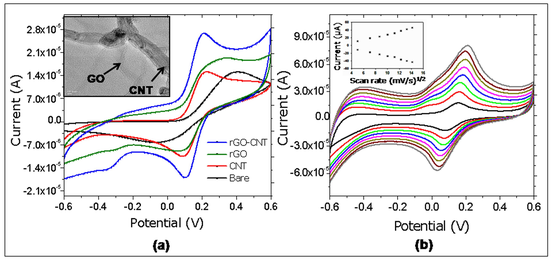
A potential reductive scan from 0 to -1.5 V with the scan rate 0.1 V/s was applied for the electrochemical conversion of rGO/CNT nanocomposites (Supplementary Fig. S3). The thus formed nanohybrid was characterized by Raman spectroscopy and contact angle measurements (Supplementary Figs. S4 & S5). Raman spectroscopy investigated the structural aspects of rGO/CNT modification on SPE. The experimental data was fitted using Microcal Origin 6.1 in order to elucidate the peak position and full width of half-maxima (FWHM) of D, G, and 2D bands. The contact angle measurements further revealed the hydrophilic/hydrophobic character of the modified SPE surface due to the decrease in value of the contact angle after surface modification with rGO/CNT. A large number of hydrophilic (-COOH) groups present in rGO and CNT makes the surface more hydrophilic resulting in reduced contact angle value.
**Magneto-immunoassay optimisation**. A competitive inhibition immunoassay format was developed on ELISA plates with in-house generated hapten-protein conjugate and specific bioreceptor (anti-diuron antibody) (23). Concentration of nanobioprobes in the reported ELISA procedure was optimized. Nanobioprobe mediated immunocomplex formed on the plates were washed and acid dissolved for the desorption of nanoparticles from the immobilized antibody by using a mild acid (1N HCl) followed by partial neutralization with 1N NaOH. The electrochemical bursting of Au/Fe nanoparticles to release large number of Fe ions on rGO/CNT modified biosensing platform was optimized in terms of reductive scan (0 to -1.5 V). (Supplementary Fig. 6) monitored by differential pulse voltammetry (DPV) technique. Liberation of the large number of (Fe2+) ions were detected by their oxidation response on rGO/CNT nanostructured electrodes, which possess the enhanced electrochemical response due to the oxygen containing groups leading to rapid electron transfer (24).
**Results analysis**. Calibration curve for diuron (standard sample concentrations between (0.01 pg/ml to 1 μg/ml) was established based on a semi-log plot method. Data analysis was performed by normalizing the absorbance values using the following formula:
% B/B0 = {(I – Iex) / (I0 – Iex)}
Where I, I0, and Iex are the relative current intensities of the sample, hapten at zero concentration, and hapten at excess concentration, respectively.
The cross reactivity of the generated antibody was calculated by determining half maximal inhibitory concentration (IC50) for diuron and other herbicides, atrazine, 2,4-D, fenuron and linuron (Supplementary Figs. S7 and S8).
**Procedure**
**Synthesis of Ab-Au/Fenanobioprobes ● TIMING ~3 h 30 min**
1. The Au/Fe nanoparticles were synthesized by first preparing Fe3O4 seeds using modified co-precipitation method25 which are further oxidized to encapsulate with gold shells by following the steps given in Box 1. The synthesized Au/Fe nanoparticles were labeled with anti-diuron antibodies23 (generated in-house) as per the steps followed in Box 2.
Box 1 | SYNTHESIS OF Au/Fe NANOPARTICLES ● TIMING ~1 h 30 min
1. Dissolve FeCl3 (1.28 M) and FeSO4.7H2O (0.64 M) in 1:2 ratios in deoxygenated water under vigorous stirring in nitrogen environment.
- CRITICAL STEP Oxygen-free environment protects the oxidation of iron nano particles/seeds.
- Add a solution of 1.5 M NaOH dropwise into the mixture followed by stirring for 40 min.
- Black precipitate of magnetite formed which is collected by a permanent magnet. Wash the precipitate with deionized water.
CRITICAL STEP Thoroughly wash the precipitate formed to remove trace amount of NaOH (reducing agent).
- ? TROUBLESHOOTING
- Reconstitute the precipitate 1: 200 dilution in deionized water.
- Add sodium citrate (155 mM) slowly to the boiling solution under constant stirring for 15 min.
- CRITICAL STEP Boiling of magnetic seeds are important before addition of gold and sodium citrate for the efficient coating of gold over magnetic seeds/nanoparticles.
- Add 10 ml of gold chloride (10 mM) immediately into the oxidized magnetic solution on a stirring sonicator to encapsulate the iron nanoparticles with gold shells.
- CRITICAL STEP Increase in the Au concentration in the Au/Fe ratio will lead to thicker gold shells thereby affecting the magnetic properties of NPs.
- Collect Au/Fe NPs by magnetic separation followed by washings with deionised water and finally reconstitute in 0.5 ml water.
- CRITICAL STEP The water used for the synthesis should be de-ionised, pH ~7.0, and having resistivity >18 MΩ-cm to avoid flocculation.
- Characterise the synthesised nanoparticles by TEM/EDX. The Figure 2 indicates the inclusion of Fe core and Au shell as single Au/Fe nanostructure on the basis of point and line mapping studies.
Box 2 | LABELING OF Au/Fe NANOPARTICLES ● TIMING ~2h
1. Prepare antibody solution (1 mg/ml) in PB
- Add 100 µl antibody solution in 1 ml Au/Fe solution under mild stirring conditions.
- CRITICAL STEP The minimum amount of antibody required to stabilize the NPs is optimized by flocculation assay (see experimental design).
- Maintain the pH of NPs solution at 7.4 by adding 0.1 M K2CO3 before adding antibody solution.
- Incubate the solution at 37 °C for 2 h followed by centrifugation at 12,000 rpm for 30 min to remove traces of unconjugated antibody.
- PAUSE POINT May also be incubated overnight at 4 °C.
- Wash the pellet twice with 10 mM Tris (pH 8.0) containing 3% BSA.
- CRITICAL STEP The addition of BSA will prevent the aggregation of nanoparticles and will eventually increase the stability of the nanobioprobes.
- ? TROUBLESHOOTING
- Resuspend the pellet in 1 ml of phosphate buffer (pH 7.4) and store at 4 °C.
2│The synthesized Ab-Au/Fenanobioprobes are characterized morphologically by Scanning Transmission Electron Microscope. Further, size profiling of antibody tagged nanoparticles by dynamic light scattering system confirms the binding of antibodies to NPs (Supplementary Fig. S1). SQUID analysis also demonstrates the change in magnetic properties of Au/Fe NPs and their subsequent functionalization with specific antibodies.
CRITICAL STEP For SQUID analysis, the samples should be vacuum concentrated and completely dry.
**Development of Magneto-electrochemical immunoassay ● TIMING ~3 h**
1. Coat the microtiter ELISA plates with 100 µl of hapten-protein conjugate (10 µg/ml) prepared in carbonate buffer.
- Cover the plate with an adhesive plastic sheet and incubate at 37 ⁰C for 2 hours followed by washing with PBST (three times).
- PAUSE POINT Incubation can be prolonged to overnight at 4 °C
- Block the unbound protein binding sites with 10% defatted skimmed milk (prepared in PBS) for 1 h at 37 °C.
- Wash the plates with PBST (three times).
- A competitive inhibition immunoassay format is developed by coating the ELISA plates with DCPU–BSA conjugate by following the steps given in Box 3.
**Synthesis of rGO/CNT nanohybrid ● TIMING ~1 h**
1. Synthesize GO by the oxidation of exfoliated graphite using modified Hummer’s method6 from graphite powders using NaNO3, H2SO4, and KMnO4 in an ice bath.
- Filter GO through anodized aluminium oxide (AAO) membrane with a nominal pore size of 0.02 μm.
- Peel off the thin GO film from the AAO filter after air drying.
CRITICAL STEP Vaccum oven can be used for the complete drying of the nanocomposite.
- For preparing rGO/CNT nanocomposite, high aspect ratio (length: 15–30 nm and diameter: ~30 nm) pristine multiwalled CNTs and the above prepared GO in step 5 are dissolved in (1:1) DMF and water.
- Sonicate the mixture for 1h at 96% power.
- Drop-caste the 5 µl of the suspension on the working area of SPEs followed by incubation in vacuum oven for 1 h at 60 °C.
- CRITICAL STEP Optimise the concentration of rGO/CNT nanocomposite on SPE on the basis of maximum current signal response using cyclic votammetry (CV) technique.
- ? TROUBLESHOOTING
- Apply a potential reductive scan from 0 to -1.5 V with the scan rate 0.1 V/s for the electrochemical conversion of rGO/CNT nanocomposites on SPE.
- CRITICAL STEP Carefully observe the characteristic reduction peak of rGO/CNT at -0.5V (Supplementary Fig. S2). If the peak is not observed check the contacts with SPE and repeat the reduction scan.
- Characterize the thus formed nanohybrid by TEM and Raman spectroscopy. For characterization, samples are prepared electrochemically on Indium tin oxide (ITO) coated glass by applying the potential between 0 to -1.5 V.
- Raman spectra of first order scattering (D and G peaks) are observed around 1350 cm-1 and 1600 cm-1 respectively (Supplementary Fig. S4).
- Completely dry the samples in vacuum oven for 1h at ~60 ºC. Scrap off the samples from the surface followed by TEM analysis on a carbon coated copper grid (#300 mesh) dropcasted with sample followed by drying in air for 15 min. The micrograph of the nanocomposite display a view of CNT bundles attached to GO layer indicating the formation of rGO/CNT nanocomposite (inset of Fig. 3a).
- Use the characterized rGO/CNT modified SPE for DPV measurements in the development of immunoassay using varying concentrations of diuron.
Box 3 | IMMUNOCOMPLEX FORMATION AND ASSAY DEVELOPMENT ● TIMING ~45 min
1. Mix as prepared Ab-Au/Fe nanobioprobes (1:5 dilution) with varying concentrations of diuron (0.01 pg/ml – 1 μg/ml); 50 µl of mixture added into each well of microtiter plate and subsequently incubated for 20 min at RT.
- A strong magnet kept beneath the plate speed up the immunocomplex formation which is separated.
- Wash the immunocomplex formed on the plates with PB.
PAUSE POINT The plates can be stored at 4 ºC.
- Dissociate the bound immobilized antibody complex from plate with 0.1N HCl followed by partial neutralization with 0.1 N NaOH to retain pH ~5.2.
- Transfer the solution (50 µl) to rGO/CNT modified SPE surface, as prepared in steps 8-14.
- Apply a reductive scan (0 to -1.5 V) which will eventually burst Fe2O3 nanoparticles into large number of metal ions (Fe2+) by applying a potential sweep between 0 to -1.6 V vs. Ag/AgCl.
- CRITICAL STEP Observe a characteristic broad reductive peak at -0.75 V as shown in inset of supplementary fig. S6.
- Use differential pulse voltammetry (DPV) at amplitude 50 mV, pulse width 0.2 s, pulse period 0.5 s. using the electrochemical workstation.
### Troubleshooting
- Box 1
- Step 3 No black color precipitate formed Rusting of Magnetic seeds during reaction Carry out the synthesis of magnetic seeds in deoxygenated environmemt
- Box 2
- Step 5 Aggregation of synthesized nanobioprobes Excessive concentration of antibody if added. Optimum concentration of antibody should be added into NPs solution after employing critical flocculation assay.
- Step 13 Decreased current signal of rGO/CNT modified sensors than bare SPE The concentration of the nanocomposite on SPE may be too high or too low Varying concentrations of nanocomposite (0.1-10 µg/ml) can be used for optimization.
### Anticipated Results
The developed sensing platform combines the advantages of GO and CNT nanohybrid offering enhanced electrochemical properties giving a synergistic effect in electroanalytical performance of the resulting electrode material along with a large number of metal ions (Fe2+) available on electrode which are detected by differential pulse voltammetry technique (Fig. 4a,b). This combined strategy successfully enhanced the immunoassay sensitivity, and thus provides a novel promising platform for environmental or clinical applications where sensitivity is a major issue.

### References
1. Yang, W., Ratinac, K.R., Ringer, S.P., Thordarson, P., Gooding, J. J. & Braet, F. Carbon nanomaterials in biosensors: should you use nanotubes or graphene? *Angew. Chem. Int. Ed. Engl*. 49, 2114-38 (2010).
- Shao, Y., Wang, J., Engelhard, M., Wang, C. & Lin, Y. Facile and controllable electrochemical reduction of graphene oxide and its applications. *J. Mat. Chem*. 20, 743-748 (2010).
- Wu, X. M. et al. Electrochemical approach for detection of extracellular oxygen released from erythrocytes based on graphene film integrated with laccase and 2, 2-azino-bis(3-ethylbenzothiazoline-6-sulfonic acid). *Anal. Chem*. 82, 3588-3596 (2010).
- Zhang, Y., Sun, X., Zhu, L., Shen, H. & Jia, N. Electrochemical sensing based on graphene oxide/Prussian blue hybrid film modified electrode. *Electrochimica Acta*. 56, 1239-1245 (2011).
- Dong, X., Huang, W. & Chen, P. In Situ Synthesis of Reduced Graphene Oxide and Gold Nanocomposites for Nanoelectronics and Biosensing. Nanoscale Research, 6, 60 (2011).
- Cote, L.J., Kim, F. & Huang, J.X. Langmuir−Blodgett Assembly of Graphite Oxide Single Layers. *J. Am. Chem. Soc*. 131, 1043-1049 (2009).
- Salzmann, C.G., Llewellyn, S. A., Tobias, G., Ward, M.A.H., Huh Y. & Green, M.L.H. The Role of Carboxylated Carbonaceous Fragments in the Functionalization and Spectroscopy of a Single-Walled Carbon-Nanotube Material. *Adv. Mater*. 19, 883-887 (2007).
- Kim, J.,Tung, V.C. & Huang, J. Water Processable Graphene Oxide:Single Walled Carbon Nanotube Composite as Anode Modifier for Polymer Solar Cells. *Adv. Energy Mater*. 1, 1052-1057 (2011).
- Tung,V.C. et al. Low-temperature solution processing of graphene-carbon nanotube hybrid materials for high-performance transparent conductors. *Nano Lett*. 9, 1949-1955 (2009).
- Dimitrakakis, G.K., Tylianakis, E. & Froudakis & G.E. Pillared. Graphene: A New 3-D Network Nanostructure for Enhanced Hydrogen Storage. *Nano Lett*. 8, 3166-3170 (2008).
- Qiu, L., Yang, X., Gou, X., Yang, W., Ma, Z.F., Wallace, G.G. & Li, D. Dispersing carbon nanotubes with graphene oxide in water and synergistic effects between graphene derivatives. *Chem. Eur. J*. 16, 10653-10658 (2010).
- Chen, M., Yamamuro, S., Farrell, D. & Majetich, S.A. Gold-coated iron nanoparticles for biomedical applications. *J. Appl. Phys*. 93, 7551–7553 (2003).
- Ban, Z., Barnaov, Y.A., Li, F., Golup,V.O. & O’Conner, C.J. The synthesis of core–shell iron@gold nanoparticles and their characterization. *J. Mater. Chem*. 15, 4660-4662 (2005).
- Cho, S.J., Kauzlarich, S.M., Olamit, J., Liu, K., Grandjean, F., Rebbouh, L. & Long, G. J. Characterization and magnetic properties of core–shell structured Fe–Au nanoparticles. *J. Appl. Phys*. 95, 6803–6806 (2004).
- Wang, J., Liu, G., Wu, H. & Lin, Y. Quantum-Dot-Based Electrochemical Immunoassay for High-Throughput Screening of the Prostate-Specific Antigen. *Small*, 4, 82-86 (2008).
- Chu, X., Fu, X., Chen, K., Shen, G.L. & Yu, R.Q. An electrochemical stripping metallo immunoassay based on silver-enhanced gold nanoparticle label. *Biosens. and Bioelectron*. 20, 1805-1812 (2005).
- Chen, L.Y., Chen, C.L., Li, R.N., Li, Y. & Liu, S.Q. CdTe quantum dot functionalized silica nanosphere labels for ultrasensitive detection of biomarker. *Chem. Commun*., 2670–2672 (2009).
- Nangia, Y., Bhalla, V., Kumar, B. & Suri, C.R. Electrochemical stripping voltammetry of gold ions for development of ultra-sensitive immunoassay for chlorsulfuron. *Electrochem. Comm.* 14, 51-54 (2012).
- Sharma, P., Bhalla, V., Dravid, V., Shekhawat,G., Wu, J., Prasad, E. S., Suri, C. R. Enhancing electrochemical detection on graphene oxide-CNT nanostructured electrodes using magneto-nanobioprobes. *Scientific Report* 2, 877 (2012).
- Huang, C., Jiang, J., Muangphat, C., Sun, X. & Hao, Y. Trapping Iron Oxide into Hollow Gold Nanoparticles. *Nanoscale Res. Lett*. 6, 43 (2011).
- Hainfeld, J. F. & Powell, R.D. New frontiers in gold labeling. *J. Histochem. Cytochem*. 48, 471–480 (2000).
- Wangoo, N., Bhasin, K.K., Mehta, S.K., & Suri, C.R. Synthesis and capping of water-dispersed gold nanoparticles by an amino acid: bioconjugation and binding studies. *J. Colld. Inter. Sci*., 323(2), 247-254(2008).
- Sharma, P. & Suri, C.R. Biotransformation and biomonitoring of phenylurea herbicide diuron. *Bioresource Tech*. 102, 3119-3125 (2011).
- Wong, J.W.C., Fang, M., Zhao, Z. & Xing, B. Effect of surfactants on solubilisation and degradation of phenanthrene under thermophilic conditions. *J. Environ. Qual*. 33, 2015–2025 (2004).
- Gupta, A.K. & Gupta, M. Synthesis and surface engineering of iron oxide nanoparticles for biomedical applications. *Biomaterials*, 26, 3995-4021 (2005).
### Acknowledgements
The authors greatly acknowledge NUANCE, NWU, IL for carrying out TEM/EDX imaging. Authors also acknowledge Jiaxing Huang and Laura Cote, NWU, IL for valuable suggestions and discussions on GO synthesis.
### Figures
**Figure 1: Schematic illustration of the optimised nanohybrid biosensing systems**

*Schematic illustration of the optimised nanohybrid biosensing systems. The method involves synthesis of Au/Fe nanoparticles functionalised with specific antibodies used as nanobioprobes and their subsequent metal ion sensing on rGO/CNT nanostructured electrodes. Microtiter ELISA plates were coated with 100 µl of hapten-protein conjugate (10 µg/ml) prepared in carbonate buffer and subsequently immunocomplex was formed with different concentrations of diuron sample in competitive ELISA approach. Electrochemical bursting of nanoparticles releasing large number of Fe2+ ions presented ultra-high sensitivity for diuron detection on SPE*.
*Figure from reference 19: Sharma, P., Bhalla, V., Dravid, V., Shekhawat,G., Wu, J., Prasad, E. S., Suri, C. R. Enhancing electrochemical detection on graphene oxide-CNT nanostructured electrodes using magneto-nanobioprobes. Scientific Report 2, 877 (2012)*.
**Figure 2: TEM micrographs of Au/Fe nanoparticles**

*(a) TEM micrograph of Au/Fe nanoparticles showing the morphology of the synthesized Au/Fe nanoparticles with an approximate dia of ~30 nm (b) The line map curve showing the ratio of Au:Fe found to be nearly 11:1 in a single selected nanoparticle (c) EDX spectra of the whole scan area showing Au LR, Au Lâ, Fe KR, and Fe Kâ lines at 9.8 keV, 11.6 keV, 6.4 keV, and 7.0 keV respectively (d) The whole area mapping analysis of nanoparticles in dark field showing the distribution of Fe and Au in the synthesized nanoparticles. In (e) and (f) pink and red dots represent Fe and Au respectively*
*Figure from reference 19: Sharma, P., Bhalla, V., Dravid, V., Shekhawat,G., Wu, J., Prasad, E. S., Suri, C. R. Enhancing electrochemical detection on graphene oxide-CNT nanostructured electrodes using magneto-nanobioprobes. Scientific Report 2, 877 (2012)*.
**Figure 3: Cyclic voltammograms of nanocomposite formed on SPE**

*(a) Cyclic voltammograms (CV) of rGO, CNT and rGO/CNT nanocomposite formed on SPE using 2.5 mM ferrocyanide solution prepared in PBS. Inset of the figure shows the TEM characterization of rGO/CNT nanocomposite. The corresponding CV scans recorded for the redox of small ion (Fe2+) for rGO/CNT showed maximum current signal for anodic and cathodic peak currents for the first reductive scan as compared to GO and CNTs dropcasted individually on separate electrodes and further reduced electrochemically. In figure b, CV scans recorded at different scan rates from 25 to 200 mV/s. The anodic potential shifts more towards the positive potential and the cathodic peak potential shifts in the reverse direction with increase in higher scan rate*
*Figure from reference 19: Sharma, P., Bhalla, V., Dravid, V., Shekhawat,G., Wu, J., Prasad, E. S., Suri, C. R. Enhancing electrochemical detection on graphene oxide-CNT nanostructured electrodes using magneto-nanobioprobes. Scientific Report 2, 877 (2012)*.
**Figure 4: Magneto-electrochemical immunoassay format using modified SPE**

*(a) Response curves of rGO/CNT modified SPE The signal response was measured by a differential pulse voltammetry technique at amplitude 50 mV, pulse width 0.2 s, pulse period 0.5 s. (b) Competitive inhibition response curve for diuron at different concentrations from 0.01 pg/ml to 1 µg/ml (a to h). Analysis of the competitive inhibition assay data was performed by normalizing the absorbance (Fig. 4ii). The developed immunoassay showed excellent sensitivity and specificity demonstrating detection limit upto 0.1 pg/ml (sub-ppt) for diuron samples with high degree of reproducibility (n=3)*
*Figure from reference 19: Sharma, P., Bhalla, V., Dravid, V., Shekhawat,G., Wu, J., Prasad, E. S., Suri, C. R. Enhancing electrochemical detection on graphene oxide-CNT nanostructured electrodes using magneto-nanobioprobes. Scientific Report 2, 877 (2012)*.
**Supplementary document: Supplementary document**
[Download Supplementary document](http://www.nature.com/protocolexchange/system/uploads/2359/original/supporting_info.doc?1354775056)
### Associated Publications
**Enhancing electrochemical detection on graphene oxide-CNT nanostructured electrodes using magneto-nanobioprobes**. Priyanka Sharma, Vijayender Bhalla, Vinayak Dravid, Gajendera Shekhawat, Jinsong-Wu, E. Senthil Prasad, and C. Raman Suri. *Scientific Reports* 2() 19/11/2012 [doi:10.1038/srep00877](http://dx.doi.org/10.1038/srep00877)
### Author information
**Priyanka Sharma, V Bhalla, E Senthil Prasad & C. Raman Suri**, IMTECH
V Dravid & G Shekhawat, NWU, IL
Correspondence to: C. Raman Suri (raman@imtech.res.in)
*Source: [Protocol Exchange](http://www.nature.com/protocolexchange/protocols/2535) (2012) doi:10.1038/protex.2012.059. Originally published online 6 December 2012*.
doi:10.5281/zenodo.13779
2020-09-20T20:25:46Z
CERN
CERN.ZENODO
2
CERN.ZENODO
10.5281/ZENODO.13779
sprotocols
ScientificProtocols.org
Optogenetic Manipulation Of Ventral Tegmental Area (Vta) Neurons That Project To The Nucleus Accumbens (Nac) And Medial Prefrontal Cortex (Mpfc)
Zenodo
2015
2015-01-06
Journal article
https://zenodo.org/record/13779
Creative Commons Zero - CC0 1.0
Open Access
Authors: Jessica Walsh, Dipesh Chaudhury, Allyson Friedman, Barbara Juarez, Stacy Ku, Mary Kay Lobo & Ming-Hu Han
### Abstract
Optogenetics has evolved to be a critical technique used to manipulate the firing activity of specific subsets of neurons. Through the use of specific firing parameters, it has become possible to control the behavior of freely moving animals. Here we have established a system to control projection pathway-specific neurons from a particular brain region through the combined use of a Cre-dependent ChR2 and a transceullar, retrograde, Cre virus.
### Introduction
There is an urgent need for more effective treatment strategies for major depressive disorder (MDD). The efficacy of novel depression treatment with deep brain stimulation implicates MDD as a neural circuit disorder. Therefore, a better understanding of the neural circuit mechanisms underling MDD is crucial for the development of neural circuit-oriented treatment strategies. Studies have implicated the mesolimbic dopamine (DA) system, specifically DA neurons in the ventral tegmental area (VTA) and its projections to the nucleus accumbens (NAc) and medial prefrontal cortex (mPFC), in the pathophysiology of depression. Through the combined use of optogenetics and viral mediated gene transfer technology, we manipulated the firing patterns of these pathways in order to elucidate the functional role of these circuits in the regulation of behavioral abnormalities. To selectively target VTA-NAc or VTA-mPFC neurons for the optogenetic experiments we injected a transcellular, retrograde, Cre virus into the NAc or mPFC and the conditional AAV-DIO-ChR2 virus into the VTA. We found that selective induction of phasic firing in VTA-NAc neurons generated a susceptible phenotype, whereas the inhibition of VTA-mPFC neuron activity induced the same susceptible phenotype. These types of manipulations can provide highly useful information for a target-oriented treatment of depression, as well as many other illnesses.
### Reagents
**Surgery**:
1. Anesthetic (Ketamine (100mg/kg)/ Xylaxine (10mg/kg))
- Milli Q water
- Sterile phosphate-buffered saline
- 70% ethanol
- Acetone
- Betadine
- Alcohol wipes
- Puralube vet ointment
- Neosporin
- AAV-DIO-ChR2-EYFP (UNC Vector Core)
- PRV-Cre (Jeffrey Friedman’s laboratory – Rockefeller University)
### Equipment
**Surgery**:
1. 1 mL syringes
- 30 gauge needles
- Sterile cotton swabs
- Reflex 7 clip applier and 7 mm clips
- Forceps
- Scissors
- Hamilton syringes and 26 gauge needles
- Ideal micro-drill and bits (Roboz Surgical Instrument)
- Stereotaxic apparatus (Kopf Instruments)
- Heating pad
- Timer
- Permanent implantable optic fibers (see Sparta, D.R. et al)
- Screws
- Screw Driver
- Dental Cement (Grip cement; Dentsply)
- Transfer Pipettes
**Subthreshold social defeat**:
1. Perforated plexiglass divider
- Timer
**Stimulation and Social Interaction**:
1. Optical Fibers (Thor Labs, BFL37-200)
- Blue light Crystal Laser (BCL-473-050 M)
- Yellow light Crystal Laser (CL561-050-L)
- Stimulator (Agilent Technologies, #33220A)
- Square shaped arena (44×44 cm)
- Wire mesh cage (10×6 cm)
- Ethovision 3.0, Noldus
### Procedure
**Injection of AAV-DIO-ChR2 into VTA**:
1. One hour prior to surgery, give the mice a subcutaneous injection of penicillin and atropine.
- Anesthetize mice with ketamine (100mg/kg)/xylaxine (10mg/kg) mixture. Make sure animals are fully anesthetized by gently squeezing the footpad to ensure no reflex response.
- Shave the top portion of the head.
- Place the head of the mouse securely in the stereotaxic apparatus by positioning the front teeth in the nose holder, followed by securing the ear bars in place. Make sure that the nose holder and ear bars are set a zero.
- Apply ocular lubricant to the eyes of the mouse.
- Disinfect the dissection area using cotton swabs with betadine. Make sure to start in the center of the head, moving the swab in circular motions outward to minimize contamination.
- Using sterilized forceps and scissors expose the skull by making a sagittal incision along the midline. Make sure to peel the periosteum off using a cotton swab.
- Roughly make the skull of the mouse as flat as possible by eye.
- Attach both Hamilton syringes with 26 gauge needles to the stereotaxic apparatus and set the syringe on the right side to zero degrees. Set the other syringe to 7° for VTA injection.
- Perform the flat test by placing the Hamilton syringe that is set to zero degrees on bregma and measure the dorsal/ventral coordinate.
- Following this measurement, move the syringe posterior to lambda and again measure the dorsal/ventral coordinate. If the two measurements are more than 0.2mm out of alignment, adjust accordingly.
- Then move the syringe back to bregma and take the two measurements that are lateral to bregma. Again make sure there is not more than a 0.2mm difference.
- Once the flat test has been performed, adjust both syringes to be at 7° for the AAV-DIO-ChR2 injection.
- Place both needles at bregma and take the anterior/posterior (A/P), medial/lateral (M/L), and dorsal/ventral (D/V) measurements.
- Once these measurements have been taken, move the syringes to the VTA coordinates (AP -3.3mm; LM +1.05mm; DV -4.6mm).
- Using a micro-drill, make burr holes at the new coordinates.
- Fill the entire syringe with PBS and then push out the solution until 1.5 μl of the syringe is full.
- Pull up to 2.0 μl with air.
- Fill the syringe with 1.0 μl of AAV-DIO-ChR2 (total volume of syringe is now 3.0 μl).
- Lower syringe to 0.1 mm below the newly calculated dorsal/ventral coordinates to create a pocket in the tissue and then immediately pull up to the calculated coordinate.
- Inject 0.1 μl of virus per minute to avoid tissue damage.
- Keep syringe in place for 5 minutes after all of the virus has been injected.
- Remove the Hamilton syringes by slowly pulling up and remove mouse from stereotaxic apparatus.
- Apply neosporin to the skull using a cotton swab.
- Close incision using sutures holding the two sides of the tissue with forceps.
- Place mouse on heating pad in its cage until it wakes up.
**Injection of retrograde travelling pseudorabies virus expressing Cre (PRV-Cre) into NAc or mPFC followed by implantation of permanent optical fibers (see Sparta et al Nature Protocols for details on how to make fibers)**:
1. Two weeks following the DIO-ChR2 surgery, perform the second surgery. The protocol is the same as above for the virus injection with a few alterations.
- a. After step (8), choose a location for the skull screw that is not near bregma, the viral injection location or the ferrule location and then proceed to drill a small burr hole. Screw the skull screw into the small hole using curved forceps to hold the screw and screwdriver to fit into the hole. Only screw until it has tightly gripped the skull. Proceed with flat test.
- b. Inject PRV-Cre into the NAc at 10° (AP +1.6mm; LM +1.5mm; DV -4.4mm) and at 15° mPFC (AP +1.7mm; LM +0.75mm; DV -2.5mm), and use a 0.5 μl volume of the virus to inject bilaterally.
- Remove Hamilton syringes and replace with ferrule holders with implantable fibers attached and change the angle to 7°.
- Determine the location for ferrule placement from bregma for VTA (AP -3.3mm; LM +1.05mm; DV -4.6mm).
- Secure the ferrules in place with white dental cement.
- Do not remove the ferrule holders until the cement is completely dry (~10-15 minutes).
- Remove the mouse and allow it to recover on the heating pad.
**Subthreshold social defeat**:
1. Place a c57 test mouse (intruder) into the home cage of a larger, CD1 retired breeder mouse for 2 minutes during which the test mouse is physically attacked by the CD1 aggressive mouse.
- After 2 minutes of physical contact, place a perforated plexiglass partition in the middle of the CD1 mouse home cage and separate the test mouse from the CD1 mouse for 10 minutes to allow for sensory stress or optical stimulation (see below).
- Following the 10 minutes of sensory stress or optical stimulation, place the test mouse back into its home cage for 5 minutes.
- Repeat steps 1 and 2.
- Return the test mouse to its home cage.
**Optical stimulation and social interaction**:
1. Optical stimulation can be performed during subthresold social defeat as stated above or during social interaction test (see below).
- Connect optical fibers via a FC/PC adaptor to a 473 nm blue or 561 nm yellow laser diode and stimulator to generate blue or yellow light pulses.
- Attach the other end of the optical fibers, with a ferrule attached, to the two implanted optical fibers in the test mouse using ferrule sleeves.
- For low frequency, tonic light stimulation set the stimulator to 0.5Hz and 15 ms.
- For high frequency, phasic light stimulation set the stimulator to 20Hz and 40 ms.
- For both tonic and phasic stimulation protocols, expose projection-specific VTA neurons to 5 spikes over each 10 second period.
- Set the stimulator to the desired parameters and turn the laser on during the two-stages of the social interaction test.
- To measure social avoidance behavior towards a novel CD1 mouse, perform a two-stage social interaction test.
- During the first 2.5 minutes of the test, allow the test mouse to freely explore a square shaped arena (44×44 cm) containing a wire mesh cage (10×6 cm) placed on one side of the area with the target CD1 mouse absent. Ensure that the laser is on during these 2.5 minutes.
- Turn the laser off, remove the test mouse from the arena and place it back into its home cage.
- Place an unfamiliar CD1 mouse into the wire mesh cage and place it into the arena.
- Turn the laser back on and place the test mouse into the arena, allowing it to freely explore.
- Use video tracking software to measure the amount of time the experimental mouse spent in the “Interaction Zone” (14×26 cm), “Corner Zone” (10×10 cm) and “Total Travel” within the arena.
- To segregate mice as susceptible or resilient, calculate the interaction ratio as (interaction time with target present)/(interaction time with target absent) normalized to 100.
- Mice with scores less than 100 are defined as “susceptible” and those with scores greater than or equal to 100 are defined as “unsusceptible” or resilient.
### Timing
- Injections: 10 min for each injection 0.5 μl of virus
- Microdefeat: 30 min
- Stimulation and Social Interaction: ~7 min per animal
### Troubleshooting
1. One of the most common problems is the Hamilton syringe needle gets clogged. First try clearing the needle using acetone, ethanol and water. If this does not work, replace the needle and recalculate the coordinates.
- The permanent implantable fiber breaks. Replace the fiber with a new one.
- The implantable fibers come out when trying to remove it from the holder. There is not much that can be done at this point. Make sure that the cement is completely hardened to try to prevent this from happening.
### References
1. Berton, O. et al. Essential role of BDNF in the mesolimbic dopamine pathway in social defeat stress. *Science* 311, 864-868 (2006).
- Cao, J. L. et al. Mesolimbic dopamine neurons in the brain reward circuit mediate susceptibility to social defeat and antidepressant action. *J Neurosci* 30, 16453-16458 (2010).
- Cardin, J.A. et al. Targeted optogenetic stimulation and recording of neurons in vivo using cell-type-specific expression of Channelrhodopsin-2. *Nat Protoc* 5, 247-254 (2010).
- Grace, A. A., Floresco, S. B., Goto, Y. & Lodge, D. J. Regulation of firing of
dopaminergic neurons and control of goal-directed behaviors. *Trends Neurosci* 30, 220-227 (2007).
- Hommel, J. D., Sears, R. M., Georgescu, D., Simmons, D. L. & DiLeone, R. J. Local gene knockdown in the brain using viral-mediated RNA interference. *Nat Med* 9, 1539-1544 (2003).
- Iniguez, S. D. et al. Extracellular signal-regulated kinase-2 within the ventral tegmental area regulates responses to stress. *J Neurosci* 30, 7652-7663 (2010).
- Krishnan, V. et al. Molecular adaptations underlying susceptibility and resistance to social defeat in brain reward regions. *Cell* 131, 391-404 (2007).
- Lobo, M. K. et al. Cell type-specific loss of BDNF signaling mimics optogenetic control of cocaine reward. *Science* 330, 385-390 (2010).
- Razzoli, M., Andreoli, M., Michielin, F., Quarta, D. & Sokal, D. M. Increased phasic activity of VTA dopamine neurons in mice 3 weeks after repeated social defeat. *Behav Brain Res* 218, 253-257 (2011).
- Schultz, W. Dopamine signals for reward value and risk: basic and recent data. *Behav Brain Funct* 6, 24 (2010).
- Sparta, D. R. et al. Construction of implantable optical fibers for long-term optogenetic manipulation of neural circuits. *Nat Protoc* 7, 12-23 (2012).
- Tsai, H. C. et al. Phasic firing in dopaminergic neurons is sufficient for behavioral conditioning. *Science* 324, 1080-1084 (2009).
- Ungless, M. A., Magill, P. J. & Bolam, J. P. Uniform inhibition of dopamine neurons in the ventral tegmental area by aversive stimuli. *Science* 303, 2040-2042 (2004).
### Acknowledgements
- NIMH F31MH095425
- NIMH F32MH096464
- IMHRO Johnson & Johnson
- NIMH R01MH092306
### Author information
**Jessica Walsh*, Dipesh Chaudhury*, Allyson Friedman, Barbara Juarez, Stacy Ku & Ming-Hu Han**, Han's Lab, Mount Sinai School of Medicine
**Mary Kay Lobo**, University of Maryland School of Medicine
Correspondence to: Ming-Hu Han (Ming-Hu.Han@mssm.edu)
*Source: [Protocol Exchange](http://www.nature.com/protocolexchange/protocols/2498) (2012) doi:10.1038/protex.2012.049. Originally published online 10 October 2012*.
doi:10.5281/zenodo.13799
2020-09-20T20:25:50Z
CERN
CERN.ZENODO
2
CERN.ZENODO
10.5281/ZENODO.13799
sprotocols
ScientificProtocols.org
Engineering Of Ultra-Small Diagnostic Nanoprobes Through Oriented Conjugation Of Single-Domain Antibodies And Quantum Dots
Zenodo
2015
2015-01-07
Journal article
https://zenodo.org/record/13799
Creative Commons Zero - CC0 1.0
Open Access
Authors: Alyona Sukhanova, Klervi Even-Desrumeaux, Patrick Chames, Daniel Baty, Mikhail Artemyev, Vladimir Oleinikov & Igor Nabiev
### Abstract
Nanoparticle-based biodetection commonly employs monoclonal antibodies (mAbs) for targeting. Although several types of conjugates have been used for biomarker labeling, the large size of mAbs limits the number of ligands per nanoparticle, impedes their intratumoral distribution, and limits intracellular penetration. Furthermore, the conditions of mAb conjugation using conventional techniques provide nanoprobes with irregular orientation of mAbs on the nanoparticle surface and often provoke mAb unfolding. Here, we have developed a protocol to engineer ultrasmall diagnostic nanoprobes through directional conjugation of semiconductor quantum dots (QDs) with 13-kDa single-domain antibodies (sdAbs) derived from llama immunoglobulin G (IgG). sdAbs are conjugated with QDs in a highly oriented manner via an additional cysteine residue specifically integrated into the sdAb C-terminus. The resultant nanoprobes are <12 nm in diameter, ten times smaller in volume compared to the known alternatives. They have been proved highly efficient in flow cytometry and immunuhistochemical diagnosis. This approach is easy to extend to other semiconductor and plasmonic nanoparticles. In general, sdAb-QD bioconjugation, quality control and characterization take 3 days.
### Introduction
The common approach to bioimaging, detection, and diagnosis with nanoparticles is to make use of the specificity and avidity of monoclonal antibodies (mAbs) for targeting (Fig. 1a,b) (1,2). Although several mAb–nanoparticle conjugates have been used for biomarker labeling, these functionalized nanoprobes are large, which limits the number of ligands that can be linked to the surface of a nanoparticle, impedes intratumoral distribution of nanoprobes because of interstitial tumor pressure, and limits their intracellular and intratissular penetration (3). Immunoglobulins G (IgGs) have a molecular weight of 150 kDa and an average size of 14.5×8.5×4 nm, which considerably limits their use for targeting (4). Furthermore, the conditions of mAb conjugation using conventional techniques provide the nanoprobes with irregular orientation of mAbs on the nanoparticle surface and often provoke IgG unfolding (Fig. 1c) (5). Smaller antibody fragments conjugated with the nanoparticles in a highly oriented manner may become an attractive alternative as components of the smallest possible targeted nanoprobes.
IgGs are composed of two identical light chains and two identical heavy chains (Fig. 1b). A light chain contains one variable domain (VL) and one constant domain (CL), and a heavy chain has one variable domain (VH) and three constant domains (CHs). The antigen-binding sites of IgG are formed by association of the variable domains, VL–VH. Three interchain disulfide bonds ensure the stability and functional activity of IgG (Fig. 1a,b). As free sulfhydryls of Ab may be useful in a conjugation reaction with nanoparticle, the disulfide bond in the hinge region of IgG should be selectively reduced to obtain a functionally active partially cleaved heavy–light chain Ab fragment (75 kDa, Fig. 1c).

**Figure 1**. *Schematic diagram of the structures of full-size antibodies (Abs), their fragments, and different approaches to their linkage to nanoparticles*.
- *(a) The Y-shaped structure of a full-size Ab, which is the ligand to be attached to the nanoparticle; the two light chains (variable regions) and the heavy chains (constant regions) are shown in violet and red, respectively. The specific functional sites at which the Ab can bind antigens are shown in green. The groups that can be used for attachment to nanoparticles are shown in yellow*.
- *(b) A three-dimensional model of an Ab based on X-ray crystallography data. The Ab structure was taken from entry 1IGY of the Protein Data Bank (PDB). Light chains are shown in orange and cyan; heavy chains, in yellow and green. Carbohydrate residues are shown in purple*.
- *(c) Fragmentation of an Ab into functional and nonfunctional Ab fragments after reduction of their disulfide bonds*.
- *(d) Fragmentation of a llama heavy-chain Ab (HcAb) resulting in single variable-domain Ab fragments (single-domain antibodies, sdAbs)*.
**Previous techniques and alternative methods**
In terms of increasing the number of functionally active Abs on the nanoparticle surface, the integrity of the Ab binding sites and proper orientation of Abs after conjugation are the two crucial conditions. Commercial Ab–nanoparticle probes, e.g., Ab–quantum dot (QD) nanoprobes are made by conjugation of fragments of completely reduced Abs with amino groups on the surface of QDs (Fig. 1c) (5,6). Complete reduction of Abs disrupts the integrity of the recognition sites, each of which is formed by the variable domains of a heavy and a light chain linked by disulfide bonds, because these are also reduced . Other known strategies for Ab covalent coupling to QDs require a passivating ligand bound to the quantum surface to make it possible to use carbodiimide (–COOH), NHS ester (–NH2), or maleimide (–SH) chemistry routes (8,9). These approaches are not specific for the conjugation site, and they yield nanoprobes with irregular orientation of Abs on the nanoparticle surface (Fig. 2a).
Recently, we have developed an advanced conjugation procedure based on selective reduction of the disulfide bond in the hinge region of IgG, leaving the bonds between the heavy and light chains intact (Fig.1c) (7). This ensures a high yield of functionally active half-antibodies, which can be purified and covalently conjugated with QDs by sulfo-SMCC chemistry methods to obtain nanoprobes with intact recognition sites and homogeneous orientations of Abs relative to the QD surface. These probes, though rather large in size, exhibit a tenfold higher recognition capacity compared to conventional nanoprobes (7). Despite this improvement, the approach developed does not always guarantee uniform orientation of the Ab functional fragments on the QD surface; therefore, new approaches to directional conjugation are required.
One strategy to overcome the aforementioned problems is to engineer very small but functional Ab fragments, modify them so that only one, unique site per fragment is accessible for conjugation with the carrier (e.g., a nanoparticle), and deliver many such fragments on a single carrier (Fig. 2b). It is even possible to obtain multivalent nanoprobes, where small, functionally active fragments of different Abs against different antigens may be bound to the same nanoparticle in the same orientation10. In this way, more than one cellular target can be identified with a single multivalent probe (11).

**Figure 2**. *Conjugates of (a) full-size and (b) single-domain antibodies with quantum dots*.
- *(a) Quantum dots (QDs) are conjugated with full-size antibodies (Abs) using carbodiimide chemistry. Abs are oriented randomly relative to the nanoparticle surface; some antigen-binding domains (red ovals) are sterically inaccessible (blue arrows). Only domains exposed to the outside are functionally active (orange arrows)*.
- *(b) QDs are conjugated with single-domain Abs (sdAbs) via a single Cys residue specifically integrated in the sdAb C terminus. The antigen-binding domain of every sdAb is exposed to the outside and remains functionally active*.
- The anatomy of QDs: *Se, orange; Cd, violet; S, yellow; Zn, dark-blue; C, light-blue; O, red; H, white*.
- The anatomy of Abs: *β-structures, green bands; α-helix, red cylinders*.
**Objectives of this technique**
With a molecular weight of only 13 kDa, single-domain antibodies (sdAbs or VhH, Fig. 1d) represent the smallest functional Ab fragments capable of binding antigens with affinities comparable to those of conventional antibodies (12). An sdAb molecule occupies 12 times less space than a conventional IgG antibody does, and its size allows it to bind epitopes inaccessible to conventional IgGs (13). In addition to their small size, sdAbs are not prone to aggregation; they exist as monomers, diffuse much better into tissues than full-size IgGs (14), and their size allows them to label finer and more remote segments of organs and bind with the corresponding antigens more accurately compared to conventional IgGs (15,16). sdAbs are resistant to chemical detergents, extreme pH levels, heat, and proteolytic enzymes , and can be produced inexpensively using Escherichia coli or yeast cultures. All these characteristics make sdAbs the best capture molecules to prepare QD-based fluorescent nanoprobes for biodetection and diagnosis. Zaman et al. (19,20) recently used carbodiimide chemistry to conjugate anti-EGFR sdAbs to QDs. However, this approach provides nanoprobes with irregular orientation of sdAbs on the nanoparticle surface; hence, the resultant conjugates are not more efficient than conventional mAb–QD conjugates. To fully use the advantages of these unique ultrasmall capture molecules, they should be coupled with nanoparticles in a highly oriented manner (Fig. 2b).
Here, we describe a well-tested protocol for engineering a new generation of ultrasmall, stable, specific diagnostic nanoprobes based on sdAbs (Fig. 1d) linked to QDs in a highly oriented manner (Fig. 2b) (15,16). We present a method for preparing diagnostic nanoparticles <12 nm in diameter (ten times smaller in volume than that obtainable with alternative techniques) and demonstrate their high efficiency in flow cytometry and immunohistochemical diagnostic platforms. The protocol is so designed that it can be easily extended to other types of semiconductor or noble metal plasmonic or magnetic nanoparticles of different shapes, such as nanodots, nanorods, and nanowires. sdAbs containing a single Cys residue for conjugation with these nanoparticles can be engineered in about the same way. In this case, the concentrations of functionalized sdAbs and nanoparticles in the conjugation reaction should be optimized depending on the nanoparticle size, shape, and concentration.
**Experimental design**
The protocol described here consists of
- (i) colloidal nanocrystal synthesis, characterization, quality control, and standardization;
- (ii) nanocrystal water-solubilization, purification, functionalization, and quality control;
- (iii) llama immunization and construction of a sdAb library followed by selection and ELISA screening of phage–sdAbs;
- (iv) sdAb cloning, specific Cys-residue integration, sdAb production and purification, and affinity measurements;
- (v) conjugation of sdAb–Cys antibodies with hydroxy- or amino-modified colloidal nanocrystals followed by characterization and quality control of the resultant diagnostic nanoprobes.
The efficiency of this protocol was proved by the use of the engineered diagnostic nanoprobes in flow cytometry detection of cells expressing a rare biomarker and detection of immunohistochemistry biomarkers in clinical biopsies, where the probes have ensured clear discrimination between pathological and healthy areas (15,16). The sdAb–QD conjugates stain all antigenic sites revealed by “gold standard” anatomopathological diagnostic methods, whereas the conventional fluorescence-based medical diagnostic protocol leaves many antigenic sites undetected (see ANTICIPATED RESULTS).
### Reagents
**REAGENTS**
1. Cadmium oxide (Aldrich, cat. no. 244783)
- 2-Ethylhexanoic acid, 99% (Aldrich, cat. no. E29141)
- Octadecene, 90% (Aldrich, cat. no. O806)
- Oleylamine,, technical grade, 70% (Aldrich, cat. no. O7805)
- Hexadecylphosphonic acid, 97% (Strem, cat. no. 15-2400)
- Selenium powder, 100 mesh, ≥99.5% trace metals basis (Aldrich, cat. no. 209651)
- Trioctylphosphine, technical grade, 90% (Aldrich, cat. no. 17854)
- Zinc oxide puriss. (Aldrich, cat. no. 14439)
- Triethylene glycol dimethyl ether, 99% (Aldrich, cat. no. T59803)
- Thiourea puriss. p.a., ACS reagent, ≥99.0% (RT) (Aldrich, cat. no. 88810)
- Isopropanol, 99% (Fluka, cat. no. 59310)
- Trioctylphosphine oxide ReagentPlus®, 99% (Aldrich, cat. no. 223301)
- DL-Cysteine hydrochloride hydrate (Sigma, cat. no. C8256)
- Methanol, ACS spectrophotometric grade (Sigma, cat. no. 154903)
- Chloroform, ACS spectrophotometric grade (Sigma, cat. no. 366919)
- NaOH (Fisher, cat. no. S318) ! CAUTION Wear gloves and use a fume hood when handling NaOH.
- SH and OH-modified polyethylene glycol, PEG (ProChimia Surfaces, cat. no. TH 001-m11.n6)
- SH and NH2-modified polyethylene glycol, PEG (ProChimia Surfaces, cat. no. TH 002-m11.n6)
- Sephadex® G-25 (Sigma, cat. no. G2550)
- Ficoll-Histopaque-1077 (PAA, cat. no. J15-004)
- Phosphate-buffered saline (10× PBS) (Gibco, Invitrogen, cat. no. 14200-067)
- GenElute Mammalian Total RNA Miniprep Kit (Sigma, cat. no. RTN70)
- Sense and antisense primers (any commercial provider, e.g., Invitrogen):
- 3’CH2-2: GGT ACG TGC TGT TGA ACT GTT CC
- 3’VHH Not: CCA CGA TTC TGC GGC CGC TGA GGA GAC RGT GAC CTG GGT CC
- 5’VH1 Sfi: C ATG CCA TGA CTC GCG GCC CAG CCG GCC ATG GCC CAG GTG CAG CTG GTG CAG TCT GG
- 5’VH2 Sfi: C ATG CCA TGA CTC GCG GCC CAG CCG GCC ATG GCC CAG GTC ACC TTG AAG GAG TCT GG
- 5’VH3 Sfi: C ATG CCA TGA CTC GCG GCC CAG CCG GCC ATG GCC GAG GTG CAG CTG GTG GAG TCT GG
- 5’VH4 Sfi: C ATG CCA TGA CTC GCG GCC CAG CCG GCC ATG GCC CAG GTG CAG CTG CAG GAG TCG GG
- Diethyl pyrocarbonate (DEPC) (Sigma, cat. no. D5758)
- Transcriptor reverse transcriptase, 200 U/µl, and the appropriate buffer (Roche, cat. no. 03531317001)
- Ribonuclease inhibitor from human placenta (RNAsine) (Sigma, cat. no. R2520).
- dNTPs, (Eurogentec, cat. no. 0020-50)
- Phusion, 2 U/µl and corresponding buffer (Finnzymes, cat. no. F-530L)
- Ultra-pure water (Biochrom AG, cat. no. L0015)
- Agarose (Eurobio, cat. no. GEPAGA07-65)
- Dynazyme II DNA polymerase, 250 U (Fisher, cat. no. w386M5)
- SfiI restriction enzyme (New England Biolabs, cat. no. R01235)
- NotI restriction enzyme (New England Biolabs, cat. no. R01895)
- BglII restriction enzyme (New England Biolabs, cat. no. R01435)
- pHENI vector (available upon request)
- Antarctic Phosphatase (New England Biolabs, cat. no. M0289L)
- T4 DNA ligase (Promega, cat. no. M180B)
- T4 DNA ligase 10× buffer (Promega, cat. no. C126B)
- Agar (MP Biomedicals, cat. no. 150178)
- 2×TY broth (MP Biomedicals, cat. no. 3012-032)
- D-(+)-Glucose monohydrate (Fluka, cat. no. 49159)
- Ampicillin (Sigma, cat. no. A9518)
- Kanamycin (Sigma, cat. no. K1377)
- 5-Bromo-4-chloro-3-indolyl phosphate sodium salt (BCIP) (Sigma, cat. no. B6149)
- E. coli TG1 strain (Zymo research, cat no. T3017 )
- Glycerol, ultra-pure (MP Biomedicals, cat. no. 800688)
- Tween 20 (Sigma, cat. no. P5927)
- Nonfat dry milk
- KM13 helper phage (available upon request)
- Polyethylene glycol (Fluka, cat. no. 81268)
- NaCl (Sigma, cat. no. 21074)
- Epoxy Dynabeads® (Invitrogen, cat. no. 140.11)
- Trypsin (Sigma, cat. no. T1426)
- 0.25% Trypsin/EDTA (Gibco, Invitrogen, cat. no. 25200)
- Trypan Blue Stain (Invitrogen, cat. no. 15250-061)
- M13KO7 helper phage (New England Biolabs, cat. no. N0315S)
- HRP-coupled anti-M13 monoclonal antibody (GE Healthcare, cat. no. 27-9421-01)
- Sodium citrate (Fisher, cat. no. S279) ! CAUTION Wear gloves and use a fume hood when handling sodium citrate.
- H2O2, 30% (Sigma, cat. no. 21-676-3)
- Sodium citrate tribasic dehydrate, ACS reagent (Sigma, cat. no. 54641)
- Citric acid (Sigma, cat. no. C0759)
- ABTS (Sigma, cat. no. A9941)
- Bl21(DE3) strain (EMD Millipore, cat. no. 69387)
- Pfu Ultra High-Fidelity DNA polymerase, 100 U (Agilent, cat. no. 600380)
- TG1 electrocompetent cells (Euromedex, cat. no. 60502-2)
- Isopropyl β-D-1-thiogalactopyranosid (IPTG) (Sigma, cat. no. I1284)
- BugBuster (VWR, cat. no.70584-4)
- Talon™ metal affinity resin (Ozyme, cat. no. 635503)
- Protein assay kit (Bio-Rad Laboratories, cat. nos. 500-0113 and 500-0114)
- TCEP∙HCl (Pierce, cat. no. 20490)
- Sulfosuccinimidyl 4-(N-maleimidomethyl)-cyclohexane-1-caroxylate water soluble heterobifunctional crosslinker, Sulfo-SMCC (Pierce, cat. no. 22322)
- Superdex® 200 Prep Grade (Sigma, cat. no. S6782)
- N-(p-Maleimidophenyl) isocyanate crosslinker, PMPI (Pierce, cat. no. 28100)
- Dimethyl sulfoxide, DMSO (Sigma, cat. no. D8418)
- Phosphate-buffered saline tablets, pH 7.4 (Sigma, cat. no. P4417)
- BupH Borate Buffer Packs (Pierce, cat. no. 28384)
- Sodium phosphate dibasic (Sigma, cat. no. 71636)
- Sodium phosphate monobasic (Sigma, cat. no. S8282)
- MC38 cells (available upon request)
- MC38CEA (available upon request)
- DMEM glutaMAX media (Invitrogen, Gibco, cat. no. 31965-023)
- Heat-inactivated FCS (BioWhittaker, cat. no. 14-503)
- Penicillin (Sigma, cat. no. P3032)
- Streptomycin (Sigma, cat. no. S9137)
- Fungizone (Sigma, cat. no. A9528)
- G418 (Sigma, cat. no. A1720)
- Human serum from a pool of nontransfused AB male donors (Institute Jacques Boy, cat. no. 201021334)
- Human appendix tissue samples from retrospective incision biopsy specimens (Department of Pathology of University Hospital Robert Debré, Reims, France)
- BSA (Sigma, cat. no. B4287)
- BSA fraction V 7.5% solution (Life Technologies, cat. no. 15260037)
- Polyoxylethylene-sorbitan monolaurate, Tween 20 (Sigma, cat. no. P2287)
- CEA-specific monoclonal antibody, clone TF 3H8-1 (Ventana Medical Systems, cat. no. 760-2507)
- Polyclonal goat anti-mouse immunoglobulin conjugated with fluorescein isothiocyanate (Dako, cat. no. F0479)
- Biotinylated sheep anti-mouse polyclonal immunoglobulin (GE Healthcare, cat. no. RPN1001)
- REAL™ system kit (peroxidase/DAB) (Dako, cat. no. K5001)
- 40 mM HEPES, pHB8.5 (Fisher, cat. no. BP310)
**REAGENT SETUP**
1. **2× TY medium**: prepare the solution and autoclave.
- **Ampicillin stock solution (1000×)**: 100 mg/ml.
- **Kanamycin stock solution (200×)**: 10 mg/ml.
- **Glucose stock solution**: 40%.
- **PEG8000/NaCl**: 20% PEG8000 and 2.5 M NaCl.
- **TPBS**: 0.1% Tween 20 in PBS.
- **2% MPBS**: 2% nonfat dry milk diluted in PBS.
- **MT-PBS**: 2% Milk and 2% Tween 20 in PBS.
- **Glycerol stock solution**: 80%.
- **Trypsin stock solution (10×)**: 10 mg/ml in 50 mM tris HCl pH 7,4, 1 mM CaCl2
- **IPTG stock solution (1000×)**: 100 mM in water.
- **ELISA revelation mixture**: 18 ml of PBS, 1 ml of 1 M sodium citrate, 1 ml of 1 M citric acid, 20 µl of 30% H2O2, and one tablet of ABTS.
- **2× TYA**: 2× TY and 100 µg/ml ampicillin.
- **2× TYAG**: 2× TY, 100 µg/ml ampicillin, and 2% glucose.
- **2× TYAK**: 2× TY, 100 µg/ml ampicillin, and 50 µg/ml kanamycin.
- **2× TYAG plates**: 90- or 120-mm Petri dishes containing 2× TY, 100 µg/ml ampicillin, 2% glucose, and agar.
- **2× TYAG plates + BCIP**: 90-mm Petri dishes containing 2× TY, 100 µg/ml ampicillin, 50 µg/ml BCIP, and agar.
- **5’VHx Sfi**: 50 µl of 10 µM 5’VH3 Sfi, 40 µl of 10 µM 5’VH1 Sfi, and 10 µl of 10 µM 5’VH4 Sfi.
- **H2O DEPC**: 0.1% (v/v) DEPC in water. Incubate for 1 h at 37°C and autoclave.
- **Sodium borate buffer, pH 8.5**: empty the contents of one foil envelope of a BupH Borate Buffer pack (Pierce, cat. no. 28384) into a beaker, add ultrapure water and stir to dissolve. When dissolved in 500 ml of water, each pack yields 50 mM borate, pH 8.5.
- **Phosphate buffer, pH 7.0**: mix 423 ml of 1 M monobasic sodium phosphate (Sigma, cat. no. S8282) and 577 ml of 1 M dibasic sodium phosphate (Sigma, cat. no. 71636) to obtain 1 l of a 1 M buffer solution.
- **Phosphate buffer, pH 7.2**: mix 316 ml of 1 M monobasic sodium phosphate (Sigma, cat. no. S8282) and 684 ml of 1 M dibasic sodium phosphate (Sigma, cat. no. 71636) to obtain 1 l of a 1 M buffer solution.
- **PBS**: dissolve one tablet of phosphate-buffered saline (Sigma, cat. no. P4417) in 200 ml of deionized water to obtain 0.01 M phosphate buffer, add 0.0027 M potassium chloride and 0.137 M sodium chloride, pH 7.4, at 25°C.
- **PBS with 0.05% Tween 20**: mix 0.5 ml of Tween 20 and 1 l of PBS on a magnetic stirrer.
- **1% BSA in PBS**: dissolve 5 g of BSA (Sigma, cat. no. B4287) in 500 ml of PBS (Sigma, cat. no. P4417), mix on a magnetic stirrer, and filter through a 0.22-µm filter.
- **2% BSA in PBS with 0.05% Tween 20**: add 10 g of BSA to 500 ml of PBS containing 0.05% Tween 20, stir on a magnetic stirrer, and filter through a 0.22-µm filter.
- **DL-cysteine solution**: dissolve 10 mg of DL-cysteine hydrochloride hydrate (Sigma, cat. no. C8256) in 1 ml of methanol (Sigma, cat. no. 154903). ▲CRITICAL Use the solution immediately after preparation.
- **PEG derivative solutions**: dissolve 75 mg of hydroxyPEG (ProChimia Surfaces, cat. no. TH 001-m11.n6) or 50 mg of aminoPEG SH and NH2-modified PEG (ProChimia Surfaces, cat. no. TH 002-m11.n6) in 0.5 ml of Milli-Q water. ▲CRITICAL Use the solutions immediately after preparation.
### Equipment
1. Heating mantle, model WM/R1/25 (Horst Winkler)
- Power supply, Mc227 (VWR)
- Thermocouple thermometer, HI 93531 (VWR)
- Magnetic stirrer, KMO 2 basic IKAMAG (VWR)
- Vacuum pump, LABOPORT N842.3 FT.18 (VWR)
- Centrifuge, Eppendorf 5804 (VWR)
- Three-neck round-bottom flask, 25 ml (Aldrich)
- High-resolution Miniature Fiber Optic Spectrometer, HR 2000 (Ocean Optics, Inc.)
- Spectrofluorimeter, Jobin Yvon Spex FluoroMax 2 (Jobin Yvon Inc.)
- Varian Cary 50 Conc. UV/Vis spectrophotometer
- Varian Cary Eclipse spectrofluorimeter
- Zetasizer Nano ZS (Malvern Instruments)
- Amicon Ultra-15 filter units of 10 kDa cut-off (VWR)
- Disposable polypropylene columns (2-10 ml) (Pierce)
- NucleoSpin Extract II column (Macherey-Nagel)
- PCR thermocycler T3000 (Biometra)
- Breathable sealer (Dutcher)
- Blood separation tube (PAA)
- VIVASPIN 20 PES 5 KD, (Dutcher)
- iEMS Incubator/Shaker HT (Thermo Scientific)
- Cuvette for electroporation (Ozyme)
- PD MiniTrap G-25 (GE Healthcare)
- Nalgene Filter Units, 500-ml capacity, MF75 series (VWR)
- Bransonic ultrasonic cleaner, Branson 2510EMT (Sigma)
- Eppendorf 5810R bench top centrifuge (Eppendorf)
- Eppendorf 5418 microcentrifuge (Eppendorf)
- Eppendorf concentrator plus complete system (Eppendorf)
- RM-2L Intelli-Mixer (Dutscher)
- FACStarPlus flow cytometer (Becton Dickinson).
- Guava EasyCyte™ Plus, flow cytometer (Guava Technologies).
- Fluorescence microscope, Intravert (Carl Zeiss).
### Procedure
**COLLOIDAL NANOCRYSTAL SYNTHESIS, CHARACTERIZATION, QUALITY CONTROL, AND STANDARDIZATION**
**Synthesis of colloidal hydrophobic CdSe core nanocrystals (quantum dots) ●TIMING 90 min**
1.Place 1 mmol of cadmium oxide, 3 mmol of 2-ethylhexanoic acid, and 2 ml of octadecene into a three-neck 25-ml round-bottom flask and heat in a heating mantle to ca. 200°C for 10 min until cadmium oxide completely dissolves and clear solution is obtained. Cool the mixture to the room temperature and add 6 ml of octadecene, 2 ml of oleylamine and 100 mg of hexadecylphosphonic acid. Equip the system with adapters for vacuum drying, argon flow, a thermocouple, and a magnetic stirring bar. Heat the reaction mixture to 100°C and pump out to 5 mbar for 5 min under vigorous magnetic stirring. Stop pumping, let the argon flow, and heat the mixture to 170°C. Stop the argon flow, pump out the system, and dry the reaction mixture at 170°C for 20 min under vigorous stirring.
2.Parallel to step 1, place 3 mmol of selenium powder into a glass tube, add 1 ml of octadecene, seal the tube with Parafilm and blow with argon for 10 min. Inject 4 mmol of trioctylphosphine into the solution with a syringe and blow the solution with argon for another 20 min until complete dissolution of selenium and formation of a clear viscous solution.
? TROUBLESHOOTING
3.Heat the reaction mixture in the flask to 250°C under argon flow and vigorous stirring. Inject the selenium solution with a syringe into the reaction mixture in the flask. Keep the temperature of the reaction mixture at 230°C. Every 30 s, take an aliquot (ca. 0.1 ml) of the reaction mixture with a glass syringe, dissolve it quickly in 2 ml of chloroform in an optical quartz cuvette, and record the optical absorption and the luminescence spectra (excitation wavelength, 400 nm; spectral range, 420–650 nm; integration time, 0.1 s; slit width, 3 nm). ▲CRITICAL STEP Initially, a weak photoluminescence band centered at ca. 480 nm is formed shortly after the injection of the selenium solution; it quickly shifts to the longer-wave region due to the growth of CdSe nanocrystals. The main photoluminescence band is also accompanied by a very broad secondary photoluminescence band in the red region. Be careful not to overgrow the CdSe core nanocrystals: do not miss the reaction time when the blue photoluminescence band approaches 510 nm.
? TROUBLESHOOTING
4.Immediately after the photoluminescence band has approached 510 nm, stop heating and quickly cool the reaction mixture to 100°C.
▲CRITICAL STEP Too slow cooling may result in overgrowth of CdSe core nanocrystals and a spectral shift of the photoluminescence band far from 510 nm. If necessary, inject 1–3 ml of cold benzene into the reaction mixture to speed up the cooling.
**Growth of an epitaxial ZnS shell around the CdSe core ●TIMING 90 min**
5.Add 2 ml of oleylamine into the reaction mixture in the three-neck flask, keep stirring the mixture under argon at 100°C for 10 min. While the mixture is being stirred, place 3 mmol of zinc oxide, 7 mmol of ethylcaproic acid, and 3 ml of triethyleneglycol dimethyl ether into a 10-ml reaction tube and heat the mixture to 150°C to completely dissolve zinc oxide and obtain a clear solution. Cool the solution to the room temperature. Place 2.5 mol of thiourea and 3 ml of triethyleneglycol dimethyl ether into another 10-ml tube and slowly heat to 100°C to completely dissolve thiourea. Cool the solution to the room temperature. ▲CRITICAL STEP Do not overheat the thiourea solution. The appearance of opalescence or yellow–brown color will indicate partial decomposition of thiourea (Fig. 3). Such a colored solution should be discarded, and the procedure repeated.

**Figure 3**. *A test tube containing a thiourea solution in triethyleneglycol dimethyl ether*.
- *(a) A properly prepared solution*.
- *(b) The same solution when overheated, with thiourea partly decomposed*.
6.Mix together the solutions of zinc ethylcaproate and thiourea in one reaction tube, seal with Parafilm and purge with argon for 10 min at room temperature. Heat the reaction mixture in the flask to 180°C under argon while vigorously stirring and inject the zinc salt and thiourea dissolved in triethyleneglycol dimethyl ether dropwise to the reaction mixture at 180°C under argon flow. The injection rate should be about 1 ml/min. After finishing the injection, continue stirring the reaction mixture at 180°C for another 30 min and stop the heating. Cool the reaction mixture to 70–80°C.
7.Open the system, add ca. 10 ml of isopropanol to the reaction mixture and stir it for 1–2 min without heating. The initially clear colloidal solution with bright green luminescence (Fig. 4a) becomes muddy orange with weak yellow luminescence (Fig. 4b,c). ? TROUBLESHOOTING

**Figure 4**. *A flask containing CdSe/ZnS core–shell colloidal nanocrystals*.
- *(a) A photoluminescence image of the flask containing as-synthesized nanocrystals*.
- *(b, c) Optical and photoluminescence images, respectively, of the same flask after addition of isopropanol. The suspension of quantum dots is clearly seen as a muddy solution with weak yellow luminescence*.
Transfer the suspension of the core–shell nanocrystals into a 50-ml polypropylene centrifuge tube and centrifuge the solid phase out of the mother solution at 5000 rpm for 5 min. Discard the solution, fill the tube with 10 ml of chloroform, completely dissolve the solid phase of nanocrystals in the chloroform and add 10 ml of methanol. Centrifuge the suspension at 5000 rpm for 10 min. Discard the solution, add a second portion of chloroform (10 ml), completely dissolve the nanocrystals, and add 10 ml of methanol. Centrifuge the suspension at 5000 rpm for 10 min. Discard the solution, add the third portion of chloroform (10 ml) and 200 mg of trioctylphosphine oxide. Completely dissolve the mixture to obtain a clear solution.
■PAUSE POINT The resultant CdSe/ZnS core–shell nanocrystals (quantum dots, QDs) can be stored in two forms (see options A and B below).
(A) Transfer the solution into a vial and store at room temperature in the dark. It can be stored under these conditions for one year.
(B) Put the solution into a 50-ml crystallization dish and slowly evaporate chloroform under a ventilation hood at room temperature to obtain a solid powder. Transfer the powder into a vial and store at room temperature in the dark. It can be stored under these conditions for one year.
**NANOCRYSTAL WATER-SOLUBILIZATION, PURIFICATION, FUNCTIONALIZATION, AND QUALITY CONTROL**
**Nanocrystal solubilization ●TIMING 120 min**
8.Dissolve 10 mg of nanocrystals (QDs) in 1 ml of chloroform. Add 1 ml of methanol and wash by centrifugation for 4 min at 14,000 rpm. Repeat the washing two times and dissolve a pellet in 1 ml of chloroform. Add 200 µl of 10 mg/ml solution of DL-Cystein in methanol dropwise to 1 ml of the solution of QDs in chloroform until the solution becomes cloudy. ? TROUBLESHOOTING
9.Sediment the QDs by centrifugation at 14,000 rpm, wash them three times with methanol to remove the excess Cys that has not reacted, and dry them under vacuum.
10.Dissolve the dry powder of QDs in Milli-Q water by adding 1 M solution of NaOH dropwise. Sonicate the solution and filter it through 0.22-µm Ultrafree-MC microcentrifuge filters. The resultant water-soluble QDs exhibit bright orange photoluminescence with an emission maximum at 570 nm and a quantum yield close to 40% at room temperature. ▲CRITICAL STEP Add the methanol solution of DL-Cys to the chloroform solution of QDs slowly and dropwise, controlling the aggregation state of the mixture. ? TROUBLESHOOTING
**Quantum dot functionalization and purification ●TIMING 24 h**
One of the possible ways to obtain water-stable QDs with functional groups available for conjugation with biomolecules is the use of polymers that form a self-assembled monolayer on the surface of QDs.
11.To replace DL-Cys from the surface of QDs with thiol-containing polyethyleneglycol (PEG) derivatives containing hydroxyl or amino end groups, add 156 µl of a 150 mg/ml hydroxyPEG solution in pure water or a mixture of 25 µl of a 100 mg/ml aminoPEG solution and 140 µl of a 150 mg/ml hydroxyPEG solution to 1 ml of a 10 mg/ml pure-water solution of the preparations of QDs conjugated with DL-Cys.
12.Incubate the samples overnight at +4°C, pre-purify them by centrifugation with the use of Amicon Ultra-15 filter units (10 kDa cut-off), and finally purify them from excess ligands by gel-exclusion chromatography on Sephadex-25 home-made columns. ▲CRITICAL STEP Use freshly prepared solutions of thiol-containing PEG derivatives.
**Quantum dot quality control ●TIMING 24 h**
13.The QD samples can be characterized using the dynamic light scattering (DLS) and electrophoresis techniques by means of a Zetasizer Nano ZS device (Malvern Instruments). Pass the samples through a 0.1-µm filter and measure the particle size distribution at 25°C in a low-volume quartz batch cuvette. Calculate the particle hydrodynamic size from the diffusion times using the Stokes–Einstein equation. Repeat measurements at least three times for each sample and at each value of intensity of scattering measurement (10 runs per measurement) and calculate the hydrodynamic diameter of the sample using the CONTIN algorithm. Record the absorbance spectra and measure the photoluminescence at λex = 400 nm.
■ PAUSE POINT Functionalized QDs can be stored at +4°C for up to 2 months until conjugation with antibodies. Do not freeze the samples, because this will cause irreversible aggregation.
**LLAMA IMMUNIZATION AND sdAb LIBRARY CONSTRUCTION FOLLOWED BY SELECTION AND ELISA SCREENING OF PHAGE PARTICLES CARRYING sdAbs (PHAGE–sdAbs) (Fig. 5)**
**Llama immunization ●TIMING 2 months**
14.A young adult male llama (*Lama glama*) is immunized subcutaneously on days 1, 30, 60, 90, and 120 with cells expressing the antigen (50∙106 cells per immunization). Sera are collected 15 days before each injection to follow the immune response against the immunogen.
**Lymphocyte preparation ●TIMING 5 h**
15.Blood samples (>100 ml) are taken 15 days after each of the last three immunizations. Peripheral blood mononuclear cells (PBMCs) are isolated by discontinuous gradient centrifugation. The whole procedure should be performed at room temperature.
16.*Preparation of blood separation tubes* (50 ml). Place 17 ml of Ficoll-Histopaque-1077 into each tube and centrifuge it for 30 s at 840g at room temperature to force the medium through the porous barrier. Remove the excess ficoll from above the barrier. ▲CRITICAL STEP No air should be left under the barrier; the surface of the medium and the barrier should be at the same level.
17.*Lymphocyte purification*. Dilute blood twofold in PBS. Place 30 ml of the diluted blood into each tube and centrifuge it at 400g for 40 min at room temperature without using a brake for deceleration. The lymphocytes (70–100% enrichment) are concentrated in the interphase (a white layer) between the plasma and the separation solution (Fig. 5). Recover the lymphocytes by pipetting and wash them twice with PBS containing 1% FCS by centrifugation at 1500g for 20 min at room temperature.
■PAUSE POINT The lymphocyte pellet can be stored at –80°C until RNA extraction.

**Figure 5**. *Schematic overview describing the selection of single-domain antibodies*.
- *(1) Llamas are immunized with the antigen of interest*.
- *(2) Peripheral blood mononuclear cells are recovered from blood using density gradient centrifugation (ficoll)*.
- *(3) A pool of cDNA coding for sdAb genes is amplified by RT–PCR from a total RNA preparation and cloned into a phagemid vector*.
- *(4) A helper phage is used to produce a library of phage particles carrying sdAbs on their surface by fusion to the minor coat protein p3*.
- *(5) This phage-sdAb library is enriched with binders by incubation with immobilized antigen, washing and elution*.
- *(6) A monoclonal screening assay allows the identification of the binders*.
- *(7) Soluble sdAbs corresponding to positive phage–sdAbs are produced, purified from E. coli and analyzed by SDS–PAGE*.
**RNA extraction ●TIMING 2 h**
18.Lymphocyte RNA is extracted using the GenElute Mammalian Total RNA Miniprep Kit (Sigma Aldrich) according to the recommendations of the manufacturer. Check the RNA extraction on 2% agarose gel (Fig. 6a). ▲CRITICAL STEP When working with RNA, wear gloves, use filter tips, and H2O DEPC.
■PAUSE POINT RNA can be stored at –80°C until construction of the library.
**
VHH library construction ●TIMING 4 days**
*Insert preparation*
19.*Reverse transcription to obtain cDNA*. Put 1 µl of RNA mix, 1 µl of the 3’CH2-2 primer, and 13 µl of H2O DEPC into an RNase-free Eppendorf tube. Incubate for 5 min at 65°C and cool down on ice. Add 4 µl of the reverse transcriptase buffer, 0.5 µl of RNAsine, 2 µl of 10 mM dNTP mix, and 0.5 µl of reverse transcriptase. Incubate for 30 min at 55°C and 5 min at 85°C and cool down on ice. ▲CRITICAL STEP Wear gloves and use filter tips when working with RNA.
20.*The first PCR on cDNA for IgG gene amplificatio*n. PCR amplification is performed using the primer 3’CH2-2 (0.05 µM) and the 5’VHx Sfi mixture (0.1 µM) (50% of 5’VH3 Sfi, 40% of 5’VH1 Sfi, and 10% of 5’VH4 Sfi). Each reaction mixture (50 µl) contains 4 µl of cDNA, 1× Phusion HF buffer, 200 µM dNTPs, the primers, and 1 U of Phusion enzyme. The mixture is heated for 3 min at 94°C, which is followed by 40 cycles consisting of denaturation at 94°C (1 min), annealing at 65°C (1 min), and elongation at 72°C (1.5 min); finally, the mixture is heated for 10 min at 72°C to complete elongation. Check the results of PCR on 2% agarose gel (Fig. 6b).
■PAUSE POINT This product can be stored at –20°C.
20a.*(an optional step) HCAb (IgG2 and IgG3) gene purification*. If a library containing only VHH (without VH) is required, isolate the genes of IgG2 and IgG3 on agarose gel and purify DNA on a NucleoSpin Extract II column.
21.*The second PCR for VHH amplification*. For amplification, use the primer 3’VHHNot (0.5 µM) and the 5’VHx Sfi mixture (0.5 µM) (50% of 5’VH3 Sfi, 40% of 5’VH1 Sfi, and 10% of 5’VH4 Sfi). Each reaction mixture (200 µl) contains 0.8 µl of the first PCR product, 1× Dynazyme buffer, 200 µM dNTPs, the primers, and 1 U of Dynazyme II enzyme. The mixture is heated for 3 min at 94°C, which is followed by 30 cycles consisting of denaturation at 94°C (30 s), annealing at 65°C (30 s), and extension at 72°C (1 min); then, the mixture is heated for 10 min at 72°C for final extension. Check the PCR on 2% agarose gel (Fig. 6c). Purify the PCR product on a NucleoSpin Extract II column and elute it in a final volume of 30 µl.
■PAUSE POINT This product can be stored at –20°C.

**Figure 6**. *Examples of a successful total RNA isolation and PCR results*.
- *(a) An example of a successful total RNA isolation from PBMCs. The main bands corresponding to 28S and 18S RNAs are shown*.
- *(b) An example of the result of PCR1. Three main bands can be seen; they correspond to the amplification of the DNA fragments coding VH–CH1–CH2 of IgG1 and VHH–CH2 of the heavy chains of IgG2 and IgG3*.
- *(c) An example of a successful result of PCR2. A diffuse band migrating at around 400 bp can be seen; it corresponds to VhH genes coding for single-domain antibodies*.
22.*Insert digestion*. Digest the entire PCR product for 3 h with the restriction endonucleases BglI (80 U) and NotI (80 U) following the recommendations of the manufacturer. Purify the digestion product on a NucleoSpin Extract II column and elute in a final volume of 20 µl. Check the digestion on 2% agarose gel.
*Vector preparation*
The pHENI vector containing the in-frame PhoA gene and the 6hisGS tag is used.
23.*Vector digestion*. Digest 5 µg of vector with the NotI (150 U, 3 h, 37°C) and SfiI (100 U, 3 h, 50°C) enzymes following the recommendations of the manufacturer. Purify the digestion product on a NucleoSpin Extract II column and elute in a final volume of 200 µl. Check the digestion on 1% agarose gel.
24.*Vector dephosphorylation*. Dephosphorylate the vector with Antartic phosphatase following the recommendations of the manufacturer. Purify the product on a NucleoSpin Extract II column and elute it in a final volume of 40 µl.
25.*Vector purification*. Purify the digested vector on agarose 1% gel and then purify DNA on a NucleoSpin Extract II column.
*Ligation*
26.A fivefold molar excess of the insert over the vector is used for the ligation reaction. In this case, the insert is 10 times smaller than the vector, which corresponds to a twofold excess of the vector by weight. Thus, for one ligation reaction (in a final volume of 10 µl), use 80 ng of the vector, 40 ng of the insert, T4 DNA ligase (3 U), and enzyme buffer following the recommendations of the manufacturer. Do not forget to perform a negative control of ligation without the insert. Incubate overnight at 16°C. Inactivate the DNA ligase by incubation for 20 min at 65°C. ▲CRITICAL STEP This inactivation step is crucial for obtaining the necessary diversity, because it increases the efficiency of the subsequent electroporation step.
*Electroporation*
27.Use 2 µl of the ligation product and 25 µl of the TG1 electrocompetent cell suspension per electroporation following the recommendations of the manufacturer. Plate the transformation product onto 2× TYAG agar plates (9-cm Petri dishes) containing BCIP for PhoA expression detection. Calculate the diversity obtained with one electroporation (with 2 µl of the ligation reaction mixture) and perform enough electroporations to reach a minimum diversity of 106. ? TROUBLESHOOTING
*Library amplification*
28.Keep 10 µl of the electroporation pool for titration. Centrifuge the rest at 3000g for 10 min. Resuspend the pellet in 2 ml of 2× TYAG. Plate 500 µl of the bacteria suspension onto four 2× TYAG agar plates (15-cm Petri dish). Grow overnight at 37°C. Resuspend the colonies in 2.5 ml of 2× TYAG by scraping them with a spatula (from six 2× TYAG agar plates) and place them in a fresh test tube. Spin at 3000g for 10 min. Discard the supernatant, resuspend the cells using a volume of 2× TYAG equivalent to the pellet volume and add glycerol to a final concentration of 15%. Mix and store at –80°C (this will serve as the glycerol stock of your library). Resuspension of a pellet in an equal volume of 2× TYAG should yield a suspension with an OD of about 50–100. This value is used to calculate the amount of the glycerol stock required for the following rescue to avoid losing the diversity.
*Library titration*
29.Use the electroporation product pool to perform serial dilutions. Add 10 µl of the pool to 995 µl of 2× TY (a 10–2 dilution). Make serial dilutions of the pool to a dilution of 10–8. Plate 100 µl of each dilution of the bacteria suspension onto 2× TYAG agar plates (9-cm Petri dish). Grow the cells overnight at 37°C. Count the colonies and calculate the CFU or CFU/ml titer according to the dilution.
**Selection of sdAbs against the cell surface receptor target ●TIMING 5 days**
▲CRITICAL STEP Filamentous phages are difficult to eliminate. Use disposable tubes and pipettes as much as possible to avoid phage contamination. The most effective method for removing the phages is treatment with 2% hypochlorite.
*Production of phage–sdAbs with helper phage KM13*
30.Inoculate 2× TYAG medium with a representative aliquot of your library.
▲CRITICAL STEP Use 10 to 100 times more bacteria compared to the library diversity to avoid the loss of diversity. As a rough guide, for TG1 strain, OD600 = 1 corresponds to 2∙10e8 cells.
31.Grow while shaking at 250 rpm at 37°C until the OD600 reaches 0.5. Add the KM13 helper phage to reach a ratio of 10–20 helper phages per cell. Incubate without shaking at 37°C for 30 min. Spin at 3000g for 10 min. Resuspend the pellet in a volume of 2× TYAK five times larger than the initial volume.
32.Grow the culture while shaking at 250 rpm at 30°C overnight. Centrifuge the bacterial culture in a 50-ml test tube at 3000g for 15 min. Precipitate phage particles by transferring 25 ml of the supernatant to a fresh test tube containing 1/5 the volume of PEG/NaCl. Mix by inversion and incubate for 1 h on ice. Centrifuge for 15 min at 3000g at 4°C and discard the supernatant. Resuspend the pellet in 1 ml of cold PBS and transfer the suspension to a 1.5-ml Eppendorf tube. Centrifuge for 5 min at 14,000g. Precipitate phage particles by transferring the supernatant to a fresh test tube containing 1/5 the volume of PEG/NaCl. Mix by inversion and incubate for 20 min on ice. Centrifuge for 5 min at 14,000g at 4°C and discard the supernatant. Resuspend the pellet in 1 ml of cold PBS containing 15% glycerol.
■PAUSE POINT The phage can be stored at –80°C until the selection step.
*The first round of selection on purified antigen coated on epoxy beads*
33.Coat epoxy beads with antigen according to the manual. Prepare an overnight preculture from a fresh colony of TG1 in 3 ml of 2× TY. Incubate overnight at 37°C. Wash the immobilized antigen two or three times with TPBS and two or three times with PBS. Saturate the antigen-coated material and 1012 phages of your library for 1–2 h at room temperature in two separate vials using 1 ml of MPBS for each. Keep 10 µl of this phage suspension for titration (input). Remove the MPBS and add the preblocked phage to the blocked antigen. Incubate for 2 h at room temperature while shaking gently. Wash the beads nine times with TPBS and two times with PBS. ▲CRITICAL STEP When beads and test tubes are used, make sure to recover and wash beads that may have been trapped in the vial caps.
*Elution*
34.Elute the phage by resuspending the cells in 500 µl of trypsin (10 µg/ml) in PBS for 30 min at room temperature on a rotator (DNase may be added if the eluate is too viscous). Add 500 µl of PBS to a final volume of 1 ml corresponding to the output of the selection.
■PAUSE POINT If necessary, the input and output phages can be stored at 4°C for 1 month.
*Infection of E. coli TG1 with the selected phage*
35.Keep 10 µl of the eluted (output) phage for titration. Dilute the output phage suspension with 4 ml of 2× TY. Add 5 ml of TG1 at OD600 = 0.5. Incubate without shaking at 37°C for 30 min. Spin at 3000g for 10 min. Resuspend the pellet in 3 ml of 2× TYAG. Plate 500 µl of the bacteria suspension on six 2× TYAG agar plates (15-cm Petri dishes).
36.Grow the culture overnight at 37°C. Resuspend colonies in 2.5 ml of 2× TYAG by scraping them with a spatula (from six 2×TYAG agar plates) and place them into a fresh test tube. Centrifuge at 3000g for 10 min. Resuspend the cells using one pellet volume of 2× TYAG and add glycerol to a final concentration of 15%. Mix and store at –80°C (this will serve as the glycerol stock of the selection output). Start with this for the production of phage–sdAbs for the second round of selection.
*Phage titration (of the input and output phage suspensions)*
37.Add 5 µl of each of the input and output phage suspensions to 495 µl of 2× TY (a 10e–2 dilution). Make serial dilutions of the phage suspension to a final dilution of 10–12 for the input suspension and 10e–8 for the output one. Inoculate the suspensions with 500 µl of TG1 at OD600 = 0.5. Incubate without shaking at 37°C for 30 min. Plate 100 µl of each dilution of the bacteria suspension onto 2× TYAG agar plates (9-cm Petri dishes). Grow overnight at 37°C. Count the colonies and calculate the CFU or CFU/ml titer according to the dilution. ▲CRITICAL STEP Monitor properly the OD of the TG1 culture. An OD of 0.4–0.6 (corresponding to the exponential phase) maximizes the expression of pili, which is required for infection with phages.
*Master plate preparation*
38.Fill each well of a 96-well U-bottom polypropylene microtiter plate with 150 µl of 2× TYAG. Pick 94 clones with sterile tips from the desired panning round and inoculate each well. Seal the plate with a breathable sealing film. Leave two wells without clones as a negative control.
39.Incubate the cultures overnight in a microtiter plate shaker at 37°C at 900 rpm. Add glycerol solution to the overnight culture to a final concentration of 15%. Mix the cell suspensions and store this master plate at –80°C.
*The second round of selection on intact cells*
40.*Preparation of cells*. Selection has to be performed on cells displaying the antigen. Adherent cells are enzymatically detached using a Trypsin–EDTA solution to obtain a suspension of separate cells. The trypsin incubation should be as short as possible. Add the medium containing 10% (v/v) serum to inhibit trypsin and to prevent further proteolytic degradation of surface molecules. Count the cells (the vitality of the cells can be determined by trypan blue exclusion staining). Sediment the cells by centrifugation for 5 min at 300g at 4°C. Add 10 ml of cold PBS and resuspend the cells. Sediment the cells for 5 min at 300g at 4°C. Use (10–50)∙106 of each cell type at the next step. ▲CRITICAL STEP In order to avoid the internalization of your target antigen during selection or screening, it is essential that all procedures involving cells should be performed at 4°C.
41.The second round of selection. Saturate antigen-positive cells by incubation with 5 ml of MPBS for 1 h on a rotator at 4°C. Sediment the cells by centrifugation for 5 min at 300g at 4°C and add 1012 phage–sdAb (blocked with MBPS as described above) to the cells. Incubate for 2 h at 4°C on a rotator. Pellet the cells for 5 min at 300g at 4°C and transfer the supernatant to a fresh test tube. Wash the cells with 1 ml of PBS. Pellet the cells for 5 min at 300g at 4°C. Repeat this washing procedure 10 times. All subsequent steps are identical to the first round of selection.
The number of rounds required to select the majority of binders is usually two or three for an immune library and four to six for a nonimmune library. This number should be varied depending on the enrichment obtained; i.e., if few relevant clones are obtained during screening, an additional round is required.
▲CRITICAL STEP In order to avoid the internalization of your target antigen during selection or screening, it is essential that all procedures involving cells should be performed at at 4°C. ? TROUBLESHOOTING
**Screening of phage–sdAbs against the cell surface receptor target ●TIMING 2 days**
*Phage–antibody production in 96-well microtiter plates*
42.Fill a 96-well U-bottom polypropylene microtiter plate with 150 µl of 2× TYAG and add 5 µl of the glycerol culture from the master plate. Incubate at 37°C with a breathable sealer in a microtiter plate shaker at 900 rpm (to a OD600 = 0.5) for about 1.5 h if you have used a fresh master plate culture for inoculation or about 2.5 h if a frozen master plate is used. Add helper phage M13KO7 to obtain a ratio of 10–20 helper phages per cell. Incubate the cells without shaking at 37°C for 30 min. Centrifuge the suspension at 350g for 10 min.
Resuspend the pellet in 150 µl/well of 2× TYAK. Grow the culture overnight in a microtiter plate shaker at 30°C at 900 rpm. ▲CRITICAL STEP Be careful not to add glucose while producing phage–sdAbs; otherwise, the promoter will be repressed and no production will occur.
*Screening for positive phage–sdAb by ELISA on intact cells*
43.Centrifuge the 96 well U-bottom polypropylene microtiter plate containing the phage–antibodies at 350g for 10 min. The supernatant contains the phage–antibodies that will be used for ELISA. Screening should be performed for both the cells expressing the specific antigen and the cells devoid of this antigen to be used as a negative control (ideally, use cells from the same line transfected and not transfected with the antigen). Adherent cells are enzymatically detached with a Trypsin–EDTA solution to obtain a suspension of separate cells. The trypsin incubation should be as short as possible. Add the medium containing 10% (v/v) serum to inhibit trypsin and to prevent further proteolytic degradation of surface molecules. Count cells (the vitality of the cells can be determined by trypan blue exclusion staining). Sediment the cells by centrifugation for 5 min at 300g at 4°C. Discard the supernatant completely. Saturate cells and V-bottom microtiter plates using 5% MPBS for 1 h at 4°C. Resuspend the cells (2×10e6 cells/ml) and place the suspension into V-bottom microtiter plates using100 µl/wells. Centrifuge the cells for 5 min at 300g at 4°C. Discard the supernatant completely (the microtiter plate should be emptied immediately after centrifugation by turning the plate face down and discarding the supernatant with one push). Put the microtiter plate on ice and resuspend the cells in 80 µl of 5% MPBS and 20 µl of the phage–antibody solution per well for 2 h at 4°C while mixing gently. Wash the cells three times with 150 µl/well of PBS (add PBS, mix the cells, centrifuge the suspension, and discard the supernatant; repeat three times). Put the microtiter plate on ice and resuspend the cells in 50 µl per well of anti-M13-HRP monoclonal antibody for 1 h at 4°C while mixing gently. Wash the cells three times with 150 µl/well of PBS (add PBS, mix cells, centrifuge the suspension, and discard the supernatant; repeat three times). Finally, resuspend the cells in 100 µl/well of the staining solution (18 ml of PBS, 1 ml of 1 M sodium citrate, 1 ml of 1 M citric acid, 20 µl of 30% H2O2, and one pastille of ABTS). ▲CRITICAL STEP When the output of the selection is less than 10% of positive clones, it is advisable to perform an additional round of selection.
? TROUBLESHOOTING
**sdAb CLONING, SPECIFIC CYS-RESIDUE INTEGRATION, sdAb PRODUCTION, PURIFICATION, AND AFFINITY MEASUREMENTS**
**SdAb subcloning in the pET vector for cytoplasmic production of sdAb ●TIMING 2 days**
44.The sdAbs are first subcloned into the pET vector allowing its cytoplasmic pool to be linked to the hexahistidine tag under the control of the T7 promoter in the BL21DE3 strain, which yields the plasmid pET sdAb-his6.
**Specific Cys-residue integration ●TIMING 1 day**
45.Engineer an extra C-terminal cysteine to facilitate sdAb conjugation by linear amplification using the primers 6hisCysfor (CCATCATCATCACGGATCCTGCTAAGCTTGCTGAGCAATAACTAGC) and 6hisCysrev (GCTAGTTATTGCTCAGCAAGCTTAGCAGGATCCGTGATGATGATGG); this yields pET sdAb–his6Cys. Each reaction mixture (25 µl) contains 50 ng of the vector, 1× PCR buffer, 200 µM dNTPs, 150 ng of each of the sense and antisense primers, and 1.25 U of Pfu Ultra DNA polymerase (Stratagene). Heat the mixture for 30 s at 95°C and then perform 25 cycles consisting of denaturation at 95°C (30 s), annealing at 55°C (1 min), and elongation at 68°C (2 min per kilobase of the new construct). On completion, treat 9 µl of the reaction with 1 µl of a DpnI solution for 2 h at 37°C to digest the methylated parental plasmid. Purify DNA by precipitation with absolute ethanol and washing with 70% ethanol. The reaction mixture is electroporated into electrocompetent XL1-blue cells following the manufacturer’s instructions. Clones are checked by DNA sequencing.
**SdAb–Cys production and purification ●TIMING 2 days**
46.The pET sdAb–his6Cys vectors are electroporated into the E. coli strain Bl21DE3. Inoculate the cells containing the plasmid in 10 ml of 2× TYAG medium. Grow the cells overnight at 37°C (250 rpm), dilute the cultures to an OD600 of 0.1 in 400 ml of fresh 2× TYA, then grow the cultures until the OD600 reaches 0.5. SdAb expression is induced by addition of 0.1 mM IPTG, and the cells are incubated at 30°C while shaking at 250 rpm for 20 h. Freeze the cell pellet for 20 min at –80°C and lyse it by adding 20 ml of BugBuster for 20 min while gently shaking. Purification on Talon™ metal affinity resin is performed following the recommendation of the manufacturer. Concentrate proteins in PBS by ultrafiltration with VIVASPIN 20 PES 5 kD and store them at –20°C. Their purity is evaluated by SDS–PAGE analysis, and the protein concentration (on average, 5 mg/ml) is determined spectrophotometrically using a protein assay kit.
**CONJUGATION OF sdAb–CYS WITH HYDROXY-MODIFIED COLLOIDAL NANOCRYSTALS FOLLOWED BY CHARACTERIZATION AND QUALITY CONTROL OF THE RESULTANT DIAGNOSTIC NANOPROBES**
**TCEP reduction of the intermolecular disulfide bonds within sdAb dimers ●TIMING 1 h**
47.Prepare a 10 mM stock solution of Tris(2-carboxyethyl)phosphine (TCEP) in 50 mM phosphate buffer (pH 7.0) immediately before use. Dilute an sdAb sample to obtain a 100 µM solution of protein in 50 mM phosphate buffer, pH 7.0.
48.Add a tenfold molar excess of TCEP and incubate the mixture for 30 min at room temperature, then use PD MiniTrap G-25 desalting centrifugation columns to remove the TCEP products and concentrate the sdAb–SH.
▲CRITICAL STEP Use the sample of reduced sdAb–SH for conjugation with QDs immediately.
**Conjugation of sdAb-SHs with QDs ●TIMING 1 day (either option)**
49.This step can be performed using option A or option B, depending on the active functional groups at the surface of QDs (Fig. 7).

**Figure 7**. *Schematic presentation of the use of (a) the sulfosuccinimidyl 4-(N-maleimidomethyl)-cyclohexane-1-caroxylate (sulfo-SMCC) or (b) the N-(p-maleimidophenyl) isocyanate (PMPI) conjugation reaction.
Conjugation reactions (a) and (b) were used to obtain oriented sdAb–QD conjugates by linking, respectively, NH2 and OH groups on the QD surface with SH groups of sdAbs. Both conjugations involve the SH group of the single Cys residue specifically integrated in the C terminus of sdAbs that is available for conjugation. The procedures yield conjugates with an average of four copies of homogeneously oriented sdAbs per QD*.
(A) *Conjugation of sdAb–SH with amino-modified QDs using the sulfosuccinimidyl 4-(N-maleimidomethyl)-cyclohexane-1-caroxylate (Sulfo-SMCC) reaction*
(Fig. 7a)
- (i) Dilute water-soluble QDs containing 10% of aminoPEG and 90% of hydroxyPEG on their surface to obtain 0.5 ml of a 4 mg/ml QD solution in 100 mM phosphate buffer, pH 7.2.
- (ii) Add a 100-fold molar excess of Sulfo-SMCC to the QD preparation. Incubate the reaction mixture for 1 h at room temperature in the dark while stirring gently (40 rpm) on an RM-2L Intelli-Mixer. Immediately purify the maleimide-activated QDs by applying the reaction mixture onto a home-made column packed with Sephadex G-25 resin equilibrated with 100 mM phosphate buffer, pH 7.2.
- (iii) Mix the maleimide-activated QDs with sdAb-SH to obtain a molar ratio of 1:10. Incubate the reaction mixture for 2 h at room temperature in the dark while stirring gently (40 rpm) on an RM-2L Intelli-Mixer. Finally, purify sdAb–QD conjugates by gel exclusion chromatography on a home-made Superdex 200 resin column equilibrated with 100 mM phosphate buffer, pH 7.2.
▲CRITICAL STEP Use freshly prepared samples of sdAb-SH and solution of the Sulfo-SMCC crosslinker.
(B) *Conjugation of sdAb-SHs with hydroxy-modified QDs using the PMPI (N-(p-maleimidophenyl) isocyanate) reaction*
(Fig. 7b)
- (i) Prepare the working solution of the PMPI crosslinker in DMSO. Dilute the water-soluble QDs containing only hydroxyl groups on their surface to obtain 0.5 ml of a 2 mg/ml QD solution in 50 mM sodium borate buffer, pH 8.5.
- (ii) Add a 50-fold molar excess of PMPI to the sample. Incubate the reaction mixture for 30 min at room temperature in the dark while stirring gently (40 rpm) on an RM-2L Intelli-Mixer. Immediately purify maleimide-activated QDs by applying the reaction mixture onto a home-made column packed with Sephadex G-25 resin and equilibrated with 50 mM phosphate buffer, pH 7.0.
- (iii) Mix purified maleimide-activated QDs with sdAb-SH to obtain a molar ratio of 1:10. Incubate the mixture for 2 h at room temperature in the dark while stirring gently (40 rpm) on an RM-2L Intelli-Mixer. Finally, purify the sdAb–QD conjugate by gel exclusion chromatography on a home-made Superdex 200 resin column equilibrated with 50 mM phosphate buffer, pH 7.0.
▲CRITICAL STEP Use freshly prepared samples of sdAb-SH and solution of the PMPI crosslinker.
■PAUSE POINT The prepared conjugates can be kept at +4°C.
**A functional test: cell labeling and immunohistochemistry**
*Labelling cells with sdAb–QD conjugates and flow cytometry measurements*
50.Suspend MC38 and MC38CEA cells by gently shaking for 5 min. Wash 3∙10e5 cells and incubate them for 30 min at 4°C in the dark with 50 µl of different dilutions of sdAb–QD conjugates in PBS or human serum. Wash two times with PBS containing 1% of bovine serum albumin (BSA). Begin the next step immediately.
51.Perform flow cytometry measurements of the stained cells with a FACStarPlus (Becton Dickinson) or Guava EasyCyte™ Plus (Guava Technologies™) flow cytometer. Use a 488-nm argon laser for excitation and measure the fluorescence intensity in the range 564–586 nm with a FACStarPlus flow cytometer or in the range 570–596 nm with a Guava EasyCyte™ Plus flow cytometer. Collect at least 5000 events for each sample. Use geometric mean fluorescence (GMF) intensity channels to quantify the staining of each sample.
*Immunohistochemistry and fluorescence immunostaining*
52.Deparaffinize 5-μm paraffin sections in xylene, rehydrate them through ethanol (100, 96, and 70%), and finally bring them to water. Incubate the slides for 60 min in a citrate buffer solution (2% citric acid and 8% sodium citrate) at 95°C and then for 20 min at room temperature in the same buffer. Incubate slides with 3% hydrogen peroxide and 20% methanol to quench the endogenous peroxidase activity and then wash them with water. Block nonspecific binding by a 20-min incubation of the tissue sections in a 2% solution of BSA in PBS containing 0.05% Tween 20.
53.Stain the tissue section with a 1.5∙10e–8 M solution of anti-CEA (carcinoembryogenic antigen) sdAb–QD570 conjugates for 1 h in a humidified chamber at room temperature. Wash three times with PBS. Observe fluorescence emission under a fluorescence microscope (Carl Zeiss) using 350–400 nm UV excitation and 450-nm (long pass) emission filters.
54.For the control test, apply a 1.6∙10e–9 M solution of anti-CEA monoclonal antibody (clone TF3H8) to the tissue section for 1 h in a humidified chamber at room temperature. Wash it three times with PBS. Stain the tissue with polyclonal goat anti-mouse IgG conjugated with FITC for 1 h at room temperature. After washing three times with PBS, mount the slides with the mounting medium and view them under a fluorescence microscope (Carl Zeiss) using a 420- to 490-nm excitation filter and a 520-nm (long pass) emission filter.
55.For the “gold standard” immunohistochemical control labeling of the tissue section, incubate the slides with anti-CEA monoclonal antibody (clone TF 3H8-1, 6∙10e–9 M) for 1 h in a humidified chamber at room temperature. Wash the slides with PBS and incubate them with biotinylated sheep anti-mouse polyclonal IgG in PBS at room temperature for 1 h; develop the slides using a REAL™ system kit (peroxidase/DAB). After washing with PBS–Tween, view the slides under an optical microscope (Carl Zeiss). ? TROUBLESHOOTING
### Timing
In general, sdAb-QD bioconjugation, quality control, and characterization take 3 days.
### Troubleshooting

### Anticipated Results
We have recently used ultrasmall diagnostic nanoprobes engineered by our method in the flow cytometry and immunohistochemical cancer diagnostic platforms (15,16). In order to prove the concept, we used carcinoembryonic antigen (CEA), a well-known cancer biomarker, as a target (21). An elevated concentration of CEA can be detected in the blood of patients with some cancers, especially large intestine (colorectal) cancer. It may also be detected in patients with pancreas, breast, ovary, or lung cancer. CEA is normally produced during embryonic development (21). The production of CEA stops before birth, and the antigen is not normally found in the blood of healthy adults. The CEA test is used to find how widespread some cancers, especially colorectal cancer, are and to test the success of their treatment. The CEA levels before and after surgery can be measured to evaluate both the success of the surgery, the patient’s chances of recovery, and the efficiency of therapy, as well as to detect recurrence of the disease (21). As a membrane antigen overexpressed by cancer cells, CEA can be targeted for imaging or therapeutic purposes.
We have shown that sdAb–QD conjugates are stable, retain target specificity to CEA-expressing tumor cells in human serum, and may be used for detection of CEA-expressing tumor cells by means of flow cytometry assay. Moreover, the data show excellent correlation between the number of cells detected as CEA-positive and the actual number of CEA-positive cells in mixtures of CEA-positive and CEA-negative MC38 cells, where as few as 1% of CEA-positive cells can be easily detected (Fig. 8). This confirms the high specificity of flow cytometry detection using sdAb–QD conjugates.

**Figure 8**. *Discrimination of CEA-positive (MC38CEA) and CEA-negative (MC38) cells in their mixture using sdAb–QD conjugates*.
- *(a) Distribution of the intensity of staining with sdAb–QD conjugates in a mixture of MC38CEA and MC38 cells. The MF intensity of MC38 cells (M1) is 5.7; the MF intensity of MC38CEA cells (M2) is 95.7 (red, 100% of MC38; pink, 90% of MC38 + 10% of MC38CEA; blue, 75% of MC38 + 25% of MC38CEA; green, 100% of MC38CEA)*.
- *(b) The calibration curve for quantitative detection of MC38CEA cells in mixtures of MC38CEA and MC38 cells*.
Finally, immunolabeling of human biopsies with the use of sdAb–QD conjugates is as efficient as that provided by the “gold standard” DAB-based protocol or, in some respects, more efficient than it and ensures clear discrimination between tumor and non-pathological tissue areas. The sdAb–QD fluorescent detection has also been favorably compared with the standard fluorescence detection procedure, where biopsies are stained with anti-CEA mAbs revealed using polyclonal goat anti-mouse IgG–FITC conjugates. In addition, sdAb–QD conjugates have been shown to stain all antigenic sites revealed with the “gold standard” anatomopathological diagnosis, whereas the conventional fluorescence-based medical diagnostic protocol leaves many antigenic sites undetected (Fig. 9).
Our protocol has been so designed that it can be easily extended to other types of plasmonic and semiconductor nanoparticles.

**Figure 9**. *Comparative histochemical immunostaining of a patient’s appendix epithelial crypts using the sdAb–QD and conventional techniques*.
- *(a) CEA (brown) revealed with the use of anti-CEA IgG and DAB chromogen (light microscopy)*.
- *(b) CEA (yellow) revealed with the use of anti-CEA sdAb covalently linked to QD570 (epi-fluorescence microscopy)*.
- *(c) CEA (green) revealed with the use of mouse anti-CEA IgG and anti-mouse IgG–FITC (epi-fluorescence microscopy)*.
### References
1. Xing, Y. & Rao, J. Quantum dot bioconjugates for in vitro diagnostics & in vivo imaging. *Cancer Biomarkers* 4, 307-19 (2008).
- Jaiswal, J.K., Goldman, E.R., Mattoussi, H. & Simon, S.M. Use of quantum dots for live cell imaging. *Nat. Methods* 1, 73-78 (2004).
- Parak, W.J. et al. Biological applications of colloidal nanocrystals. *Nanotechnology* 14, R15 (2003)
- Amit, A., Mariuzza, R.A., Phillips, S.E. & Poljak, R.J. Three-dimensional structure of an antigen-antibody complex at 2.8 A resolution. *Science* 233, 747-753 (1986).
- Pathak, S., Davidson, M.C. & Silva, G.A. Characterization of the functional binding properties of antibody conjugated quantum dots. *Nano Lett*. 7, 1839-1845 (2007).
- Invitrogen : http://probes.invitrogen.com/media/pis/mp19010.pdf
- Mahmoud, W. et al. Advanced procedures for labelling of antibodies with quantum dots. *Anal. Biochem*. 416, 180-185 (2011).
- Liu, W. et al. Compact biocompatible quantum dots functionalized for cellular imaging. *J. Am. Chem. Soc*. 130, 1274–1284 (2008).
- Xing, Y. et al. Bioconjugated quantum dots for multiplexed and quantitative immunohistochemistry. *Nat. Protocols* 2, 1152-1165 (2007).
- Kumar, S., Aaron, J. & Sokolov, K. Directional conjugation of antibodies to nanoparticles for synthesis of multiplexed optical contrast agents with both delivery and targeting moieties. *Nat. Protocols* 3, 314-320 (2008)
- Holliger, P. & Hudson, P.J. Engineered antibody fragments and the rise of single domains. *Nat. Biotechnol*. 23, 1126-1136 (2005).
- Saerens, D. et al. Single domain antibodies derived from dromedary lymph node and peripheral blood lymphocytes sensing conformational variants of prostate-specific antigen. *J. Biol. Chem*. 279, 51965-51972 (2004).
- Behar, G. et al. Llama single-domain antibodies directed against nonconventional epitopes of tumour-associated carcinoembryonic antigen absent from nonspecific cross-reacting antigen. *FEBS J*. 276, 3881-3893 (2009)
- Perruchini, C. et al. Llama VHH antibody fragments against GFAP: better diffusion in fixed tissues than classical monoclonal antibodies. *Acta Neuropathol*. 118, 685-695 (2009).
- Sukhanova, A. et al. Oriented conjugates single-domain antibodies and quantum dots: toward new generation of ultra-small diagnostic nanoprobes. *NanoMedicine: NBM* 8, 516-525 (2012).
- Sukhanova, A. et al. Oriented conjugates of monoclonal and single-domain antibodies with quantum dots for flow cytometry and immunohistochemistry diagnostic applications. *Proc. SPIE* 8232, 82320T (2012).
- Dumoulin, M. et al. Single-domain antibody fragments with high conformational stability. *Protein Sci*. 11, 500-515 (2002).
- Olichon, A., Schweizer, D., Muyldermans, S. & de Marco, A. Heating as a rapid purification method for recovering correctly-folded thermotolerant VH and VHH domains. *BMC Biotechnol*. 7, 7-14 (2007).
- Zaman, M.B., Baral, T.N., Zhang, J., Whitfield, D. & Yu, K. Single-domain antibody functionalized CdSe/ZnS quantum dots for cellular imaging of cancer cells. *J. Phys. Chem. C* 113, 496-499 (2009).
- Zaman, M.B. et al. Single-domain antibody bioconjugated near-IR quantum dots for targeted cellular imaging of pancreatic cancer. *J. Nanosci. Nanotechnol*. 11, 3757-63 (2011).
- Hammarstrom S. The carcinoembryonic antigen (CEA) family: structures, suggested functions and expression in normal and malignant tissues. *Semin Cancer Biol*. 9, 67-81 (1999).
### Acknowledgements
We thank the members of the research group and associates, in particular Dr. T. Tabary, Mrs. B. Reveil, Dr. A. Kisserli, and Prof. J.M. Millot, who have contributed to the development of some stages of this protocol when working on their individual projects. We also thank Prof. M. Pluot and Prof. J.H.M. Cohen for advice and discussion. This study was partly supported by the European Commission through the FP7 Cooperation project NAMDIATREAM (grant NMP-2009-4.0-3-246479) and the Ministry of Education and Science of the Russian Federation (grant 11.G34.31.0050).
### Associated Publications
1. **Oriented conjugates of single-domain antibodies and quantum dots: toward a new generation of ultrasmall diagnostic nanoprobes**. Alyona Sukhanova, Klervi Even-Desrumeaux, Aymric Kisserli, Thierry Tabary, Brigitte Reveil, Jean-Marc Millot, Patrick Chames, Daniel Baty, Mikhail Artemyev, Vladimir Oleinikov, Michel Pluot, Jacques H.M. Cohen, and Igor Nabiev. *Nanomedicine: Nanotechnology, Biology and Medicine* 8 (4) 516 - 525 [doi:10.1016/j.nano.2011.07.007](http://dx.doi.org/10.1016/j.nano.2011.07.007)
- **Oriented conjugates of monoclonal and single-domain antibodies with quantum dots for flow cytometry and immunohistochemistry diagnostic applications** [doi:10.1117/12.905896](http://dx.doi.org/10.1117/12.905896)
### Author information
**Alyona Sukhanova & Igor Nabiev**, Technological Platform “Semiconductor Nanocrystals,” Institute of Molecular Medicine, Trinity College Dublin, James’s Street, Dublin 8, Ireland and Laboratory of Nano-Bioengineering, Moscow Engineering Physics Institute,115409 Moscow, Russian Federation.
**Klervi Even-Desrumeaux, Patrick Chames & Daniel Baty**, Inserm, U1068, CRCM, Marseille, F-13009, France; Institut Paoli-Calmettes, Marseille, F-13009, France; Aix-Marseille Univ, Marseille, F-13284, France; CNRS, UMR7258, CRCM, Marseille, F-13009, France.
**Mikhail Artemyev & Vladimir Oleinikov**, Laboratory of Nano-Bioengineering, Moscow Engineering Physics Institute, 31 Kashirskoe sh., 115409 Moscow, Russian Federation.
Correspondence to: Igor Nabiev (igor.nabiev@gmail.com)
*Source: [Protocol Exchange](http://www.nature.com/protocolexchange/protocols/2463) (2012) doi:10.1038/protex.2012.042. Originally published online 22 August 2012*.
doi:10.5281/zenodo.13840
2020-09-20T20:25:51Z
CERN
CERN.ZENODO
1
CERN.ZENODO
10.5281/zenodo.13840
sprotocols
ScientificProtocols.org
Endodcytic Labelling Of Visceral Endoderm Of Mouse Perigastrulation Embryos
Zenodo
2015
2015-01-08
Journal article
https://zenodo.org/record/13840
Creative Commons Zero - CC0 1.0
Open Access
Authors: Yoh Wada, Minako Aoyama, Ge-Hong Sun-Wada, Nobuyuki Kawamura & Hiroyuki Tabata
### Abstract
In this protocol we describe methods for observation endocytic activity in the mouse embryos. The methods are optimised for mouse embryos at E5.5~E7.2 pregastrulation/gastrulation stages. We optimise three different experimental schemes for tracing the embryonic endocytosis. In utero labelling scheme, an endocytic tracer is introduced into circulation of a pregnant mother to follow bulk uptake of fluid phase endocytosis. Rodent embryos are known to internalise maternal immunoglobulins, thus steady-state levels of endocytosis can be visualised by subcellular localization of mouse IgG. We also describe an in vitro labelling method for the isolated embryos. The last method allows pulse-labelling and chase experiments thus one can follow the temporal orders of events. Further, cellular processes involved in the endocytosis can be dissected pharmacologically by applying small- or large molecules with biological activities.
### Introduction
Endocytosis is an important cellular process by which cells internalise macromolecules impermeable to cell membranes. During the endocytosis, a portion of cell surface membranes invaginates inwardly with extracellular and membrane-embedded substances including signalling molecules, growth factors, and nutrients to form small membrane vesicles which are destined to be transported toward the intracellular compartments like endosomes and lysosomes.
The endocytosis is not only important for taking up nutritional macromolecules including a transferrin-iron complex, lipoproteins, immunoglobulins, but plays a central role in downregulation of cell-surface receptors for various signalling molecules as well. Moreover, in the various systems, signal transductions from the activated receptors to cytosolic mediators occur after ligand-receptor complexes are endocytosed. Therefore, the endocytosis plays both positive and negative regulatory roles in the signal transduction.
The visceral endoderm, a polarised absorbing epithelium overlying embryo proper, actively internalises various molecules including transferrin, immunoglobulins, lipoproteins, and albumins [1-3]. This tissue controls multiple signalling cascades that ultimately governs antero-posterior axis formation and epiblast differentiation[4, 5]. This process, in principle, is highly dependent upon the endocytic pathways in the embryonic tissues [6-8]. The endocytic activity of rodent embryo has been documented by electron-microscopy in the earlier literatures. The endocytic pathway in the visceral endoderm cells is composed of the apical canaliculi, spherical bodies, and giant organelles referred as to apical vacuoles [9, 10].
We optimise protocols for observing the endocytosis under fluorescence microscopes, and with appropriate equipment setting, one can follow the endocytic process in live embryos. Here, we describe step-by-step protocols for different labelling schemes for the endocytic compartments.
### Reagents
1. 10X Phosphate buffered saline (PBS) (Invitrogen 70011044)
- PBST 1 x PBS plus 0.05 % Tween 20 (Sigma-Aldrich P9416)
- PBST+TSA+DS: dissolve TSA blocking reagent (Perkin Elmer FP1020) at 1 %(w/v) in PBST, at 50ºC in water bath. Sterilise through 0.45 μm filter, and aliquot into 15 ml Falcon tubes, stock at -20ºC. Add normal donkey serum (Sigma-Aldrich D9663) and 1 M sodium azide to give 1 % and 10 mM, respectively.
- Dulbeccos Modified Eagle Medium (DMEM): dissolve a bottle of powder DMEM (Sigma-Aldrich D5030-10xL), 4.5 g/L glucose, and 3.7 g/L NaHCO3 into milli-Q water, sterilise through 0.22 μm filter. Add 584 mg/L L-glutamine (Invitrogen 25030081) and 110 mg/L sodium pyruvate (Invitrogen 11360070). Store at 4ºC.
- Mouse tonic saline: 0.6 % NaCl in milli-Q water, autoclave.
- Rat Serum: Prepare according to ref [11]. Alternatively, obtain from Equitech Bio Inc. (Equitech Bio,Inc. SRT-0010×10HI).
- Foetal Bovine Serum (Invitrogen, routine cell culture grade)
- Fluorescent dextran, M. W. 70,000 MW, aldehyde-fixable (Invitrogen D-1822 or D-1818): Dissolve into mouse-tonic saline at 25 mg/ml, dispense into small aliquots (25 μL in a microtube), keep at -20ºC, protect from light.
- Anti-mouse IgG antibody (Jackson ImmunoResearch 715-095-151, 715-165-151, etc): Reconstitute at 2X concentration as specified by the manufacturer. Gently mix for at least 10 min, and check all the powder goes into solution, then add the same volume of glycerol, swirl well. Store at -20ºC, protect from light.
4% formaldehyde in PBS, freshly prepared from paraformaldehyde (PFA/PBS): weigh c.a. 1 g of paraformaldehyde (PFA)(Sigma-Aldrich, 158127) into a 50 ml Falcon tube, add c.a. 15 ml milli-Q (from a small vessel dedicated to this use only, in order to avoid reverse contamination of PFA powder and vapour into milli-Q stock for other critical experiments). Heat to c.a. 70ºC in a water bath with occasional swirling. If the powder does not go into solution, add a drop of 1 M NaOH, and swirl gently. Add 1/10 volume of 10 x PBS and adjust volume with milli-Q (again, from the small vessel). Place the tube on ice to cool, and use within 24 hours for primary fixation (i. e., before immunostaining or fresh tissues), or within a week for post-staining fixation (i. e., after 2nd antibodies incubation).
- Gellan gum (Sigma-Aldrich P8169)
- Vectashield mounting medium (Vector Lab H-1000)
### Equipment
1. Forceps, needles, scissors, etc: for dissection and embryo handling [11].
- Gilson P-20, P-200, and P-1000 Pipettemans (or equivalents)
- Pipett tips (Rainin or equivalents): P-20/P-200 “yellow tips” may need to be cut approx 1 mm from the tip for handling the E6.5~E7.5 embryos.
- 15 mL and 50 mL Falcon tubes or equivalents
- Dissection microscope (Leica M205C, MZ16 or Olympus SZ50)
- Injection needles (27G or 30G, Terumo)
- Peristaltic pump and tubing for mouse fixation
- Laser confocal microscopes (Zeiss, LSM510; Nikon A1R, equipped with 60-100 x objectives) and/or a wide-field fluorescent microscope with DeBlur software (Leica, ASMDW).
- 4-well IVF plates (Nunc 144444)
- 35 mm plastic dishes (Iwaki 3910-035)
- 35 mm plastic dish with glass bottom (Iwaki 3910-035)
- Incubator, humidified, air/CO2 mixing (Asahi 4020)
- Incubator, 4ºC (Panasonic/Sanyo MIR-253)
- Incubator, 37ºC (Sansyo SIB-35): humidify with a sheet of wet paper towel. Do not forget remove the paper and dry after each experiment or it gets rusty.
- Water bath with a thermostat (Titech SM-05).
### Procedure
A. In utero labelling
1. Cross mice, and check vaginal plugs on next morning (E0).
- At E5.5-7.5, anesthetise the pregnant female by injecting pentobarbital or xylazine/ketamine. Inject 100 μL of 25 mg/mL fluorescent dextran from tail vain.
- After 30 min, check anaesthesia by foot pad reflection. Fix the pregnant female by introducing mouse tonic saline (c.a. 5 mL) and PFA/PBS into circulation from right ventricle.
- Dissect uterus in PFA/PBS, and free embryos from deciduae in PBST in 35 mm dish.
- Wash briefly with PBST in a 35 mm dish. The embryos become less sticky to pipette walls and needles.
- Remove Reichert’s membrane by needles.
- Fix for 2 hr ~ O/N in PFA/PBS at 4ºC, protect from light.
- Wash 2-3 times in PBST in 35 mm dish
- Observe under microscopes (see Section D), or process for immunostaining, if necessary (Section C).
B. In vitro labelling: pulse-labelling/chase experiments.
1. Cross mice, and check vaginal plugs on next morning (E0).
- Prepare 4 mL DMEM+RS (1:1 mixture of DMEM and rat serum) in 35 mm dish, place in the CO2 incubator.
- Prepare 20 mL isolation buffer (DMEM+10 % FBS+25 mM Hepes-Na) in 50 mL Falcon tube, tighten cap, and place in the CO2 incubator or 37ºC water bath.
- Set up an IVF plate: Mix 16 μL of TRITC-dextran (stock soln) and 184 μL of DMEM+RS, in well #1, 16 μL FITC-dextran stock plus 184 μL DMEM+RS in well #3, and 200 μL DMEM+RS (no dextrans) in well #2 and #4. Equilibrate the media in the CO2 incubator.
- Make a drop of 0.5 mL DMEM+RS in a 35 mm dish, three or four dishes are required. Place them in the CO2 incubator.
- Prepare four 35 mm dishes of the isolation buffer, place in 37ºC incubator (humidified with wet paper towel).
- Prepare 35 mm dishes containing freshly prepared PFA/PBS.
- Sacrifice the pregnant mother by cervical dislocation, dissect the embryos as quick as possible in the isolation buffer. Remove Reichert’s membrane, but not tear the visceral endoderm layer and ectoplacental cone. Place the embryos into a DMEM+RS drop.
- When all the embryos (or required numbers of embryos) are ready in DMEM+RS, transfer them into the well #1 of the IVF plate with a minimum volume of no-dye-medium. Incubate at 30 min in the CO2 incubator.
- Transfer the embryos to a drop of DMEM+RS on the 35 mm dish with minimum carry over of the medium. chase in the well #2
- After appropriate chase-duration, transfer them into well #3: incubate 5-15 min in the CO2 incubator, then transfer and wash in a DMEM+RS drop.
- Incubate in the well #4, for various duration.
- Terminate the labelling/chase by transferring the embryos into PFA/PBS. Fix for 1 hr on ice.
- Proceed for observation (IV), or for immunohistochemical staining as described in section C.
C. Immunoglobulins as an endogenous tracer
1. Cross mice, and check vaginal plugs on next morning (E0).
- At E5.5-7.5, anesthetise the pregnant female by injecting pentobarbital or xylazine/ketamine.
- Check anaesthesia by foot pad reflection. Fix the pregnant female by introducing mouse tonic saline (c.a. 5 mL) and PFA/PBS into circulation from right ventricle.
- Dissect uterus, wash in PFA/PBS, and free embryos from deciduae in PBST in 35 mm dish.
- Wash briefly with PBST in 35 mm dish. The embryos become less “sticky” to pipette walls and needles.
- Remove Reichert membranes by needles.
- Fix for 2 hr ~ O/N in PFA/PBS at 4ºC.
- Incubate the embryos in PBST+TSA+DS for 12 hr ~ O/N in a microtube.
- Transfer the embryos to 100 μL of anti-mouse IgG antibodies in PBST+TSA+DS, and incubate at 4ºC for 12hr~O/N. For FITC-, Cy3, and Cy5-labelled antibodies, use at 1/100, 1/500, and 1/250 dilutions, respectively.
- Wash the embryos with PBST in microtubes or 35 mm dish. c.a. 5~10 min wash, 5 times, with changing the tubes or dishes twice.
- Fix the embryos in PFA/PBS for 20 min.
D. Observation.
1. Wash 3-times in PBST
- Incubate in 20 % glycerol/PBST for 1 hr
- Incubate in 40 % glycerol/PBST for 1 hr
- Add approximately an equal volume of Vectashield, tap the tube gently.
- Store at 4 ºC for several days, but try to record the image ASAP.
- Mix 0.2 % gellan gum in 40 % glycerol in PBST, and microwave. Gellan gum solidifies in the presence of monovlalent or divalent ions.
- Pour 500-1000 μL of hot Gellan gum/PBST/glycerol solution into a 35 mm glass-bottom dish. Once solidified, cool in a refrigerator to harden further. Used and washed glass-bottom dish gives less fluorescence background.
- Under a dissection microscope, make a slit reaching the bottom glass with a dissecting needle. Embed an embryo into the slit, and adjust its orientation (Figure 1).
- View under/on microscopes, and record. Gellan gum gel sustains the embryos and gel itself even if the dishes set inverted, therefore the samples can be viewed on upright microscopes.
### Timing
- Day -5 ~ -7: mating set up
- Day -4 ~ -6: plug check
- Day 1: embryo isolation, culture, labelling, fix and blocking
- Day 2: primary antibodies incubation
- Day 3: washing and secondary antibodies incubation
- Day 4: washing and glycerol/anti-fade substitution
- Day 5- : observation and data recording
### Troubleshooting
Under in vitro labelling condition, mouse embryos actively take up rat IgG from rat serum, thus indirect immunofluorescence with combination of primary antibodies raised in rat and anti-rat secondary antibodies is practically impossible. Mouse serum works fine in the in vitro culture, whereas FBS or Knock-out Serum Replacement gave high background staining in our hands.
### References
1. Huxham, I.M. and F. Beck, Maternal transferrin uptake by and transfer across the visceral yolk sac of the early postimplantation rat conceptus in vitro. *Dev. Biol*., 1985. 110(1): p. 75-83.
- Ichimura, T., et al., Three-dimensional architecture of the tubular endocytic apparatus and paramembranous networks of the endoplasmic reticulum in the rat visceral yolk-sac endoderm. *Cell Tissue Res*., 1994. 278(2): p. 353-61.
- Assemat, E., et al., Expression and role of cubilin in the internalization of nutrients during the peri-implantation development of the rodent embryo. *Biol. Reprod*., 2005. 72(5): p. 1079-86.
- Takaoka, K., et al., The mouse embryo autonomously acquires anterior-posterior polarity at implantation. *Dev. Cell*, 2006. 10(4): p. 451-9.
- Yamamoto, M., et al., Nodal antagonists regulate formation of the anteroposterior axis of the mouse embryo. *Nature*, 2004. 428(6981): p. 387-92.
- Shim, J.H., et al., CHMP5 is essential for late endosome function and down-regulation of receptor signaling during mouse embryogenesis. *J. Cell Biol*., 2006. 172(7): p. 1045-56.
- Blitzer, J.T. and R. Nusse, A critical role for endocytosis in Wnt signaling. *BMC Cell Biol*., 2006. 7: p. 28.
- Aoyama, M., et al., Spatial restriction of bone morphogenetic protein signaling in mouse gastrula through the mVam2-dependent endocytic pathway. *Dev Cell*, 2012. 22(6): p. 1163-1175.
- King, B.F. and A.C. Enders, Protein absorption and transport by the guinea pig visceral yolk sac placenta. *Am J Anat*, 1970. 129(3): p. 261-87.
- Lambson, R.O., An electron microscopic visualization of transport across rat visceral yolk sac. *Am. J. Anat*., 1966. 118(1): p. 21-52.
- Nagy, A., et al., *Manipulating the mouse embryo: A laboratory manual third edition*. Third ed2003, Cold Spring Harbor, New York: Cold Spring Harbor Laboratory Press.
### Acknowledgements
We thank Takehiko Sasaki, Shunsuke Takasuga, Akihiro Harada, and Masamichi Yamamoto for discussion and comments. We also thank Yoshinori Ohsumi and Hiroshi Hamada for valuable discussion throughout the projects.
### Figures
**Figure 1: Observation of embryo embedded in Gellan gum matrix**.

*(a) Making a slit with a dissecting needle in the solidified Gellan gum gel prepared in a 35 mm glass-bottom dish. The slit should reach the bottom so that the embryo can be located close to the surface of glass. Embryo is embedded into the slit using the dissecting needle. (b) Embedding embryo into Gellan gum gel under a dissecting microscope. We use a propelling pencil for holding the needle made from a tungsten rod (0.5 mm in diameter). (c) An embryo embedded ready for observation*.
### Associated Publications
**Spatial Restriction of Bone Morphogenetic Protein Signaling in Mouse Gastrula through the mVam2-Dependent Endocytic Pathway**. Minako Aoyama, Ge-Hong Sun-Wada, Akitsugu Yamamoto, Masamichi Yamamoto, Hiroshi Hamada, and Yoh Wada. *Developmental Cell* 22 (6) 1163 - 1175 [doi:10.1016/j.devcel.2012.05.009](http://dx.doi.org/10.1016/j.devcel.2012.05.009)
### Author information
**Yoh Wada & Minako Aoyama**, Institute of Scientific and Industrial Research, Osaka University
**Ge-Hong Sun-Wada, Nobuyuki Kawamura & Hiroyuki Tabata**, Department of Biochemistry, Faculty of Pharmaceutical Science, Doshisha Womens College
Correspondence to: Yoh Wada (yohwada@sanken.osaka-u.ac.jp)
*Source: [Protocol Exchange](http://www.nature.com/protocolexchange/protocols/2453) (2012) doi:10.1038/protex.2012.039. Originally published online 14 August 2012*.
doi:10.5281/zenodo.13863
2020-09-20T20:25:52Z
CERN
CERN.ZENODO
2
CERN.ZENODO
10.5281/ZENODO.13863
sprotocols
ScientificProtocols.org
Generation Of High Quality Multi-View Confocal 3D Datasets Of Zebrafish Larval Brains Suitable For Analysis Using Virtual Brain Explorer (Vibe-Z) Software
Zenodo
2015
2015-01-09
Journal article
https://zenodo.org/record/13863
Creative Commons Zero - CC0 1.0
Open Access
Authors: Meta Rath, Roland Nitschke, Alida Filippi, Olaf Ronneberger & Wolfgang Driever
### Abstract
In this protocol we describe a method to produce multi-view confocal 3D datasets suitable to be processed by the Virtual Brain Explorer (ViBE-Z) software. The method is optimized for Zebrafish (Danio rerio) embryos and larvae from one to five days post fertilization, but may be used also for other small biological objects. Zebrafish larvae are stained using either fluorescent in situ hybridization or immunostaining. In addition, all samples are counterstained with a nuclear stain to generate information to be used for anatomical reference. Stained larval brains are imaged using standard laser scanning confocal microscopes. To properly represent regions of very high as well as very low signal intensity we generate image stacks at different laser intensities and merge them to high dynamic range datasets. Further, multiple views are recorded and merged into high resolution combined datasets. To reduce the loss of information by restricted optical depth as a result of absorption and light scattering occurring in thick samples, image stacks are recorded both from the dorsal and ventral side of larvae. Both dorsal and ventral recordings are fused using attenuation correction of the ViBE-Z software, leading to a data representation that significantly reduces absorption and diffraction artifacts typical for microscopy of tissues deep inside biological samples.
### Introduction
Confocal imaging of thick biological objects like the larval zebrafish brain, which is 400 to 500 µm in each dimension during larval stages, suffers from absorption and light scattering. The loss of signal and increased noise make high resolution imaging at deep optical planes difficult. Several optical techniques aim at reducing these problems, including multi-view optical section microscopy (Huisken et al., 2004), two-photon microscopy (Helmchen and Denk, 2005), and stitching of individual stacks to a larger dataset (Emmenlauer et al., 2009). We recently developed an imaging framework to improve recording and analysis of confocal datasets of the larval zebrafish brain, the Virtual Brain Explorer for zebrafish (ViBE-Z; Ronneberger et al., 2012). ViBE-Z software also enables expression colocalization as well as anatomical analysis in zebrafish larval brains at single cell resolution. ViBE-Z requires high quality and high resolution confocal datasets. For this purpose confocal laser scanning microscopy is perfectly suitable as it is widely used, highly standardized and generates high spatial resolution images. We provide in this protocol a method to obtain high quality image stacks from zebrafish larval brain, using standard commercial confocal microscopes.
To optimize the quality of the 3D volume data, we combine information from several optimized confocal image stacks. For best documentation of the broad range of signal intensities, high dynamic range imaging was performed by recording the samples at two different excitation laser light intensities. In order to obtain the best resolution deep inside the brain, larvae were imaged from two sides, dorsal and ventral, turning the mounted embryo on the stage. ViBE-Z enables the stitching of the two image stacks and use of the combined information for attenuation correction (Ronneberger et al., 2012). Using a 25x multi-immersion objective with a numerical apperture of 0.8 allowed to record a large part of the zebrafish brain in one stack. However, the method also enables imaging of the whole brain, by making one set of dorsal and ventral recording of the fore- and midbrain, and an additional set of the hindbrain. ViBE-Z fuses all image stacks to one high resolution data volume.
The specific signal is generated by detecting antigens by fluorescent immunostaining (Holzschuh et al. 2003) or specific RNAs by fluorescent in situ hybridization (Filippi et al. 2007). In addition to the specific stain of the gene or antigen of interest, all cell nuclei of the larva were counterstained using nucleic acid dyes – either TOTO®-3 or Sytox® – to obtain a morphological and anatomical reference. In the following, we describe a step-by-step protocol, starting with the generation of larval samples followed by staining procedures, embedding of the larvae, and finally a description of the detailed confocal recording procedure.
### Reagents
**Chemicals**
1. agarose (Bioron, Cat. No. 604005)
- Blocking Reagent (Roche Applied Science, Cat. No. 11096176001)
- BSA (bovine serum albumin) proteinase free (Sigma-Aldrich, Cat. No. A3059)
- cyanoacrylate glue (“crazy glue” or “Sekundenkleber”)
- DIG RNA labeling mix (Roche Applied Science, Cat. No. 11277073910)
- dimethyl sulfoxide – DMSO (AppliChem, Cat. No. A3006)
- disodium hydrogen phosphate – Na2HPO 4 (AppliChem, Cat. No. A1046)
- formamide (AppliChem, Cat. No. A2156)
- glycerol – C3H8O3 (AppliChem, Cat. No. A1123)
- goat serum (PAA Laboratories, Cat. No. B11-035)
- HEPES (Carl Roth GmbH, Cat. No. 9105)
- methanol – CH4O (AppliChem, Cat. No. A3493)
- methylene blue (Sigma-Aldrich, Cat. No. MB1)
- mparaformaldehyde – PFA (Sigma-Aldrich, Fluka, Cat. No. 76240)
- mphenylthiourea – PTU (Sigma-Aldrich, Cat. No. P-7629)
- mpotassium chloride – KCl (Carl Roth GmbH, Cat. No. 6781)
- mpotassium dihydrogen phosphate – KH2PO4 (AppliChem, Cat. No. A3620)
- proteinase K (AppliChem, Cat. No. A3830)
- sodium chloride – NaCl (AppliChem, Cat. No. A3597)
- sodium hydroxide – NaOH (AppliChem, Cat. No. A3910)
- sodium dihydrogen phosphate – NaH2PO4 (Carl Roth GmbH, Cat. No. K300)
- Sytox Green (Invitrogen, Cat. No. S7020)
- TOTO-3 iodide (Invitrogen, Cat. No. T3604)
- Tris – C4H11NO3 (AppliChem, Cat. No. A2264)
- tri sodium citrate – Na3C6H5O7 (Carl Roth GmbH, Cat. No. 3580)
- TSA - Tyramide Signal Amplification Kit (Invitrogen, Cat. No. T20922)
- Tween20 – polyoxyethylen 20 sorbitan monolaurate (AppliChem, Cat. No. A1389)
- modeling clay (plastic)
**Antibodies**
Primary antibodies:
1. anti-3A10 (mouse; 1:50; Developmental Studies Hybridoma Bank)
- anti-acetylated tubulin (mouse; 1:1000; Sigma-Aldrich, Cat. No. T7451)
anti-digoxigenin peroxidase conjugated (sheep; 1:400; Roche Applied Science, Cat. No. 11093274910)
- anti-GFP (chicken; 1:400; Invitrogen, Cat. No. A10262)
Secondary antibodies:
1. anti-chicken Alexa 488 (goat; 1:1000; Invitrogen, Cat. No. A11039)
- anti-mouse Alexa 488 (goat; 1:1000; Invitrogen, Cat. No. A11001)
- anti-rabbit Alexa 633 (goat; 1:1000; Invitrogen, Cat. No. A21070)
**Preparation of solutions**
1. Egg-water: 0.3 g/l sea salt in Millipore Milli-Q water
- Methylene blue egg-water: 0.5-2ppm methylene blue in egg-water
- 20x PBS stock solution: 35 mM KH2PO4, 208 mM NaH2PO4, 54 mM KCl, 2.74 M NaCl, dissolved in 1L Millipore Milli-Q water
- 1x PBS working solution: 50ml 20xPBS stock solution in 1 L Millipore Milli-Q water, adjust pH with NaOH to 7.5
- 1x PBST working solution: 50 ml 20xPBS stock solution in 1 L Millipore Milli-Q water, 0.1% Tween 20, adjust pH with NaOH to 7.5
- 10x PTU stock solution: 2 mM PTU in reverse osmosis water, dissolved over night at 4°C, stored at 4°C
- 1x PTU working solution in Methylene blue egg-water: 100 ml 10x PTU stock solution in Methylene blue egg-water
- PFA 4%: 20 g PFA in 500 ml 1x PBS
- proteinase K stock solution 20 mg/ml in Millipore Milli-Q water
- proteinase K working solution: 10 µg/ml in PBST
- 20x SSC stock solution: 3 M NaCl, 300M NaCitrate in 1 L Millipore Milli-Q water, adjust pH with HCl to 7.0
- 2x SSCT: 100 ml 20x SSC stock solution, 0.1% Tween 20 in 1 L Millipore Milli-Q water
- 0.2x SSCT: 10 ml 20x SSC stock solution, 0.1% Tween 20 in 1 L Millipore Milli-Q water
- Hybridization mix: 50% formamid, 5x SSC, 5 mg/ml Torula RNA, 50 µg/ml Heparin, 0.1% Tween 20 in 1 L Millipore Milli-Q water
- TNT: 1 M TrisHCl pH 7.5, 1 M NaCl, 0.5% Tween 20 in 0.5 L Millipore Milli-Q water
- TNTB: 1% blocking reagent in TNT
- PBTD: 1% in DSMO in PBST
- Blocking solution: 5% goat serum, 1% blocking reagent, 1% BSA proteinase free in PBTD
- TOTO-3 iodide working solution: 1:2000 diluted in PBST
- Sytox Green working solution: 1:30000 diluted in PBST
- Mounting medium: 80% glycerol, 1% agarose in PBS
- Goat serum: heat inactivated before use for 2 h at 56°C in a water bath
### Equipment
1. hollow needle 0.6×30 mm, size 14 (Braun, Melsungen, Germany)
- cover slip 24×60 mm (Menzel-Glaeser, Braunschweig, Germany)
- cover slip 22×22 mm (Menzel-Glaeser, Braunschweig, Germany)
- cover slip 18×18 mm (Menzel-Glaeser, Braunschweig, Germany)
- aluminium mounting frame holding 24×60 mm cover slip in 26×76 mm aluminium - frame (standard glass slide size; custom made)
- Incubators (Heraeus Heracool 40, Kendro Laboratory Products, Asheville, NC, USA)
- Turning Wheel (test-tube-rotator 34528, Snijders scientific b.v., Tilburg, Holland)
- Zeiss LSM510-i-NLO (Carl Zeiss MicroImaging GmbH, Jena, Germany) (or other confocal microscope)
- Objective: LD LCI Plan-Apo 25x / N.A. 0.8 Imm Korr multi immersion objective (or similar high aperture multi-immersion objective)
### Procedure
**I. Embryo incubation and fixation**
Zebrafish breeding and maintenance were carried out under standard conditions (Westerfield, 2000), larvae were raised in petri dishes in methylene blue egg-water.
All subsequent incubations may be performed in 1.5 ml micro-centrifuge tubes.
1. To prevent pigmentation, incubate living embryos older than one day in egg-water containing 0.2 mM PTU until they reach the desired stage.
- Fix larvae at the desired stage in 4% PFA in PBS overnight at 4°C.
- Wash larvae 5 times 5 min in PBST.
- Dehydrate larvae stepwise with increasing concentrations of methanol (5 min washing steps each of 25%, 50%, 75% MeOH in PBST and 100% MeOH).
- Dehydrated larvae can be stored in MeOH at -20°C until they are used for staining.
**II. Staining procedures**
Larvae can be stained by immunohistochemistry (A) or in situ hybridization (B) and counterstained with a nuclear stain. All incubations may be performed in 1.5 ml microcentrifuge tubes.
A. Fluorescent immunohistochemistry (IHC)
IHC was carried out as reported (Holzschuh et al., 2003).
1. Rehydrate larvae with stepwise decreasing concentrations of methanol (5 min washing steps each 75%, 50%, and 25% MeOH in PBST).
- Wash larvae 3 times 5 min in PBST.
- (non-obligatory step: for embryos and larvae older than two days, some immunostains are improved by limited proteinase K digestion. Please determine optimal incubation times for each antigen. Suggested: digest larvae for 30 min (48 hpf larvae), 45 min (72 hpf larvae) or 60 min (96 hpf larvae) with proteinase K solution. Wash once with PBST; fix larvae again 20 min with 4% PFA (“post-fix”). Wash larvae 5 times 5 min with PBST.)
- Block larvae one hour in blocking solution.
- Incubate with primary antibody diluted in blocking solution overnight at 4°C.
- The following day, wash larvae several times for 30 min in PBTD.
- Incubate larvae overnight with the appropriate secondary antibody (diluted 1:1000 in PBTD + 1% Blocking Reagent; incubate in the dark).
- On the third day, wash larvae 4 times 15 min in PBTD.
- Wash larvae 4 times 15 min in PBST.
B. Fluorescent in situ hybridization (FISH)
FISH was performed as described in (Filippi, 2007).
1. Rehydrate larvae with stepwise decreasing concentrations of methanol (5 min washing steps each 75%, 50%, and 25% MeOH in PBST).
- Wash larvae 3 times 5 min in PBST.
- Bleach larvae 20 min with 1% H2O2 in PBST.
- Wash larvae 2×5 min with PBST.
- Digest larvae for 30 min (48 hpf larvae), 45 min (72 hpf larvae) or 60 min (96 hpf larvae) with proteinase K solution.
- Wash once with PBST.
- Fix larvae again 20 min with 4% PFA (“post-fix”).
- Wash larvae 5 times 5 min with PBST.
- Pre-hybridize larvae for at least 2 hours in hybridization mix at 65°C.
- Hybridize larvae overnight in hybridization mix containing the specific digoxigenin-labeled RNA antisense probe at 65°C.
- The following day the, wash larvae several times at 65°C: 1×20 min in hybridization mix; 2×20 min in 50% formamide in 2x SSCT; 1×20 min in 25% formamide in 2x SSCT; 2×20 min in 2x SSCT; 3×30 min in 0.2x SSCT
- Wash larvae 5 min in TNT buffer at room temperature.
- Block larvae in TNTB for at least 1 hour.
- Incubate larvae overnight with a peroxidase-conjugated anti-digoxigenin antibody at 4°C.
- On the third day, wash 5×15 min with TNT.
- Stain larvae according to the TSA kit instructions (Invitrogen). The staining was carried out in the dark for 1 hour.
- Wash larvae 3×5 min in TNT.
**III. Nuclear staining**
In order to visualize the morphological structures of the larvae, cell nuclei were stained either with TOTO-3 iodide or with SYTOX Green.
1. Incubate stained (IHC / FISH) larvae overnight at room temperature in TOTO-3 iodide or SYTOX Green working solution.
- Wash larvae 3×5 min in PBST.
- Transfer larvae to 80% glycerol in PBS and image as soon as possible.
**IV. Mounting**
Before mounting, larvae should have spent at least six hours in 80% glycerol in PBS, in order to be completely equilibrated. Melt mounting media in water bath and maintain liquid in 40 degree Celsius heating block or water bath.
Larvae are mounted in a sandwich of one large cover slip (24×60 mm; used as “slide”) and a small coverslip (18×18 mm), with medium sized coverslips (22×22 mm) used as spacers. The sandwich is prepared by gluing with cyanoacrylate glue two stacks of small cover slips on one large cover slip at about 8 – 10 mm distance between the two stacks (Fig. 1). In general, three spacer cover slips (total thickness of 3×160 micrometer) are sufficient for two to four day old larvae. The spacers should generate a space thicker than the larvae to be mounted in order to avoid squeezing of the fixed tissue, which can cause deformations or damaged / torn tissue.
1. Put a single larva in an hourglass with some 80% glycerol in PBS.
- With two hollow needles, remove the yolk and cut off the tail (helps to keep the larva in place when mounted).
- Transfer larva with the tip of a hollow needle to a cover slip (24×60 mm) prepared with cover-slip spacer stacks.
- Fill the area between the spacers with liquid warm mounting medium.
- With the help of the hollow needles, orient the larva into the right position.
- Place a small cover slip (18×18 mm) on the spacers and confirm that the embryo is not shifted using a dissecting microscope. The agarose solidifies.
- Fix the chamber by applying spots of nail polish (Fig. 1).
- Incubate mounted larva overnight in the dark in a humid chamber at room temperature to let it equilibrate (This is very important and can significantly improve the quality of the TOTO-3 nuclear stain as it might also equilibrate the nuclear staining.)
**V. Microscope setup and confocal imaging**
1. For imaging place the cover slip sandwich with the mounted larva into the custom made aluminum frame (Fig. 2).
- Fix the cover slip sandwich in the aluminum frame with modeling clay (Fig. 2). (This set up allows easy handling of the sample when it comes to turning around the cover slip to record a stack from the opposing side, here the ventral side).
- Mount the aluminum frame on the microscope stage.
- Perform recording of stacks in the first scan position (dorsal anterior part of the head); for high dynamic range imaging, record two stacks at different laser intensities; optimize laser for first stack such that all signal is in linear range, and for second stack such that signal deep in the brain is best. The depth in z-direction should be sufficient to cover most of the ventral brain.
- Perform recording of stacks in the second scan position (dorsal posterior part of the head). The imaged volume has to overlap with the first position by about 20% to enable correct stitching. Same z-stack depth and laser settings as for first position.
- Manually turn the sample coverslip sandwich fixed in the aluminum fame upside-down to record the ventral side.
- Perform recording of stacks in the third scan position (ventral anterior part of the head), same laser settings as for first position.
- Perform recording of stacks in the fourth scan position (ventral rostral part of the head), same laser settings as for first position.
High dynamic range is obtained by recording each staining, the specific stain as well as the nuclear stain, with two intensities for every side (dorsal and ventral) and part (frontal and rostral) scanned, ending up with four channels per scan. The two intensities are individually adjusted once per larva with the first scan and kept equal for all the following scans. The low intensity is recorded first to minimize bleaching and is set in a way that no overexposure occurred, whereas the high intensity is set in a way that structures deep in the brain are fairly visible independent of how strongly the surface structures are overexposed.
Microscope settings
- Microscope: Zeiss LSM510-i-NLO laser scanning confocal microscope
- Objective: LD LCI Plan-Apo 25x/0,8 Imm Korr multi immersion objective
- Stack size: 512×512 pixels; 1 cubic micrometer voxel
- Zoom factor: 0.7
- Immersion medium setting of objective: glycerol
- Immersion medium: glycerol
- Scan mode: 12bits, multi track
- Lasers, filters, excitation and emission wavelengths: See Figure 3
**VI. Multiview resonstruction, stitching, and attenuation correction**
The recorded stacks are further processed using the ViBE-Z software package through a web interface (http://vibez.informatik.uni-freiburg.de/).
1. Recorded stacks are imported into ImageJ (http://rsbweb.nih.gov/ij/index.html) using the import plugin appropriate for the confocal microscope brand type software.
- Install the HDF5 data format plugin in ImageJ (http://lmb.informatik.uni-freiburg.de/resources/opensource/imagej_plugins/hdf5.html).
- Save stacks in HDF5 format.
- Create account at “http://vibez.informatik.uni-freiburg.de/”. Upload files and follow instructions for processing at this site.
### Timing
- Day 1 cross fish
- Day 2 collect eggs and sort embryos
- Day 3 larvae are 24 hours old
- Day 4 larvae are 48 hours old
- Day 5 larvae are 72 hours old, fix embryos over night (most recordings were done with 72 hours old larvae)
- Day 6 stop fixation, dehydrate, wait at least one hour before rehydration (better: start on the next day)
- Days 7 – 9 in situ staining or immunostaining
- Day 9 nuclear staining
- Day 10 stop nuclear staining, larvae into glycerol, wait six hours and mount
- Day 11 record larvae (approximately four hours per larva)
- Day 12 data processing
### Troubleshooting
- Weak FISH or IHC staining:
- Embryos should be fixed as freshly as possible.
- The proteinase K digest is a crucial step in both IIA and B protocols and may always be a step worth to be optimized if problems occur, especially for older larvae.
- Always make sure, all solutions are carefully prepared and probes / antibodies are working.
- High background in WISH
- Can be reduced by optimizing the probe concentration as well as with the hybridization water bath temperature (higher temperature lead to a more stringent environment and might therefore lower the background).
- High background in the IHC
- Might be decreased by reducing the antibody concentration.
- A weak or uneven nuclear staining
- Can be caused by a short staining time. It is important, especially in older larvae, that the staining is performed overnight, as the stain needs to diffuse evenly deep into tissue. It turned out that a longer staining time also enhances the signal to noise ratio (lower apparent background), as there is less stain visible in the cytoplasm and the nuclei become more clearly visible. This may be caused by TOTO3 binding equilibrium to DNA versus double stranded RNA. The nuclear stain however also diffuses over time out of the samples, thus it is suggested to do the imaging as soon as possible after the stain is complete.
- It is not recommended to increase the concentration of the staining working solutions, as this increases the background rather than improving the staining quality.
- Bleaching
- If too much bleaching occurs during imaging, the staining may be too weak and a fresh staining might be necessary. Bleaching may be reduced if multiple imaging is avoided. Recording the low channels first is also highly recommended. It might also be helpful to check that the intensities are as low as possible.
- Avoid optimizing recording settings on the same embryo that you take stacks, which may cause bleached planes in the stack data. Usually within an identically treated batch larvae are fairly similar in stain intensity, and some larvae should be sacrificed to find the optimized scan setting, which are then applied to a fresh larva.
- Orientation of larva in mounting medium
- Images of zebrafish are typically displayed thus that anterior points to the left and posterior to the right. It can be helpful to mount a larva in a way that it will automatically be recorded pointing into the right direction. This depends on the microscope setup as well as on the microscope software. Thus, depending on these two factors, the axis along which a larva is mounted as well as the direction can vary.
- Problems with data processing using the ViBE-Z web-interface
- It is important for the registration that embryos are not damaged, deformed or squeezed. To avoid damaged tissue, embryos should be as freshly fixed as possible, because long storage times can lead to artifacts in the tissue. Staining and mounting should be performed as gently as possible. If any squeezing occurs, use more spacer cover slips for mounting. For the correct stitching of the dorsal and ventral side data stacks, it is important to scan as far through the sample as possible, optimally through the whole head from each side. In case the data should also be registered to the anatomical standard reference larvae, it is important to record both the anterior and posterior regions of the brain, including the anterior tip of the notochord and otic vesicles, as these landmarks are used for registration of data.
### References
1. Emmenlauer, M. et al. XuvTools: free, fast and reliable stitching of large 3D datasets. *J Microsc* 233, 42-60 (2009).
- Filippi, A. et al. Expression and function of nr4a2, lmx1b, and pitx3 in zebrafish dopaminergic and noradrenergic neuronal development. *BMC Dev Biol* 7, 135 (2007).
- Helmchen, F. & Denk, W. Deep tissue two-photon microscopy. *Nat Methods* 2, 932-940 (2005).
- Holzschuh, J. et al. Noradrenergic neurons in the zebrafish hindbrain are induced by retinoic acid and require tfap2a for expression of the neurotransmitter phenotype. *Development* 130, 5741-5754 (2003).
- Huisken, J., Swoger, J., Del, B.F., Wittbrodt, J., & Stelzer, E.H. Optical sectioning deep inside live embryos by selective plane illumination microscopy. *Science* 305, 1007-1009 (2004).
- O. Ronneberger, K. Liu, M. Rath, D. Rueß, T. Mueller, H. Skibbe, B. Drayer, T. Schmidt, A. Filippi, R. Nitschke, T. Brox, H. Burkhardt, and W. Driever. ViBE-Z: A Framework for 3D Virtual Colocalization Analysis in Zebrafish Larval Brains. *Nature Methods* (online June 17, 2012).
- Westerfield, M., *The Zebrafish Book: A Guide to the laboratory Use of Zebrafish*, 4th ed. (University of Oregon Institute of Neurosciences, Eugene OR, 2000).
### Acknowledgements
We would like to thank the Life imaging center for support and help with the confocal microscopes and S. Götter for excellent fish care.
This work was funded by the Excellence Initiative of the German Federal and State Governments (Centre for Biological Signalling Studies EXC 294; Freiburg Institute for Advanced Studies), as well as by the EC projects 223744 (ZF-HEALTH)
### Figures
**Figure 1: Mounting in coverslip sandwich**

*Mounting scheme using the coverslip sandwich. (A) shows a side view and (B) a top view of how a larva is mounted*.
**Figure 2: Setup of sample holder on microscope stage**

*Setup of sandwich coverslip on microscope stage. To enable turning the sample upside-down, the cover slip with the embedded larva is placed into an aluminum frame and fixed with modeling clay. The frame mounted coverslip sandwich is set up on the microscope stage*.
**Figure 3: Laser and filter settings**

*Table of lasers, filters, excitation and emission wavelengths used for the different fluorophores*.
### Associated Publications
**ViBE-Z: a framework for 3D virtual colocalization analysis in zebrafish larval brains**. Olaf Ronneberger, Kun Liu, Meta Rath, Dominik Rueβ, Thomas Mueller, Henrik Skibbe, Benjamin Drayer, Thorsten Schmidt, Alida Filippi, Roland Nitschke, Thomas Brox, Hans Burkhardt, and Wolfgang Driever *Nature Methods* [doi:10.1038/nmeth.2076](http://dx.doi.org/10.1038/nmeth.2076)
### Author information
**Meta Rath, Alida Filippi & Wolfgang Driever**, Driever Lab, University of Freiburg
**Roland Nitschke**, Life Imaging Center LIC, University of Freiburg
**Olaf Ronneberger**, Informatics Institute, University of Freiburg
Correspondence to: Wolfgang Driever (driever@biologie.uni-freiburg.de)
*Source: [Protocol Exchange](http://www.nature.com/protocolexchange/protocols/2408) (2012) doi:10.1038/protex.2012.031. Originally published online 22 June 2012*.
metadataPrefix%3Doai_datacite%26set%3D~cT1sYXNlciZmcT1yZXNvdXJjZVR5cGVHZW5lcmFsOmRhdGFzZXQK%26paging_cursor%3DMTQyMTA4MzE2NDAwMCwxMC41MjgxL3plbm9kby4xMzg2Mw%26cursor%3D1